

When Top Gun: Maverick came out, Kimberly Fields, the CEO of ATI Inc., went to see it with her now 24-year-old son. As Tom Cruise climbed to the edge of the atmosphere at hypersonic speeds, Fields pointed at the edges of the plane’s black metal, which glowed orange.
“We make that,” Fields told him with infectious pride.
Not literally, of course. The “Darkstar” scramjet that gets ripped apart at Mach-10 is a fictional aircraft, flying at a currently impossible speed. Very real, though, is ATI’s importance to the aerospace and defense industries, and Fields’ palpable passion for the company and its people.
The Dallas-based manufacturer, which employs 7,600 worldwide, is the 31st-largest public company in the region by revenue. It brought in more than $4 billion in 2024 making high-performance materials and metal alloys for use in jet engines, structural components and more. It also happens to be the largest public company in Dallas-Fort Worth that’s led by a woman.
Fields, 56, recently achieved a sort of leadership triple crown, anointed after balancing single motherhood and the challenges — and opportunities — of a male-dominated industry. Named President of ATI in July 2023, and CEO in July 2024, taking over for retiring CEO Robert Wetherbee, Fields was elected Board Chair in November; she will succeed Wetherbee when he retires from the position in May.
Business Briefing
Fields will tell you she’s honored by the vote of confidence from the board and what it suggests about ATI, but get her talking about being in the field (it’s not hard) and she lights up. ATI has manufacturing facilities in 12 states, Poland and China, and sales locations all across the globe, serving customers like SpaceX and Boeing.
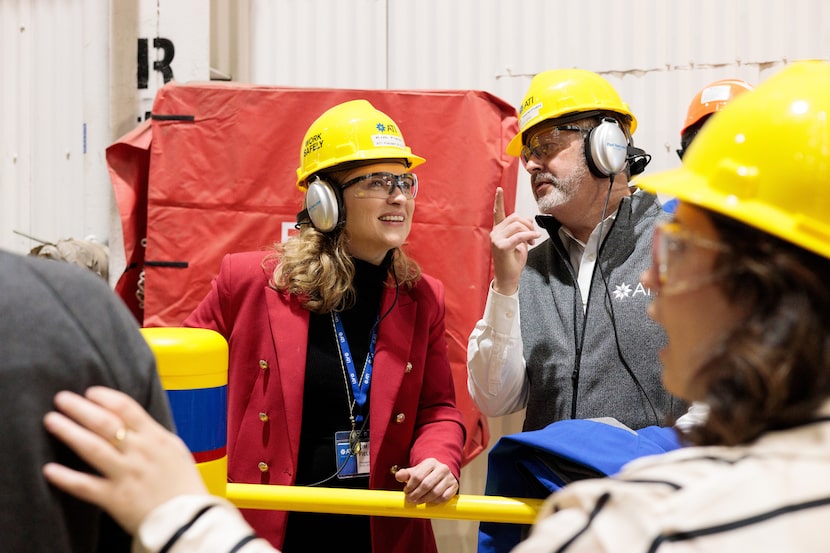
President and CEO of Dallas-based ATI Inc., Kimberly Fields at one of ATI’s manufacturing plants.
Courtesy of ATI Inc.
Visiting those and working with the people there, she said, is the best part of her job.
“Probably the most exciting day of my life is when we got to tour with one of our big customers, Cape Canaveral, and see the launch sites and see the space shuttles,” she told The Dallas Morning News in an interview in December.
“My team always knows I want to go on a plant tour. I want to go see the customers. I want to go see how [our product is] being used, because that’s really energizing to me, and then seeing the people that make it happen is just incredible.”
Fields said it’s not surprising to her that she ended up leading an aerospace company, because as a kid she wanted to be an astronaut. However, it was her first job at Owens Corning where she fell in love with working in plants.
Back then, she was an engineer fresh out of college and the only woman in the glass melting area of the company. She likened the engineering part of her job to the scene in Apollo 13 where the astronauts have to use duct tape, cardboard and plastic bags to make a carbon dioxide filter. Working with people from all walks of life was even more challenging, and commensurately rewarding.
“I found myself sitting in the control rooms talking with the guys and saying, ‘What’s your biggest problem, and can I fix that for you?’” she said.
She recalled one man, though, who was not responsive to her efforts to help.
“He just would not use the tools I was building. And it was really frustrating,” she said.
Finally, another worker at the plant pulled her aside and asked her why she thought the man wasn’t engaging with her. Fields was stumped until the worker told her the man had never learned to read. Twenty-two and a fresh college graduate, it never occurred to her that someone might not know how to read. The experience taught her that if she was going to be a leader, excitement for the task wasn’t enough. She also needed to deeply understand who she was working with.
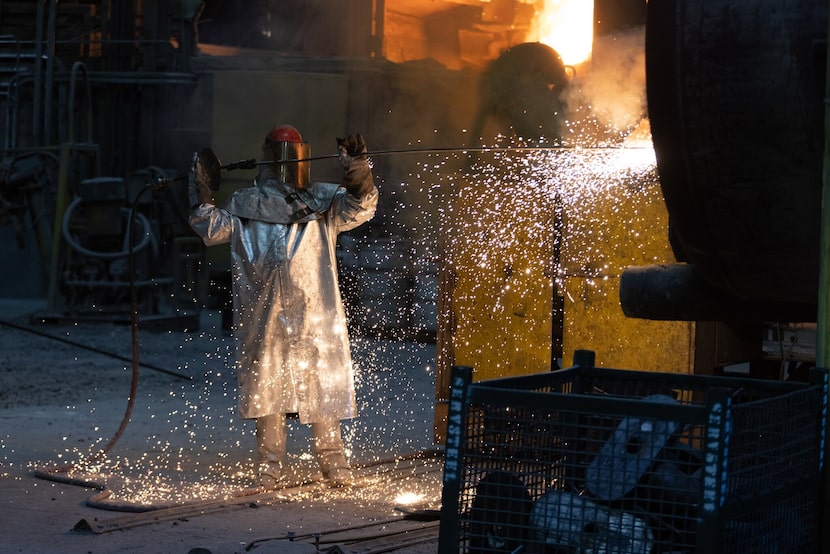
ATI Inc., based in Dallas, Texas, manufactures specialty metals and alloys for the aerospace and defense industries.
Courtesy of ATI Materials
“It happened early. I leaned towards working more with people, recognizing that power that you can unleash, and people start to see a potential they didn’t even know they had,” Fields said.
After that, she began volunteering for opportunities in team leadership and organizational development within the plant, and five years later, she decided to make the jump entirely, and enrolled in business school.
Fields joked that, at the time, she thought the really good engineers’ jobs seemed boring, because everything worked as it should. To this day, she said, “I like it when things are going wrong … I get more calm when there’s a crisis.”
‘Why would he tell you that?’
Fields hasn’t always been aware when she’s the only woman in a room. Once, back in college, she was “bored out of [her] mind” in an electrical engineering lecture of about 60 people, so she started looking around to count the women. Turns out, she was the only one. “How did I never notice that?”

Kimberly Fields, CEO of ATI, is photographed at her Uptown Dallas office, December 2, 2025. ATI is the largest woman-led public company in North Texas, and she was recently named the next chair of the ATI board as well.
Tom Fox / Staff Photographer
In D-FW, only seven of the region’s 150 largest public companies are led by women. Of the wider Fortune 500, 11% have female CEOs, and that mark only crossed into double-digits in 2023. With 19% of its CEOs being women, Fields’ own industry of aerospace and defense is well ahead of others, yet she still sometimes feels the impact of her gender. The trick has been learning how to use the moments she’s treated differently as opportunities.
As a student at the University of Illinois Urbana-Champaign, Fields liked to see the reactions — “the shock factor” — when she told frat partygoers she was majoring in nuclear engineering. When she graduated with a ceramics engineering degree and went to work for Owens Corning, she took pride in handling the hot, dirty conditions of a glass melting plant.
Early in her career, “running around the plant with my hair in a ponytail,” Fields learned how to use humor to break down barriers that kept colleagues, often union men double her age, from listening to her and trusting her. And while some still challenged her authority, usually she could get through to skeptics with her genuine enthusiasm for solving their problems.
She’s carried those lessons into her tenure as an executive at ATI, which employs around 7,700 people worldwide. Fields said that most men subconsciously compare the women they work with to either their mom or their spouse. So be it, thinks Fields, because it means they’re more vulnerable with her than they would have been with another man.
“Some of the guys on my team even laugh because I tell them about some of the conversations I’ve had with our customers’ CEOs, and they’re like ‘Why would he tell you that?’” she said. “Women listen and they engage differently, and people get relaxed. And from a leadership standpoint, it’s about helping your teams engage, get to their potential and get passionate.”
That openness can be a real competitive advantage. Fields said that people inside ATI have marveled at winning business “there’s no way we should have won.” They didn’t always have the experience or the product knowledge. But what they did have was a willingness to listen and work with customers collaboratively and openly.
In ATI’s most recent earnings call, Fields touted that her company’s deliveries of isothermal forgings to jet engine-maker Pratt & Whitney grew sixfold between 2023 and 2025.
Behind the scenes, Pratt & Whitney was in major trouble. In 2023, the company identified a manufacturing defect in potentially hundreds of the geared turbofan engines it supplied to Airbus and Embraer. Fixing the problem would require an average of 350 planes grounded at any given time between 2024-26 as they were inspected and repaired.
Facing a $6 billion financial impact from the ordeal, Pratt & Whitney reached out to ATI which already supplied some forgings to them, Fields said. They had a big ask for increased output to help get the planes off the ground, even though at the time, the companies’ relationship was not that deep. Within ATI, the president of the division supplying the forgings came to Fields upset that Pratt & Whitney would even ask with ATI’s output already at-capacity.
“‘Well, what would have to be true?’” said Fields, challenging him to think about what increased output would look like. They evaluated ATI’s assets and where things could become more efficient, and in the end, ATI was able to double its forging output to help Pratt & Whitney, deepening the relationship.
“We’re not going to worry that you’re going to steal our IP or steal our technology. We’re going to work together to figure out this problem, and we discovered a solution that nobody even saw was there,” Fields said.
‘Just for my mom’
Fields’ palpable optimism perhaps obscures the fact that manufacturing and aerospace are not easy industries.
Every time a plane engine fails, she knows about it, and can tell by the video — the location of the flames, where on the engine it broke — whether it was an ATI material that caused the problem.
Not even two months after she became Chief Operating Officer, Russia invaded Ukraine, drastically altering the landscape of defense in the years since. Last year, in her first full year as CEO, President Donald Trump’s sweeping tariffs stressed global supply chains.
But navigating choppy waters is nothing new to Fields, a single mom.
“There’s not a better multitasker [than a woman], I’m just saying, especially a mother,” she said.
When her son, now 24, was a toddler, Fields and her husband divorced. She was already working her way up the corporate ladder, and suddenly, “it’s like doing a tightrope with no net,” she said.
Bonuses early in her career went to in-home care. For a decade, she traveled and commuted so her son could stay in one place. She put demanding promotions on hold, and she was always looking for a new babysitter. She would fall in love with one, only for the babysitter to go to college, or move away. Each time, Fields figured it out, and ensured her son was happy.
Fields pointed out that even married women with careers are usually still doing most of the domestic labor at home, and what she was doing in terms of caretaking was similar before and after her divorce.
“But what happens is, then you feel very responsible that if anything slips, there isn’t that backup,” she said.
She leaned a lot on her parents, her aunt and her sister when her son was young, and they were able to pick up the slack when Fields needed to be at work and her son was sick in bed and wanted to watch Mary Poppins all day.
Now, out of college and living on his own, he returns the favor. When he visits her, they go to basketball games together, carrying on a tradition from when they lived in the Chicago area and became big Bulls fans. Fields said he keeps her grounded.
“If our stock goes up or down, he’ll be the first one to call me at five in the morning going, ‘What’s happening with your stock? What are you doing?’” she said. “He’s paying attention. … It keeps you focused on what’s important, which is family.”
Fields helped start the ATI Women’s Network in 2019, a source of support and employee engagement, in 2019, and a piece of advice she gives young women is that family and a career won’t always be 50/50. Sometimes your family needs you, and sometimes work needs you, and you have to get creative.
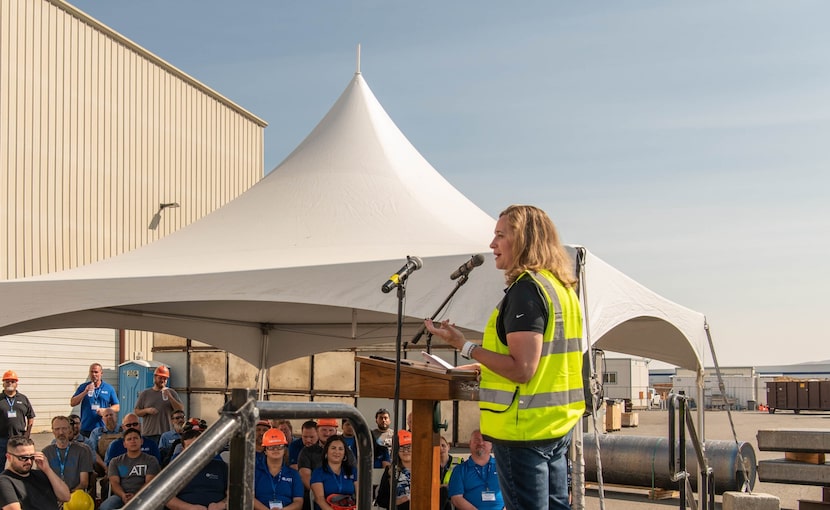
President and CEO of Dallas-based ATI Inc., Kimberly Fields speaks at one of ATI’s locations.
J Craig Sweat
“If you’re looking for balance, you’re going to be disappointed. You’re not going to meet your expectation[s],” Fields said. “But if you try to make sure you’re there for the important moments, then you can make that happen.”
Once, when her son was in second grade, he was “super excited” to get cast as the rabbit in a school play. But the day of the performance, Fields needed to travel for work.
Feeling guilty that she was going to miss the play, she reached out to his teacher to see if she could get pictures or a recording of a rehearsal. The teacher instead arranged for the class to perform during lunchtime so Fields could see her son.
“He was so excited, you wouldn’t have thought. He was like, ‘We are doing a play just for my mom. She’s that important that we’re gonna do the whole play just for her.’ And he was going around telling everyone, and over the moon,” Fields said. “Where I was feeling guilty, he took it as a positive.”
‘Do you want to work for Bob Wetherbee?’
Fields and Robert Wetherbee “weren’t friends” when he gave her the call that eventually made her ATI’s executive vice president of flat rolled products in 2019.
One of the last times they had spoken was a meeting back when Fields was 25. After deciding to go to business school, she became a consultant at Boston Consulting Group. It was a “be seen, not heard” kind of position back then, Fields said. She was working with Wetherbee at the time, and had prepared presentation materials for him and set up the room for a meeting with several metal industry CEOs.
“They come in and he goes, ‘Okay, we’re gonna do the presentation now,’ and he grabs my seat, he pulls me to the middle of the table and he’s like, ‘and Kim’s gonna give it,’” Fields said. “I was scared out of my mind, but you know, he saw my potential and gave me the courage, and it was like, ‘Okay, here I go. Hopefully this works.’”
Safe to say, it did. Two decades later, Wetherbee was promoted to CEO of ATI and needed a successor. When he told the recruiters searching for one that he wanted someone like Fields, it’s hard to say whether he was thinking of the consultant that rose to the occasion or the then Group President for Industrial and Energy at IDEX, an industrial components manufacturer. But the recruiters nevertheless said, “‘We might as well get her then,’” Fields recounted.
Her first conversation with recruiters went something like this: “Do you want to come back to the metals industry?” — “Hmm, I don’t know.” — “Do you want to work for Bob Wetherbee?”
“And I said, ‘Yes! I would love to talk,’” she said.
Wetherbee called her to seal the deal, and he told her, “‘Let’s develop you and see if you’re ready,’” Fields recalled.
“For me, I came into this role, and just the opportunity to compete and be considered for the corner office was what I was looking for. The fact that I was successful and the board supported that, it’s just icing,” she said.
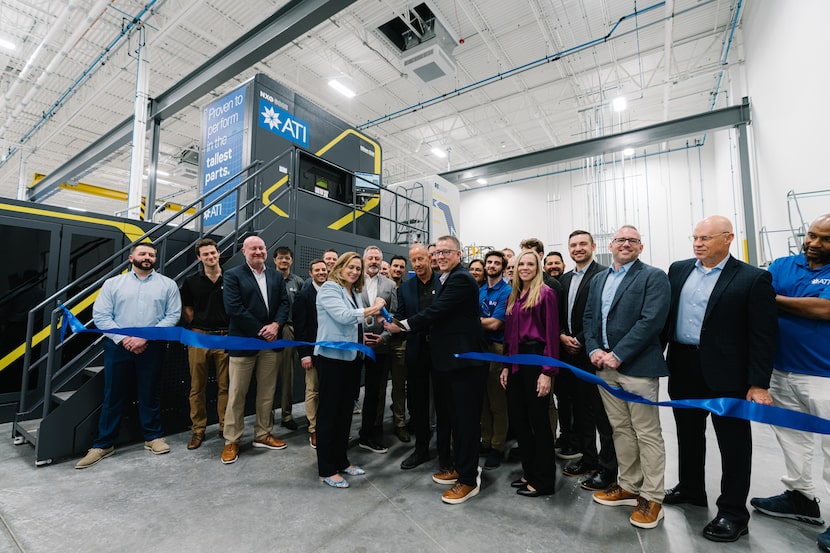
President and CEO of Dallas-based ATI Inc., Kimberly Fields cuts the ribbon at a new facility.
Stephen Luttinger Photography / Stephen Luttinger Photography
Now, as president, CEO and soon-to-be board chair, Fields still calls Wetherbee, who has become a close mentor and friend, for advice or just to chat.
“I say, ‘Hey, I’ve got this problem,” she said. “The funniest thing was, I said, ‘You had Covid. I have Trump. I think mine’s harder.’ And he laughed and he’s like, ‘Yep, I think you’re right.’”
In Fields’ tenure at the helm, ATI has seen steady growth. Since 2023, profit has grown by $200 million, and Fields is, unsurprisingly, optimistic about the future. The company is filing new patents and considering more space in its Dallas office. ATI’s board is also now 50% women.
Fields credits ATI’s young, incoming talent for the innovation and growth ATI is achieving, and she tries to give them the same chance Wetherbee gave her two decades ago, like letting a new engineer project-manage a $70 million project.
It’s why ATI moved to Dallas from Pittsburgh in 2022, to get the best talent. Fields noted the region is especially good for dual-income families and, therefore, the next generation of women leaders.
“Not only should they come, they need to. We need all of those diverse thoughts,” Fields said.
And when they come she has some advice: take the hard jobs, be present, and don’t be insecure about why they may be getting opportunities.
“All that is a chance at bat. If you strike out, you’re not going to get to keep that opportunity,” Fields said. “What you do with it is all you, and if you’re successful, that’s all you.”
 Children’s Health Associate GC Kathleen Benner making a lasting impact
She’s been a driving force behind the hospital company’s $5.4 billion pediatric campus project.
 Texas A&M cuts women, gender studies degrees, alters hundreds of courses
A&M modifies hundreds of syllabi to enforce a new policy that bans the teaching race and gender ideology in the classroom.