
The grim milestone that shows just how deadly border crossing has become in Brooks County.
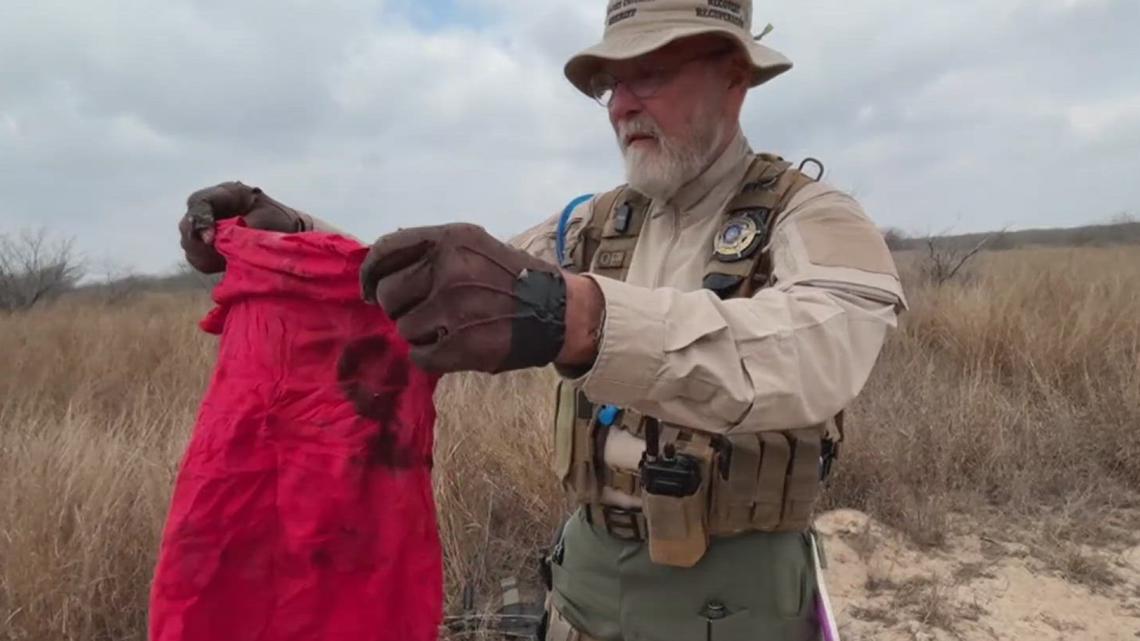
CORPUS CHRISTI, Texas — On a dry Friday morning in the brush country of Brooks County, volunteer deputy Don White, known locally as the “bone collector,” scanned ranchland off U.S. 285 west of Falfurrias for signs of the missing and the dead.
White’s latest discovery recently pushed the number of recovered human remains in the county to about 1,000 since 2009. He has personally found about 300 of them.
The land is bone dry, a harsh landscape of mesquite, oak and scrub brush roughly 70 miles north of the U.S.-Mexico border. Migrants seeking to avoid the primary checkpoint on U.S. Highway 281 often hike miles through this unforgiving terrain. Exposure to heat, dehydration and rugged conditions have made Brooks County the site of more migrant deaths than anywhere else in the United States.
“It’s sad that we are this dry but it’s helpful to me so I’m probably the only person in the county who’s actually excited about it being dry,” White said.
On Friday, White and his K9 partner, Socks, moved through brittle brush across the ranchland. The dryness helped them quickly identify items scattered on the ground, signs that migrants had recently passed through.
“Backpacks we always check to see if there’s any identification in it,” White said. “It’ll give us an idea if somebody is down somewhere.”
As he walked, he called out discoveries.
“It’s a pair of pants.”
“It’s actually pretty normal stuff. They are getting rid of what they won’t need in their next stage of travel.”
Search efforts in Brooks County are largely driven by local law enforcement and volunteers. The Brooks County Sheriff’s Office has just a handful of patrol officers covering nearly 950 square miles and often relies on tips from ranch workers and volunteers to locate remains and abandoned belongings along likely migrant routes.
Among the items found that morning was clothing that appeared to belong to a woman. A tag showed it was made in Guatemala, the only clue to where she may have started her journey. Many migrants who pass through Brooks County come from Guatemala, Honduras, El Salvador and Mexico.
White’s discovery of the 1,000th set of remains was not a milestone to celebrate.
“Hit the magic 1000, which it’s a rather sad number, but you know we are working,” he said. “We are trying to recover as many as we possibly can and start the identification process and send them on home.”
Items recovered with remains can sometimes provide clues to identity or origin. Clothing tags, backpacks and personal documents have occasionally helped trace where migrants began their journeys. But many remains are skeletal and lack identifiable markers, complicating efforts to confirm identities.
Specialized teams outside the county work to identify the deceased and, when possible, help repatriate remains to families abroad. Forensic anthropologists, graduate students and volunteer groups take part in the lengthy process of documenting and analyzing remains and attempting to match them with missing persons files.
White did not find human remains on this day. But in this region known as the Wild Horse Desert, he said it is never a matter of if, only when.
At one migrant campsite, a child’s backpack lay among the brush. White said that is not necessarily a sign of tragedy but of hope, a sign that a family may have made it through this stretch alive.
Still, he knows more souls are waiting to be found in the brush.
RELATED: Brooks County’s ‘bone collector’ helps bring closure to migrants, smuggling cases
More from 3NEWS on KIIITV.com:
Subscribe to our YouTube channel for your daily news and exclusive extended interviews.
Do you have a news tip? Tell 3!
Email tell3@kiiitv.com so we can get in touch with you about your story should we have questions or need more information. We realize some stories are sensitive in nature. Let us know if you’d like to remain anonymous.