


Dominic Anthony Walsh/HPM
A crane removes belongings and debris from a homeless encampment off Nance Street under US-59 in Houston. Oct. 1, 2025.
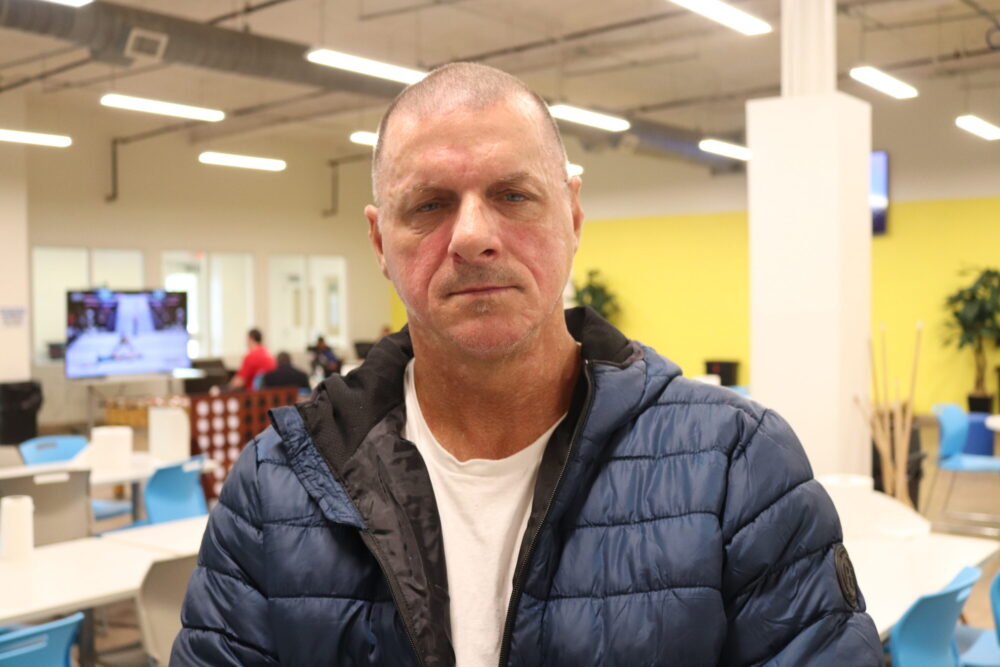
At the Navigation Center in Houston’s Fifth Ward, Thomas Romero spent October and November sleeping in a small room with two twin beds. The privacy curtain separating him from his roommate didn’t block out the snores.
Still, the city-provided accommodations were a dramatic improvement for Romero. After a decade on the streets of Lafayette, Louisiana — where he said he struggled with substance abuse — he landed in Houston at the tail end of the summer.
Sign up for the Hello, Houston! daily newsletter to get local reports like this delivered directly to your inbox.
He said he first became homeless after a series of deaths in his family.
“I started losing things around me,” he said. “I just didn’t care anymore.”
Click here for more inDepth features.
After a “mishap” he refused to elaborate on, Romero wound up at the Houston Recovery Center — a common dropoff location for police officers dealing with intoxicated individuals — and was subsequently referred to the city’s 112-bed Navigation Center.
Working with one of the center’s case managers, Romero said he had been placed on the path to permanent housing.
“What I went through in 10 years in Lafayette, this place has done in almost two months 10 times more,” Romero said. “I never had no housing in Lafayette. I never signed no papers in Lafayette.”
He was also receiving in-house mental health counseling.
“I feel amazing. Amazing,” he said. “Every day, every breath, I’m one step closer. I’m not going backwards. I’m going ahead.”
Dominic Anthony Walsh / Houston Public Media
In Dec. 2025, Thomas Romero was ready to move into permanent housing after a stint at the city’s Navigation Center.
Sheri Macek also had success at the center. After her husband died, she lived under a highway overpass in Houston for eight years. During her month in the Navigation Center in 2023 — the city-funded center’s first year of operation — she said she signed up for supplemental nutrition assistance, began taking antidepressants and signed a lease for an apartment underwritten by the Salvation Army. About three years later, she’s still in housing and working a part-time job.
“We’re people,” she said. “We’re people who are striving every day to do the same things everybody else does. We have the same right to food and shelter as anybody else.”
Because of stories like Romero’s and Macek’s, Houston is an example of the success of the “housing-first” model, in which permanent housing is prioritized before work or sobriety requirements. Macek is one of about 37,000 people moved from homelessness into permanent housing across the Houston area since 2011.
Despite the more than 15-year success story, Mayor John Whitmire asserts the city hasn’t done enough. In November 2024, he declared his intention to “end homelessness” in Houston.
“Houston, we have a problem,” Whitmire said at the time. “I’m here to declare today you help the homeless by getting them off the street and reclaiming our public spaces.”
His housing director, Mike Nichols, said that means the administration hopes to move people into housing within 90 days of them becoming homeless. The administration intends to accomplish that goal by the end of 2026, Nichols told Houston Public Media.
The mayor’s initiative will be “a game-changer for the homeless response system in the most positive way,” Nichols said.
But it’s faced challenges in the year since Whitmire’s announcement — including a substantial shortfall in its fundraising goal and criminal enforcement outpacing housing and service referrals.
City falls short of funding goal
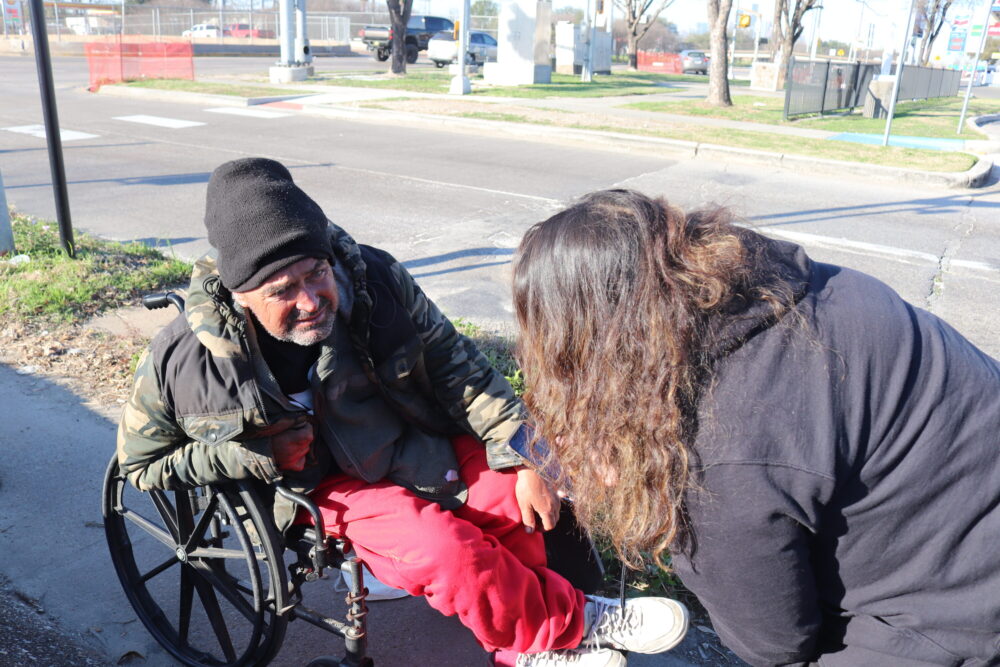
On the morning of Feb. 24, Jeremy Sanders and Jackie Urbina spotted a man in a wheelchair on a frontage road in Northeast Houston.
Timothy Wright told the outreach associates he had been homeless for about 20 years — starting after his father died.
“I’m homeless because my dad passed away,” Wright said. “I stayed with my mom and dad because they loved me so much they wouldn’t let me leave.”
Dominic Anthony Walsh / Houston Public Media
Timothy Wright responds to a survey conducted by Jackie Urbina, an outreach associate with the Coalition for the Homeless, on Feb. 24, 2026.
Sanders and Urbina were conducting a survey as part of the annual point-in-time count by the Coalition for the Homeless of Houston and Harris County. Over the course of three days, 125 teams fan out across Harris, Fort Bend and Montgomery counties to tally and survey people living on the streets and in shelters.
Wright, their first interviewee of the day, was talkative, sharing memories of his family, stories about playing football in his youth and details of a recent argument with his girlfriend. What was supposed to be a brief survey took more than 8 minutes to complete, but Urbina didn’t mind.
“I love when they go talking. I love to hear their stories,” she said. “It paints a picture for me.”
Painting a picture is a central goal of the point-in-time count. The survey includes questions about disability, substance abuse, domestic violence, natural disasters and other underlying causes of homelessness. After a months-long analysis by an epidemiologist, the report released in the middle of the year captures trends in the population.
Even as the national population of people experiencing homelessness has soared to record levels in recent years, Harris County has maintained stability — with about 3,000 people tallied during the coalition’s annual point-in-time count last year, including about 1,200 people living on the streets. That figure has held steady since 2021 after years of decline from about 8,000 in 2011.
“It’s great to stabilize what your number is, but then that’s also telling you that you do not have enough other things to move the needle,” said Kelly Young, president and CEO of the Coalition for the Homeless. “Great, we’ve stabilized it. It’s been the same. We don’t see a huge uptick. We don’t see a huge drop. Well, then what is it? What needs to happen for those individuals that are still on the street or experiencing homelessness?”
The answer from Whitmire’s administration, in part, was an effort to bolster funding from the local level.
Since 2011, the coalition has coordinated the region’s homeless services with significant funding from the federal government — an annual allocation currently sitting at about $70 million.
Over the past 15 years, natural disasters — like Hurricane Harvey and the COVID-19 pandemic — brought additional federal funding into the system, boosting the network’s ability to move even more people off the street, out of shelters and into housing. From the outbreak of the pandemic in 2020 through 2024, more than 18,000 people were housed or diverted from homelessness, according to the coalition.
“When we’ve been able to hugely move the needle” during those influxes of funding, Young said, “it helped us test the theory that you could get to the place you wanted to get to if you had enough funding.”
At the unveiling of the initiative to “end homelessness” in late 2024, Whitmire’s housing director, Nichols, said the administration hoped to gather $70 million in local funding for the plan per year. Nichols and Young said that amount would allow the city to reach “equilibrium” — moving everyone off the streets and into housing within 30 to 90 days of them becoming homeless.
Since then, the city has raised about $31 million, and it’s unclear if all the funding sources from the past year are coming back. The largest external contributor, the Metropolitan Transit Authority of Harris County (METRO), said “conversations are still ongoing” about whether to renew its $10 million contribution. The $20 million sought from private philanthropy never materialized.
RELATED: $70 million annual goal for Houston’s homeless fund will be ‘reevaluated’ after shortfall
In an interview with Houston Public Media in January, Nichols — for the first time — said the $70 million goal “probably has to be reevaluated.”
“We feel comfortable that the city’s portion is going to be maximized,” he said. “Anything we can move toward homelessness, we are trying to do that. I think that is an important number.”
Over the past year, the city of Houston repurposed about $14 million in federal funding for the homeless initiative. But when it comes to purely local dollars from the $3 billion general fund, the city contributed $3.5 million to the specialized homeless fund. It also used at least $3.5 million from the homeless fund to pay expenses for the Navigation Center, which was previously supported by the general fund. So the contribution was essentially canceled out.
In addition to supporting permanent housing and emergency beds across a handful of shelters, the city council appropriated more than $900,000 from the fund for the Houston Recovery Center — the sobering facility where Thomas Romero landed before getting on the path to permanent housing at the Navigation Center.
Under Whitmire’s initiative, Romero was among about 200 people moved from the streets to housing last year from Houston’s central urban core — a priority area for the administration. While offering services and housing to some, the city also significantly expanded criminal enforcement — another prong in Whitmire’s approach to addressing homelessness.
For now, criminal enforcement outpaces housing and services
As Romero received support in the Navigation Center in October, Trazawell Franklin slept on the street in front of a homeless services center in East Downtown.
According to Harris County court records, Franklin had repeated run-ins with the police last year — including an arrest for allegedly threatening a police officer in August. He shared a video of three officers handcuffing him on the ground in front of the center as he yelled, “For what?” He disputed the charge of threatening an officer, which he pled guilty to, and told Houston Public Media the encounter started when officers threatened a citation if he refused to move his personal possessions off the sidewalk.
“If you don’t have anywhere to place the people that’s on the street, where you going to put them if you get them off the sidewalk?” Franklin said. “You going to make it illegal to be homeless?”
Shortly after getting out of jail, he received a citation at the same location for allegedly violating the so-called civility ordinance — which prohibits sitting, laying down or placing personal possessions on sidewalks in certain parts of the city, including East Downtown.
“If I could talk to the mayor — which no one out here is really capable of talking to the man — I would try to get to an understanding about the sidewalk, because the sidewalk belongs to the city, the people. It doesn’t belong to him,” Franklin said. “Let’s get the resources up and mobile before you try to administer an ordinance or a law.”

Dominic Anthony Walsh/Houston Public Media
Trazawell Franklin, left, and April Jamarillo, right, sit in front of the SEARCH Homeless Services center on Nov. 11, 2025.
Whitmire’s administration is in the process of mobilizing resources in the area — but so far, criminal enforcement has outpaced housing and service referrals.
A few blocks to the east at 419 Emancipation Ave., the city plans to open a 240-bed facility for people experiencing homelessness by June. The city council approved the $16 million purchase of the site last year — over the objections of some community members concerned about an influx of unhoused people.
To alleviate their concerns, the city council approved an expansion of the civility ordinance to cover the entire East End area in November. It was the second major expansion last year. At the beginning of 2025, the ordinance only applied during the daytime in 12 areas of the city. In mid-July, the city council expanded it to a 24/7 rule in downtown and East Downtown.
The typical fine for violations of the civility ordinance is about $200.
According to municipal court records obtained by Houston Public Media and analyzed by the University of Texas at Austin’s Media Innovation Group, the months after the first expansion saw the highest totals of citations — for violations of the civility ordinance and more general sidewalk obstruction rules — since Whitmire took office in 2024. From July through the end of the year, officers issued nearly 2,000 citations.
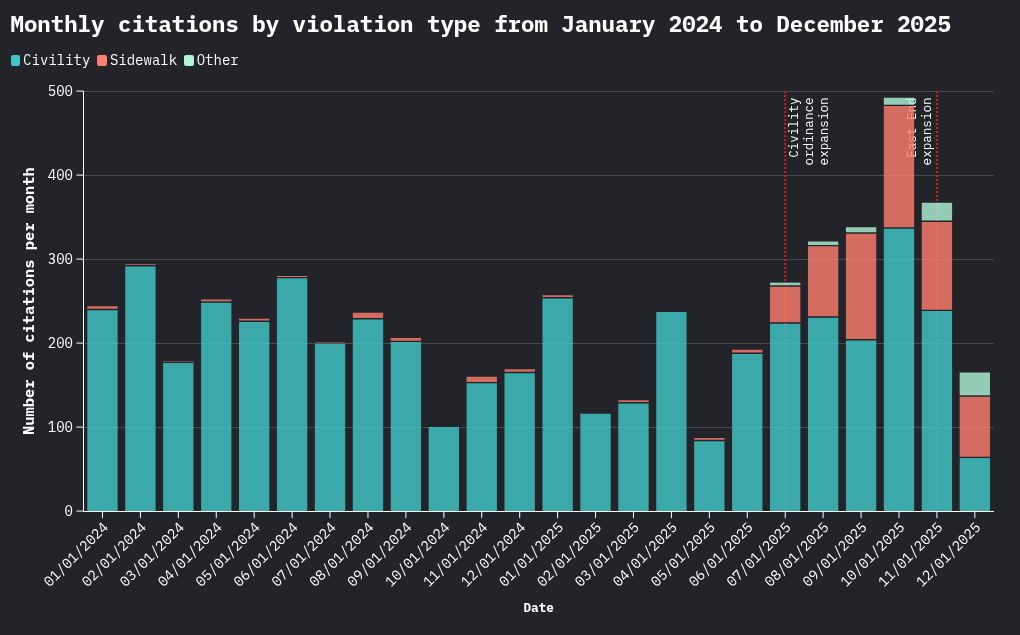
“There’s been more citations issued on that because we have to be accountable,” said Larry Satterwhite, Whitmire’s public safety director. “You offer all the love and the help you can and all the hope — trying to get them to a better place — but again, a lot of them don’t even know their own perilous situation.”
In the Central Business District — where the administration focused much of its efforts last year — officers issued more than 1,300 citations. About 200 people were moved from the central urban core into housing last year, according to city officials.
On the ground, the enforcement ramp-up has led to movement.
At the same location where Franklin was ticketed, Mike Kaufman said he has been moving block by block during his past three months on the street.
“You can move across the street or whatever — just can’t be in that same spot,” Kaufman said. “They’ll come and tell you, ‘We’re going to send the cleanup team. They’re going to come. They’ll take your stuff.’ So if you want to keep your stuff, you got to move around.”
Driving along Interstate 10 about 3 miles to the northeast during the point-in-time count on Feb. 24, Urbina the outreach associate said she’s hearing about the enforcement from new arrivals in the area.
“They have pushed a lot of the population out into the neighborhood,” Urbina said.
Dominic Anthony Walsh / Houston Public Media
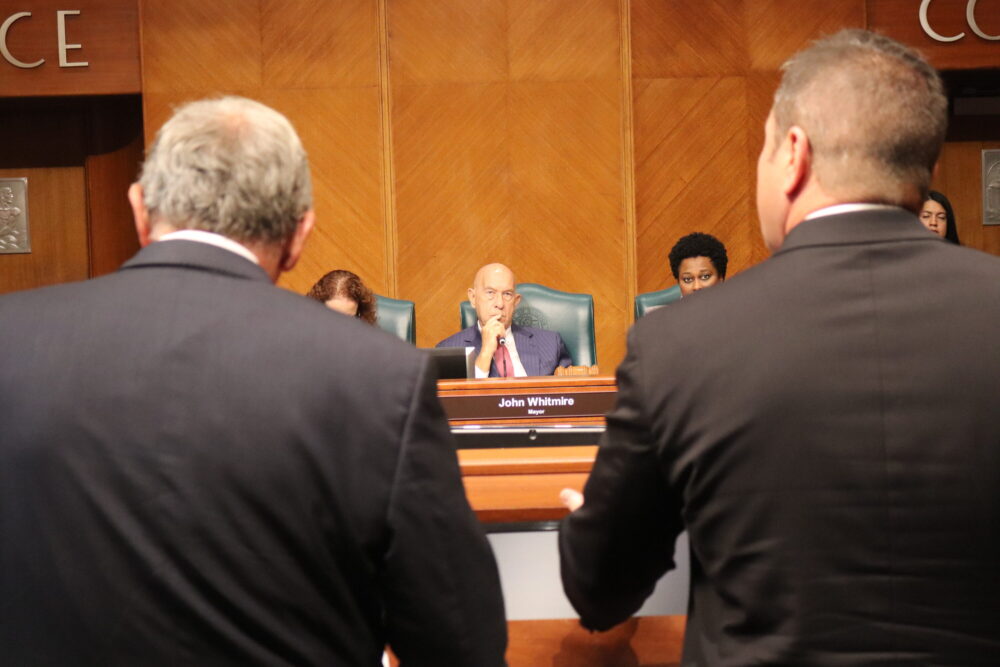
Houston housing director Mike Nichols and public safety director Larry Satterwhite speak to the Houston City Council and Mayor John Whitmire in Oct. 2025.
For many municipal leaders, criminalization of behaviors associated with homelessness “feels like an easier way to at least get at that goal of essentially sanitizing public spaces and removing people from these spaces,” said Hannah Lebovits, interim director of the Institute of Urban Studies at the University of Texas at Arlington.
“I am not surprised that a city would prioritize that above actually offering more services or retooling its service system for more efficiency and more effectiveness,” Lebovits said, “because it feels like a more immediate need to just constantly stop the in-migration into the streets or immediately respond to the in-migration to the streets, and providing services does take longer than just having a cop come out and forcibly remove somebody from an area.”
Lebovits also takes issue with the administration’s framing of its initiative as an effort to “end homelessness,” defined by officials as housing everyone within 90 days of them entering the streets.
“It’s one of those things that sounds great on paper and is true according to the process set forward by policy makers and funders,” she said. “The problem is that it doesn’t get at the fact that mostly what makes people feel uncomfortable about homelessness is not the idea that within 90 days this person won’t be rehoused. What makes people feel uncomfortable at homelessness is the fact that many people walk through public spaces and encounter individuals who make them feel unsafe, and in that moment they’re concerned about homelessness.”
Despite ramped-up enforcement coming before a comparable increase in services, the administration’s stated goal is to do more than decrease visible homelessness.
The opening of the 240-bed facility at 419 Emancipation is the lynchpin in the administration’s plan. Police officers will be able to offer an immediate alternative — a temporary bed and a potential path to housing — before threatening citations.
“We need a place that they can be. Because otherwise, we’re just moving them on to the next problem, and that’s somebody else’s neighborhood,” Satterwhite said. “We’re going to need locations that we can take them in, wrap our arms around them, get them the right kind of care, get them the right kind of treatment, so that we can actually graduate them out of that and get them into housing and be in a future life.”
Dominic Anthony Walsh / Houston Public Media
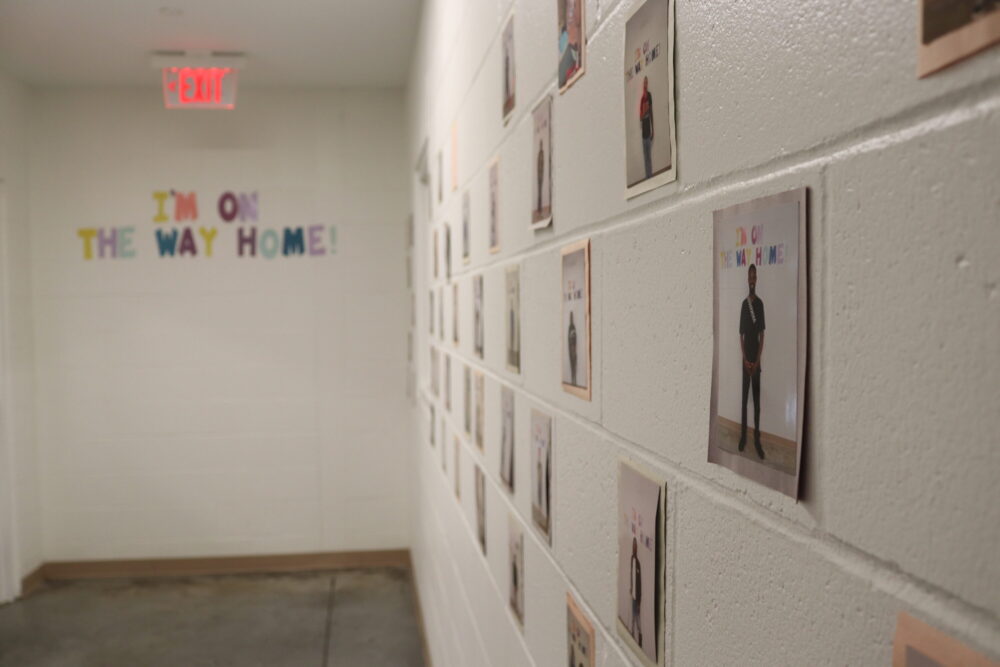
In Houston’s Navigation Center, a wall shows people who have successfully moved from homelessness into housing.
In a brief interview with Houston Public Media in October, Whitmire positioned the initiative as a banner policy for his first term in the mayor’s office — saying homelessness “might have been the first thing I had listed” when supporters asked what issues would convince him to enter the 2023 mayoral race.
“The homeless conditions have always been one of my highest priorities, and it’s very complex, but we’re really making strong strides,” Whitmire said.
After eight years sleeping under a bridge, Sheri Macek argued the ambitious, end-of-year target to end chronic homelessness is admirable — but not feasible.
“I want to end homelessness more than anybody,” Maceck said, but “he’s hoping for a miracle that’s not going to happen, and he’s setting himself up to blame the homeless because they won’t comply with his wishes.”
Still, she said, “I want to see him try.”
Data analysis of citations for this story was provided by Layla Dajani — a fellow with the Media Innovation Group, an experiential learning project within the School of Journalism and Media at the University of Texas at Austin. The group is funded by the Dallas Morning News Journalism Innovation Endowment.