
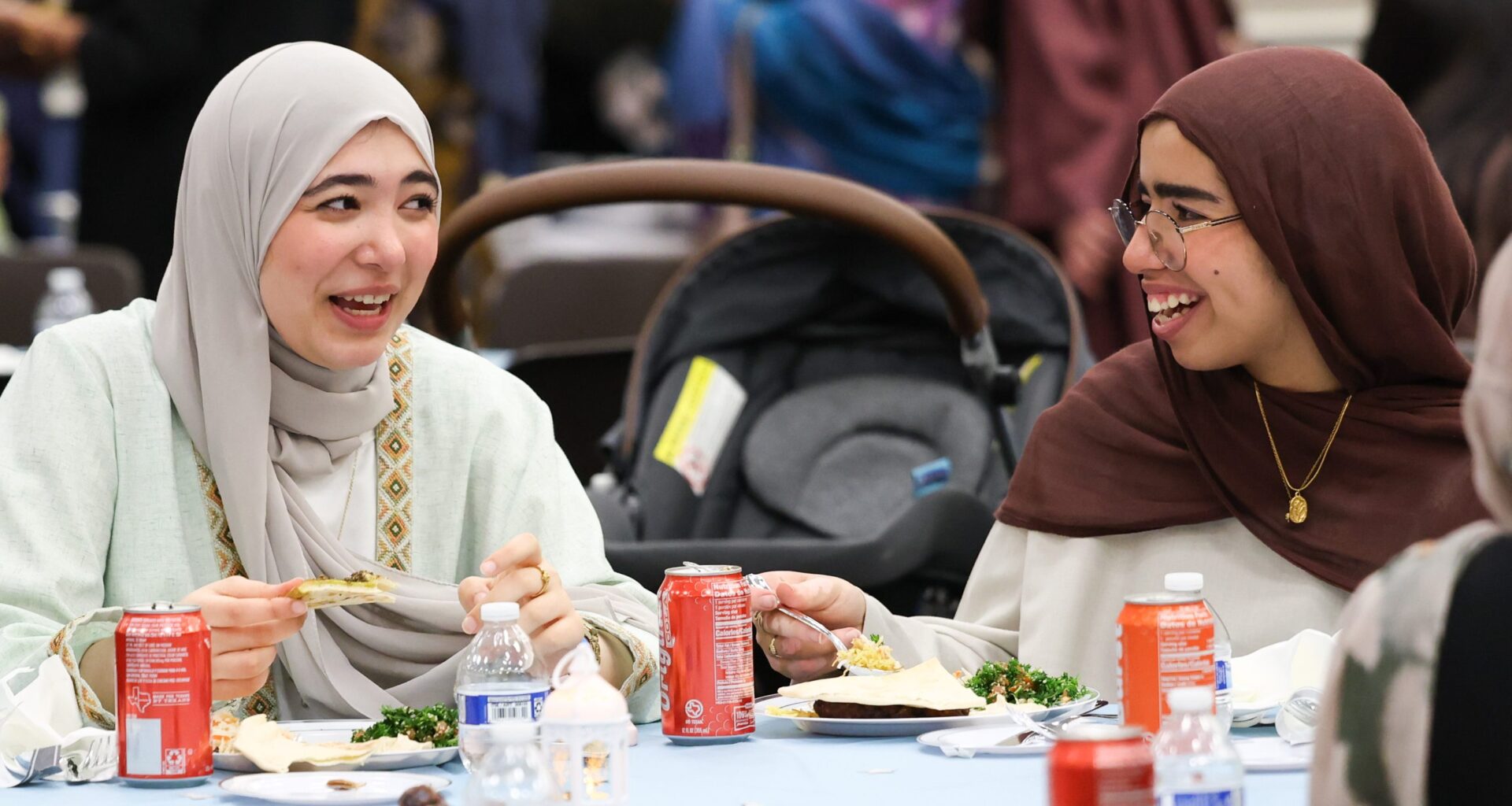
This year’s Ramadan season feels different for Fabiha Oyshi.
It’s the civil engineering student’s first year at the University of Texas at Arlington and her first time observing the holiest month of the Islamic faith away from home.
In the past, her Ramadan activities usually meant spending time with family in Southlake, often breaking their daily fast after sundown with her mother’s home-cooked meals.
But Oyshi doesn’t feel alone at college. She and her friend, Ayesha Manoa, gathered with fellow Muslim students on campus Feb. 26 for iftar, or a meal served at sunset during Ramadan to break the daily fast.
From mid-February to mid-March, Muslims across the world are observing Ramadan, the ninth month of the Islamic calendar, that is a sacred time observed with prayer, participating in charity, and partaking in daily fasts from food and water from sunup to sundown.
“Ramadan is to be the best version of yourself,” Oyshi said.
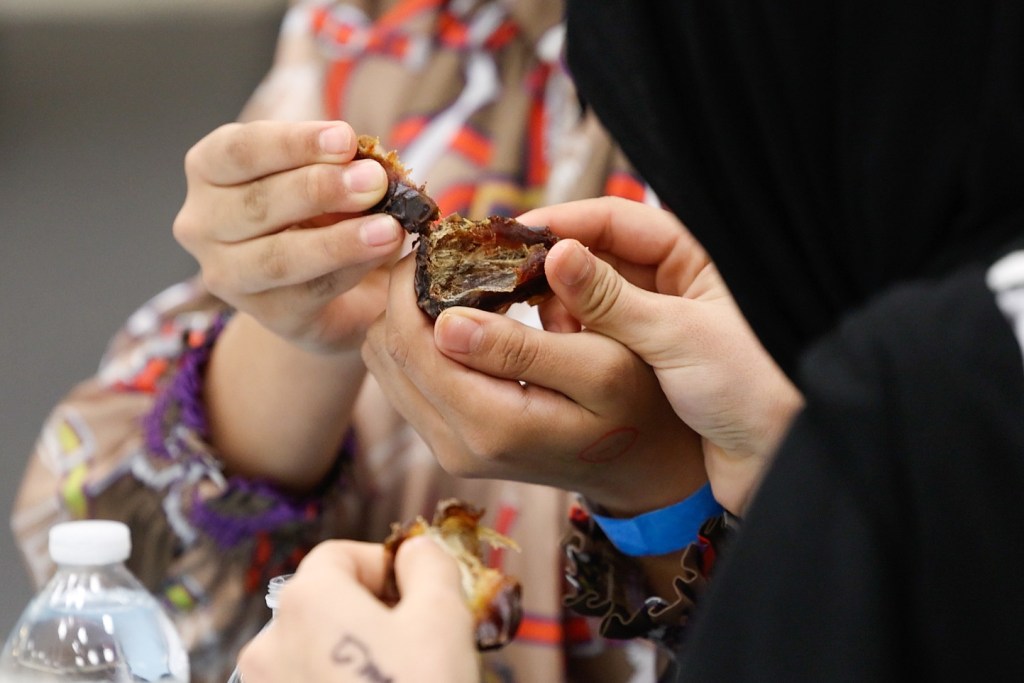 Attendees break their fast with dates during the Muslim Student Association’s Grand Iftar on Feb. 26 at UT Arlington. The tradition is from Prophet Muhammad. (Christine Vo | Fort Worth Report)
Thursday evening’s events, organized by the school’s Muslim Student Association, included a recitation of the Quran, a lesson from a local imam, duas, or invocations, and nasheeds — Islamic vocal music similar to a hymn. At sunset, about 250 attendees broke their fast with a date and some water before beginning prayer.
The night marked the association’s first iftar on campus during this year’s Ramadan observances, said Lujain Al Fidaghee, vice president of the group. The student association plans to host one iftar each week of Ramadan, excluding spring break.
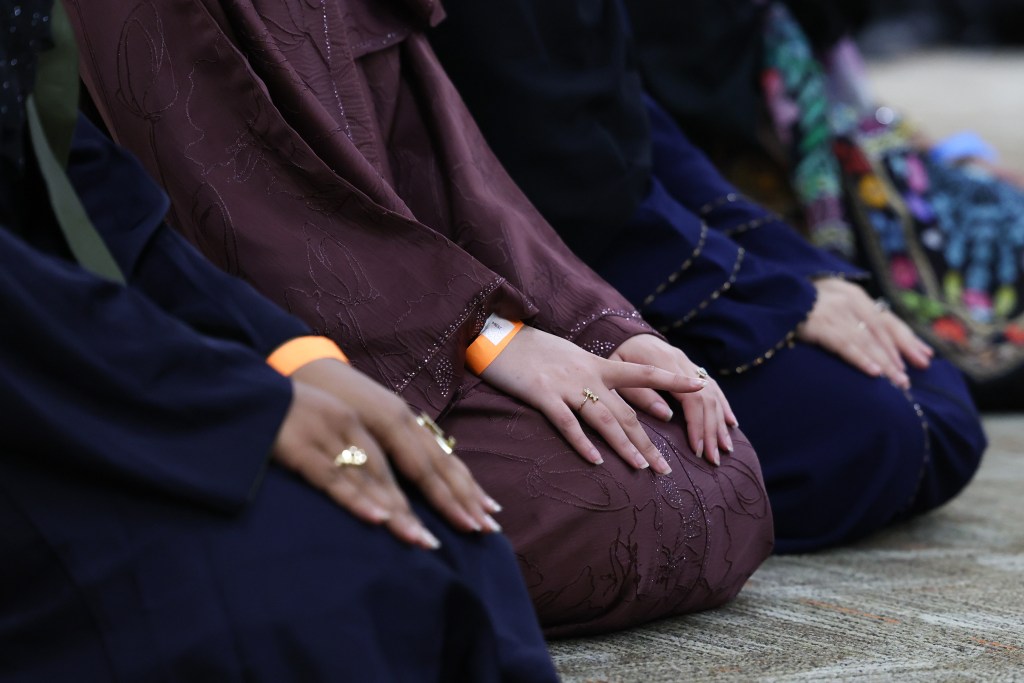 Attendees pray during the Muslim Student Association’s Grand Iftar on Feb. 26 at UT Arlington. (Christine Vo | Fort Worth Report)
The idea of hosting an iftar on campus came out of a desire to make observing Ramadan more accessible to students who spend long hours at UTA. Many international students are away from families, and those who commute are at school during the time they would typically break their fast, organizers noted.
It’s also a time to build community between different races, ethnicities and cultures that make up the Muslim community, Al Fidaghee added.
“We’re like their home away from home,” Al Fidaghee said. “Our purpose is to provide a safe space for them to fulfill their obligations and also to feel welcomed.”
Incorporating the long days of Ramadan into student life can be hard, said Fatimah Riaz, a junior studying information systems.
She is up early to eat suhoor, the meal eaten before the sun rises. She then has a class at 8 a.m. and another at 9:30 a.m.
After sunset comes iftar and much praying. In addition to the usual obligatory night prayer, called isha, Muslims hold extra prayers during Ramadan, called taraweeh. Reading the Quran — which was revealed during Ramadan — is also common during the month.
“We’re sleeping late, and then we’re getting up super early … and then you can’t really sleep during the day because we have school,” Riaz said. “It’s a whole cycle that you kind of have to get used to.”
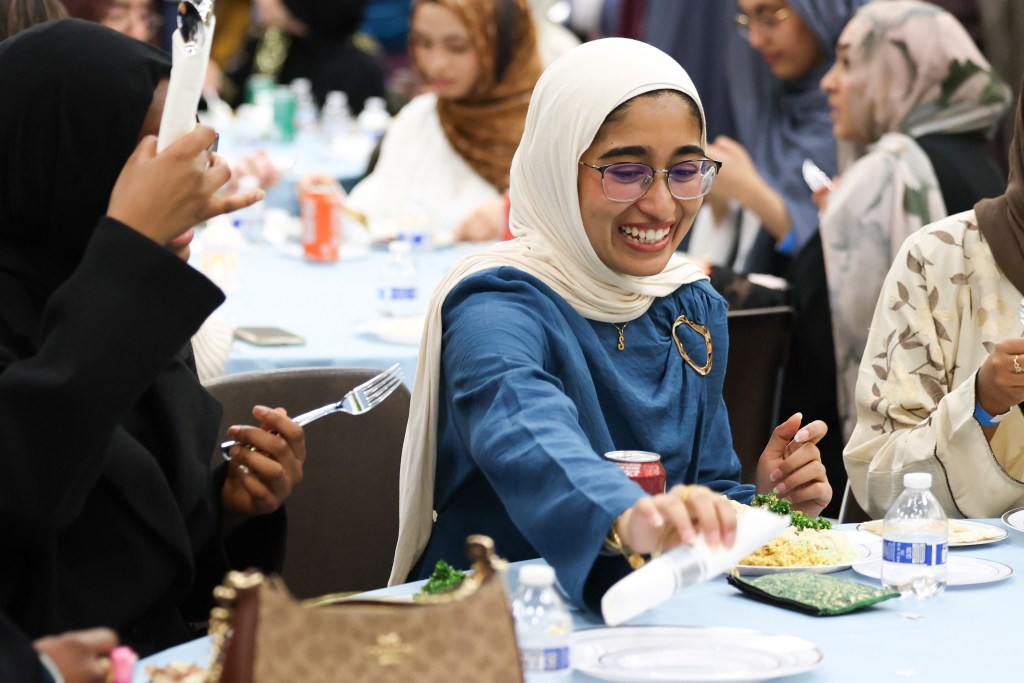 Public health sophomore Sumayya Sharif eats her meal during the Muslim Student Association’s Grand Iftar on Feb. 26 at UT Arlington. As a commuter, Sharif said it was special to be able to break fast with her friends. (Christine Vo | Fort Worth Report)
After a prayer after sunset, the students gathered inside a ballroom inside the E.H. Hereford University Center. Tables were adorned with blue tablecloths and tealight candles. A backdrop shimmered with string lights and silver letter balloons spelling “Ramadan Mubarak” or “Blessed Ramadan.”
Inside the ballroom, students shared a meal of tabbouleh, mana’eesh, kabuli pulao and other dishes as they caught up with friends, talking about classes and what it’s like being a Muslim student.
It’s important to stay connected to people in the same faith during college because it can serve as a way to uplift and “motivate each other to be a better Muslim,” Manoa said.
“It’s just really nice having a group of people who share the same values and, like, you don’t feel awkward celebrating. You don’t feel judged,” she said. “It’s really nice feeling comfortable in that space.”
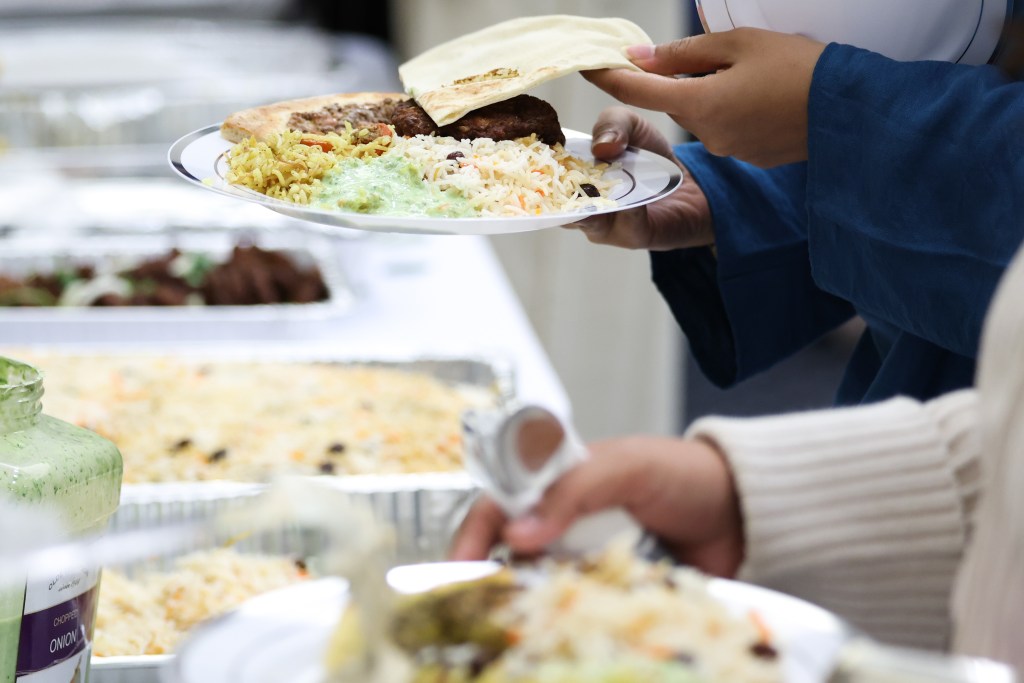 Students grab food during the Muslim Student Association’s Grand Iftar on Feb. 26 at UT Arlington. (Christine Vo | Fort Worth Report)
The Muslim community at the university extends beyond Ramadan, Riaz said. She attended an Islamic high school. When she came to UTA, she sometimes felt alienated, praying by herself in a corner before realizing she didn’t have to do it alone.
“Transitioning here, I felt like, ‘Oh, I’m one of the only people in my class,’” she said. “But especially with the community here, there’s always little places around campus where people meet up to pray together.”
Ramadan is not just about fasting — it is also a time to “set yourself up for the year to be a good person” and abstain from bad habits, she said.
“I guess Ramadan is a reminder for everyone,” Riaz said. “People think it’s all about the food, it’s about the fasting, but I think we’re just trying to be better people.”
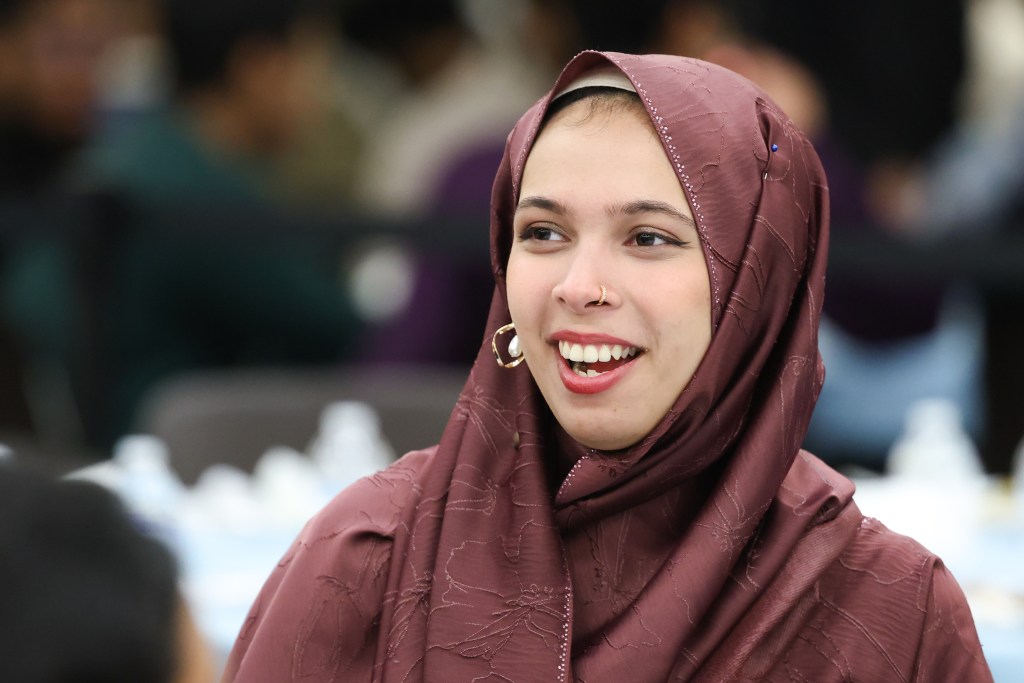 Auruba Islam, electrical engineering master’s student, talks with friends during the Muslim Student Association’s Grand Iftar on Feb. 26 at UT Arlington. As an international student without family around, Islam said gatherings like these help her find like-minded people. (Christine Vo | Fort Worth Report)
Abdullah Moghal, a senior studying information systems and the public relations co-chair for the association, echoed this. Ramadan is like a cleanse after a year when the momentum from the previous Ramadan might have waned, he said.
“I feel like Ramadan really grounds you,” he said. “It makes you more appreciative of all the small blessings.”
Marissa Greene is a Report for America corps member, covering faith for the Fort Worth Report. You can contact her at marissa.greene@fortworthreport.org.
McKinnon Rice is the higher education reporter for the Fort Worth Report. Contact her at mckinnon.rice@fortworthreport.org.
The Fort Worth Report partners with Open Campus on higher education coverage.
The Report’s higher education coverage is supported in part by major higher education institutions in Tarrant County, including Tarleton State University, Tarrant County College, Texas A&M-Fort Worth, Texas Christian University, Texas Wesleyan University, the University of Texas at Arlington and UNT Health Science Center.
At the Fort Worth Report, news decisions are made independently of our board members and financial supporters. Read more about our editorial independence policy here.
This <a target=”_blank” href=”https://fortworthreport.org/2026/02/28/uta-muslim-students-gather-for-food-prayer-community-at-grand-iftar-during-ramadan/”>article</a> first appeared on <a target=”_blank” href=”https://fortworthreport.org”>Fort Worth Report</a> and is republished here under a <a target=”_blank” href=”https://creativecommons.org/licenses/by-nd/4.0/”>Creative Commons Attribution-NoDerivatives 4.0 International License</a>.<img src=”https://i0.wp.com/fortworthreport.org/wp-content/uploads/2021/04/cropped-favicon.png?resize=150%2C150&quality=80&ssl=1″ style=”width:1em;height:1em;margin-left:10px;”>
<img id=”republication-tracker-tool-source” src=”https://fortworthreport.org/?republication-pixel=true&post=427820&ga4=2820184429″ style=”width:1px;height:1px;”><script> PARSELY = { autotrack: false, onload: function() { PARSELY.beacon.trackPageView({ url: “https://fortworthreport.org/2026/02/28/uta-muslim-students-gather-for-food-prayer-community-at-grand-iftar-during-ramadan/”, urlref: window.location.href }); } } </script> <script id=”parsely-cfg” src=”//cdn.parsely.com/keys/fortworthreport.org/p.js”></script>