
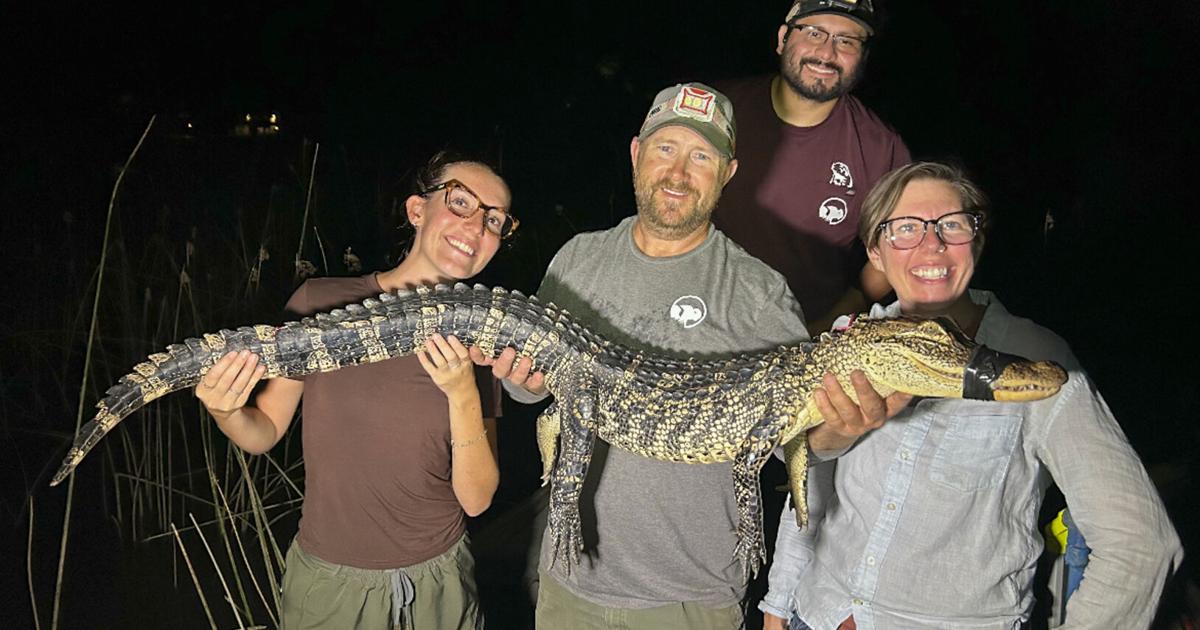
The university’s chapter of The Wildlife Society will help research the population and reproductive rates of alligators native to the Dallas-Fort Worth area.
Jared Wood, manager of the Fort Worth Nature Center and Refuge, said he wants the study to go on “as long as reasonably possible.” He said he hopes for data to be publicly available within the next couple of years and believes the study will go on for at least another 10 years.
“I think Dr. Gregory and I both share our love for getting students in the field and involved in active research projects because that goes beyond the textbook or lectures,” Wood said. “That actually gets you real-world experience, which is awesome in terms of résumé.”
Under the direction of Wood, students will be provided an opportunity to gain real-world experience, allowing for a more thorough alligator study. Andrew Gregory, an assistant professor in conservation biology and landscape ecology, and graduate student Cristal Martinez-Alvizo will help lead students in their field research.
Wood said the nature center and refuge has conducted yearly surveys to study the Fort Worth alligator population since 2023. However, Wood aims to gain a greater understanding of alligator movement patterns and the genetics of the local population. He says this research will provide better insight to the health and migration patterns of native North Texas alligators.
In comparison, Wood and Gregory are currently conducting a similar research project in Southeastern Oklahoma. Some genetic adaptations allow for alligators to withstand ice and colder weather, like the native Fort Worth alligators. Wood said these alligators will retreat to warmer, deeper water in search of comfort as land temperatures drop.
It is not known if these adaptations are also shared by alligators in places with consistently warmer weather, like Louisiana or Florida but it has been observed in Texas.
On population, Wood said he and the nature center and refuge are not sure if it is increasing, which will be one of the questions to be answered during the study.
Shyann Sanchez, biology senior and the Wildlife Society secretary, said she believes the DFW alligator population has increased after a decline she attributes to urbanization.
“Alligators used to be all up in this area, and we kind of pushed them out because of urbanization, and so it’s cool that we’re now seeing an increase because before there wasn’t really an increase, they were kind of disappearing,” Sanchez said. “I feel like it’s important that we care because we’re the ones that pushed them out.”
Along with studying alligator populations, the study will focus on genetics and movement patterns with students conducting surveys and counts of alligator eggs in the area.
The experiment will be funded through a grant given by the Fort Worth Zoo, as well as Friends of the Fort Worth Nature Center and Refuge, a support foundation that helps with private funding and donations.
To Morales, a part of the study’s mission will also be educational and working to improve the stigma surrounding alligators. He said that, like most reptiles, alligators do not want to attack, but only do so out of defense when they are afraid.
According to Texas Parks and Wildlife, alligators’ agility and speed make it dangerous for people when they approach, due to their innate fear of humans.
“As long as you leave them alone, they’re gonna leave you alone too,” Morales said. “They’re more scared of you than we should be scared of them.”
Wood said he shares Morales’ interest and hopes the general public learn alligators are not something to be afraid of and instead should be celebrated.
“I hope that we get away from the fear factor, and I hope that there’s conversations about these species for wetlands, and their presence is indicative of a healthy wetland system, which is great for the city of Fort Worth and our waters,” Wood said. “[…] they are native species.”