
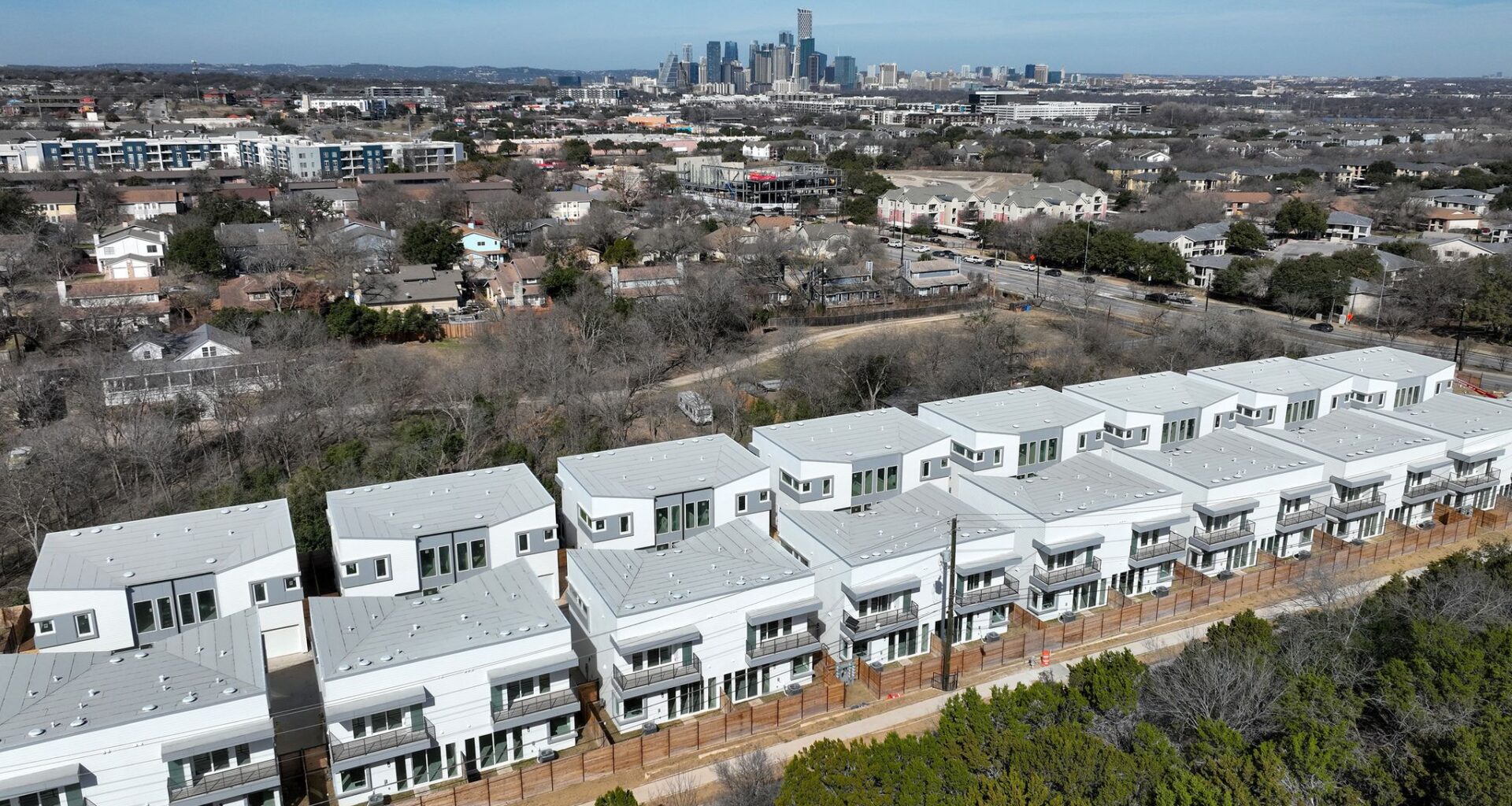
Homes are seen under construction on East Riverside Drive in Austin on Feb. 9. Online brokerage Redfin says Austin sellers outnumber buyers by 124%, one of the widest imbalances in the U.S.
Jay Janner/Austin American-Statesman
During the inaugural 2026 Central Texas Growth Forum, Travis County Judge Andy Brown commemorated the Austin Board of Realtors’ 100th anniversary — a somewhat unusual milestone to mark at a first-time event, but the juxtaposition seemed fitting.

The Central Texas housing market is hitting the reset button, too. After years of rapid growth, a pandemic-era surge and a sharp cooling period, it’s entering 2026 in recalibration mode.
Article continues below this ad
Homes under construction in a 2022 file photo. Austin-area homebuilding has declined after a peak reached that year.
Austin American-Statesman file photo
Homes for sale in a 2023 file photo.
Austin American-Statesman file photo
Travis County Judge Andy Brown presents a proclamation marking the Austin Board of Realtors’ 100th anniversary to 2026 president John Crowe at the Central Texas Growth Forum. Crowe said he is “cautiously optimistic” about the Austin housing market in 2026.
Austin Board of Realtors
At the January forum, Unlock MLS researcher Vaike O’Grady cautioned that residential real estate is likely to be more competitive this year than during the pandemic-era surge. Still, she highlighted several bright spots as the market moves into the new year.
“We are not in panic mode in Austin by any stretch of the imagination,” she said.
Housing policy shifts, Texas’ continued population growth, Austin’s demographics and the region’s healthy technology sector were all noted as positives heading into 2026. The biggest challenge, O’Grady said, will be consumer confidence.
Article continues below this ad
“We have some large global shifts and uncertainties right now,” she said. “If people aren’t confident they’re going to have a job, they’re not going to buy a house.”
DECEMBER STATS: Central Texas housing market saw slight uptick at year’s end
Looking back on 2025
Austin’s once red-hot housing market cooled to room temperature in 2025, with the number of closed sales across the Austin-Round Rock-San Marcos metro falling 3.2% to 29,383 transactions.
Article continues below this ad
Sales trailed 2024 levels through much of the year and November closings were down nearly 16% year over year before rebounding 1.9% in December. Inventory climbed above six months — the industry benchmark for balance between buyers and sellers — earlier in the year before settling at 4.2 months by year’s end.
“2025 wasn’t a year defined by urgency. It was defined by adjustment,” O’Grady said.
Prices remained relatively steady. The metro’s median home price for 2025 was $435,000, down 2.4% from 2024, while Travis County’s annual median rose 0.5% to $508,000 as sales dipped 1%.
O’Grady explained that much of the housing stock delivered between 2015 and 2023 was built with higher land and construction costs, which has contributed to stubbornly high prices despite softening demand.
Article continues below this ad
Early signs in 2026
January data suggests the market is beginning the year with renewed buyer activity, even as closings lagged year-ago levels.
Closed sales were down 14.8% but pending sales rose 10.1% year over year to 2,349 transactions — up more than 23% from December — according to data from the area’s multiple listing service.
The median home price was $400,495, down 2.3%, while active listings totaled 10,083, up 2.3%. Months of inventory came in at 4.0, down 1.4 months year over year.
Article continues below this ad
In discussing January numbers, O’Grady described the data as reflective of a market that has moved out of an overheated phase and into one where supply, pricing and demand are interacting more predictably.
Unlock MLS research adviser Vaike O’Grady speaks during the 2026 Central Texas Growth Forum on Jan. 28. O’Grady said 2025 was “a year defined by adjustment” and expressed optimism about housing activity heading into the spring.
Austin Board of Realtors
“We’re off to a good start this year,” she said.
John Crowe, 2026 president of Unlock MLS and the Austin Board of Realtors, described the mood as cautiously optimistic.
Article continues below this ad
“Deals are still happening across Central Texas but they’re taking more time and strategy to get across the finish line,” he said. “Negotiations are more nuanced and pricing decisions matter more than they did in recent years.”
Separate research from Redfin suggests Austin remains one of the strongest buyer’s markets in the country. In a new report, the online brokerage estimated that sellers outnumbered buyers across the metro area by 124% in January — one of the widest gaps among the 50 largest U.S. metros.
Nationally, Redfin found there were 44% more home sellers than buyers, the second-largest imbalance on record. By the brokerage’s definition, the country has been in a buyer’s market since mid-2024. That gap has been most pronounced in the South and West, regions that experienced heavy homebuilding during the pandemic surge as remote workers relocated.
The imbalance of supply and demand has shifted leverage toward buyers, creating more negotiating room than in recent years even if prices remain elevated compared to pre-pandemic levels.
Article continues below this ad
Crowe said sellers who adjust expectations to current conditions can still expect homes to sell.
“Sellers who are realistic about where they price their house, the house will move,” he said.
Job growth and interest rates
Eldon Rude of 360° Real Estate Analytics said the health of Austin’s for-sale housing market has traditionally been tied to two primary drivers: job growth and interest rates. Strong job growth fuels domestic and international in-migration, creating housing demand, while lower interest rates enhances affordability for would-be buyers.
Article continues below this ad
Over the past two to three years, Rude said, both forces have worked against the market’s vitality. Job growth has slowed from pandemic-era highs and mortgage rates remain elevated compared to the ultra-low levels of 2020 and 2021.
“Until one or both of these drivers move in the right direction, I don’t anticipate a sharp rebound in our for-sale housing market,” he said.
A man cycles past a house and an empty lot on East Riverside Drive in Austin, on Feb. 9.
Jay Janner/Austin American-Statesman
Nationally, rates fell below 6% last week for the first time since 2022 but mortgage data showed sales remained sluggish across the U.S.
Article continues below this ad
In Austin, closings for previously owned homes have remained relatively flat for three years, Rude noted — roughly the same period during which job growth slowed and borrowing costs climbed. Many homeowners who refinanced at historically low rates have chosen to stay put. Others are reluctant to sell for less than what their homes were worth at the 2022 pricing peak.
“I expect total available listings in the spring and summer of 2026 to surpass the totals we saw in 2025 as more existing homeowners who have been waiting to sell finally decide to list their homes,” he said.
Crowe added that homeowners who choose to stay put also reduces the number of properties entering the market, tightening supply and influencing overall market balance.
“In Austin, we’ve always been in a position where we do not have enough homes for people,” he said.
Article continues below this ad
New-home construction
Despite the demand, construction of new homes remained sluggish in 2025, though.
Between mid-2020 and mid-2022, Rude said, homebuilders increased the pace of annual starts by about 25% in response to surging job growth and in-migration. Since then, though, the pace has fallen sharply.
“Responding to slower job growth and sharply higher interest rates, builders have slowed their production pace in recent months to better balance the supply of new homes with current demand,” he said.
Article continues below this ad
RELATED: Austin ‘significantly oversupplied’ with build-ready home lots
O’Grady’s data also showed a slowdown. She said builders spent much of 2025 evaluating land positions, delaying new takedowns and working through their existing inventory of new homes. Luxury custom builders have seen more stability, she said, particularly in western Travis County.
In some submarkets, Rude said, builders are offering price reductions and interest-rate buydowns to move inventory — incentives that can give new homes an advantage over the resale market.
Austin’s housing market enters 2026 in recalibration mode, with rising listings, steadier demand and market experts cautiously optimistic. Here, the Edgewick condo community in South Austin is seen in an aerial file photo.
Jay Janner/Austin American-Statesman file photo
Beyond interest rates and job growth, immigration policy could also influence both demand and development in the year ahead.
Article continues below this ad
O’Grady said Austin has historically attracted international buyers but that segment of demand has dropped sharply through the first year of the Trump administration as some would-be buyers reassess moves to the United States. She also noted that much of the region’s construction workforce is made up of immigrant labor. If enforcement tightens while demand improves, that could affect labor availability.
MORE: ‘Construction can’t continue’: South Texas builders say ICE arrests have upended the industry
For now, however, she said she is not hearing from builders that they are struggling to obtain materials or find workers,
“We haven’t seen it yet,” she said.
Article continues below this ad
A spring test
The coming months will determine whether Austin’s housing market is stabilizing or simply slowing.
Rude said he expects homeowners who delayed selling in 2025 to list their homes this spring, potentially increasing inventory. At the same time, early-year pending sales suggest buyers may be gradually adjusting to mortgage rates hovering near 6%.
O’Grady noted that last year’s spring selling season underperformed expectations but this spring could be different.
Article continues below this ad
“I’m optimistic that we’ll see more activity this spring than we did last year,” she said.
If that renewed activity materializes, 2026 could mark a shift toward a long-term steadier footing for the Central Texas housing market.
“I am cautiously optimistic. I feel good about where things are based on conversations I’ve had with a lot of people,” Crowe said. “Both the people who are buying the homes and selling the homes as well as the experts in the industry, from the commercial side to residential side, and it looks good. We’ll see.”
Article continues below this ad