
In university art programs throughout Texas, instructors are dealing with new administration directives and mandates that they fear might compromise their ability to teach effectively. For studio art classes in particular, the directives create dilemmas in encouraging free expression among students in their artwork, and in leading and allowing discussions around relevant social and cultural topics that contemporary artists are engaging with.
The new directives are the result of continuing efforts to comply with evolving Texas law, including Texas Senate Bill 17 (SB-17), a 2023 “public higher education reform” law, and Texas Senate Bill 37 (SB-37) passed in May 2025. The University of Houston (UH), the Texas A&M University (TAMU) system, the Texas Tech University system, Texas State University, Texas Christian University, University of North Texas (UNT), and the University of Texas (UT) system have all enacted changes, including departmental eliminations and program consolidations, imposing syllabi reviews, and speech limits on what can be taught in their classrooms. One major art exhibition has been shut down, and at least one visiting artist event was canceled.
In several cases — including an ongoing series of student-led protests at UNT — faculty and students have responded with denunciations and demands for transparency in decision-making by university leadership, and an end to classroom censorship.
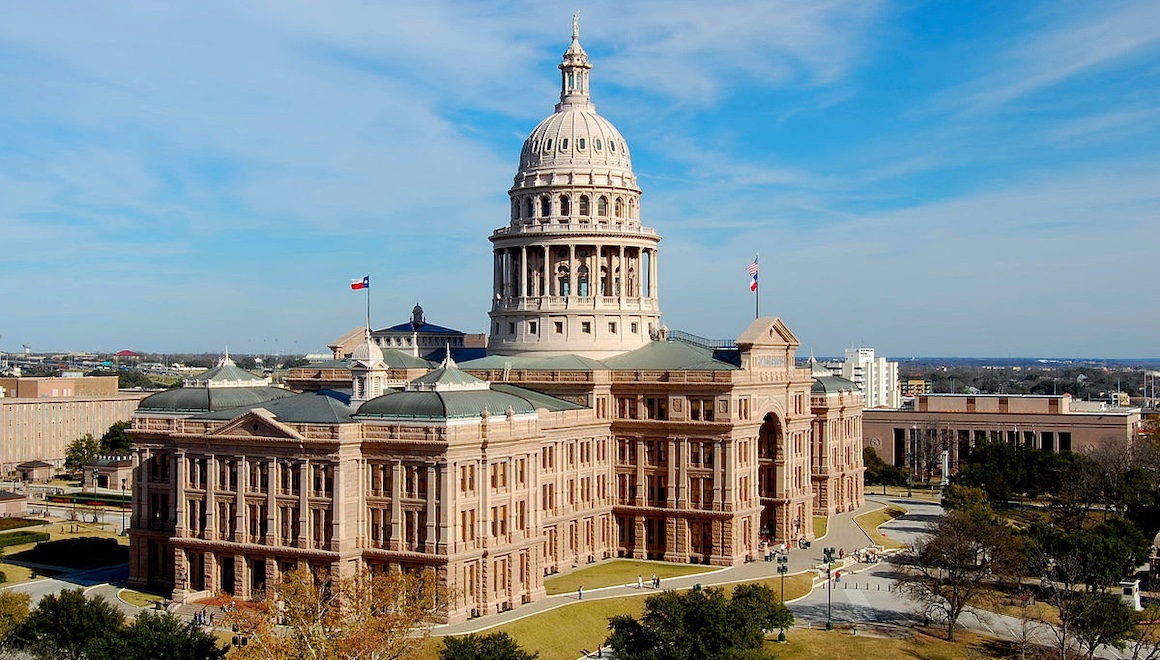
 Texas State Capitol Building in Austin
On Thursday, Friday 5, a Houston Chronicle article shared a redacted version of a November 2025 email from Renu Khator, UH President, to university faculty. The email cited compliance with SB-37 in asking instructors to review their “course titles, course syllabi, and course content to ensure that whether knowingly or unknowingly, you are not violating our academic commitment,” which she describes as, “to expose our students to different perspectives.” She continued, “Our responsibility is to give [students] the ability to form their own opinions, not to force a particular one on them. Our guiding principle is to teach them, not to indoctrinate them.” Following a round of self-reviews by instructors, the email states that the provost and university general counsel will conduct a preliminary review to determine whether courses meet the requirements, with an opportunity for faculty feedback before passing the results to the Board of Regents.
A January 21 email from Andrew Davis, Dean of the UH Kathrine G. McGovern College of the Arts (KGMCA), addressed to the school’s faculty and staff. The email states that according to UH Freedom of Expression policy, faculty members are “entitled to freedom in the classroom in discussing the subject matter;” however, the policy “does not … guarantee freedom to discuss in the classroom any topic of one’s choosing, if a topic is not related to the content of the course; and it further does not guarantee unlimited freedom of expression when one is speaking for one’s institution.” The email advises faculty to “be careful not to introduce into the teaching controversial matter, which has no close relation to the subject.” The email further mandates review of course syllabi and content, with potential repercussions, including ineligibility for pay raises, and the potential that part-time faculty might not be reappointed, if any choose not to participate in the review.
Mr. Davis closed the email stating, “There is no evidence whatsoever that our faculty and courses are not in compliance with the academic commitments and standards outlined here. I have complete confidence in, and I am proud of, what we are teaching and how we are teaching it. The process outlined here is intended to ensure that others outside the College share this same level of confidence.”
Rachel Hecker, UH KGMCA Professor Emeritus, told Glasstire that she is “deeply troubled by the ongoing threats to speech and academic freedom, and saddened for my former colleagues and students. To labor under these conditions is perverse and dangerous for all concerned, and to any value worth upholding.”
An anonymous faculty member spoke with Glasstire about Ms. Khator’s email and the additional mandates issued by Mr. Davis, which they said went beyond the president’s compliance request that did not tie participation to pay or hiring.
Activist organizations, including free speech advocate the Foundation for Individual Rights and Expression (FIRE) and the American Association of University Professors-American Federation of Teachers (AAUP-ATF) labor union, which represents 100 UH faculty members, have worked to narrow the scope of the course audit and anti-indoctrination pledge.
In a Wednesday, February 4, letter addressed to UH Deans and Senior Administrators, AAUP-ATF wrote:
“SB-37 said absolutely nothing about classroom course content or teaching method; it requires a narrow curriculum review of core, undergraduate academic courses based on standards that do not concern any alleged ‘indoctrination.’ … Chancellor Khator’s statement on ‘indoctrination’ is also not a legal policy that can be enforced … A number of Deans have strayed significantly beyond existing UH policy by requiring faculty to sign statements giving, in some cases, extensive — and vague — pedagogical directives and threatening to punish faculty who refuse to sign off on these directives. Deans simply cannot take these actions. They lack authority under UH bylaws to implement these de facto policies or to punish faculty who refuse to certify that they are aware of them.”
One adjunct faculty member told Glasstire that instructors who teach online courses might not be aware of day-to-day developments on campus regarding how new policies are being implemented, and so might not know whether they are in compliance.
Another faculty member told Glasstire, “Just the fact that we have been asked to attest that we are not indoctrinating is ominous,” and that the university has placed the risk of punitive measures on individual teachers.
In terms of effects on classroom teaching, they said, “The fear that anyone — inside or outside of the university — could find something objectionable in any class at any time has to enter your thinking when you are considering what artists to teach to your students or how you talk about the artwork being taught. The students, as always, are going to make artwork about what is important to them — which often touches on subjects deemed ‘controversial,’ and it’s my responsibility as a teacher to help students make artwork about the subjects they want to focus on.”
In at least two recent instances, teachers have faced repercussions for their teaching. In September 2025, a TAMU professor was fired for teaching a lesson addressing gender identity. Similarly, in late 2025, a University of Oklahoma instructor was placed on leave after failing a student essay that asserted a Biblical belief that gender identity beyond male and female was “demonic.” In both instances, the issues were inflamed by social media posts made by conservative groups and politicians asserting that student rights were violated.
As reported by Inside Higher Ed on Wednesday, February 20, the University of Texas system Board of Regents adopted a policy on controversial topics in the classroom during its Thursday, February 19, meeting.
The new policy asserts that instructors have the responsibility to: “foster classroom cultures of trust in which all students feel free to voice their questions and beliefs, especially when those perspectives might conflict with those of the instructor or other students; fairly present differing views and scholarly evidence on reasonably disputed matters and unsettled issues; equip students to assess competing theories and claims, and to use reason and appropriate evidence to form their own conclusions about course material; and eschew topics and controversies that are not germane to the course.”
In addition, the policy states, “Instructors must not attempt to coerce, indoctrinate, harass, or belittle students, especially in addressing controversial subjects and areas where people of good faith can hold differing convictions,” and that course syllabi must “exclude unrelated controversial or contested matters” and “avoid introducing undisclosed material that is not clearly relevant and grounded in the topic of that course. When a course includes controversial and contested issues, instructors shall ensure a broad and balanced approach to the discussion and teaching of these issues.”
Texas universities have also responded to SB-17 and SB-37 by undertaking sweeping departmental changes affecting race- and gender-based programs. In November 2025, TCU announced the forthcoming closure of its Departments of Women and Gender Studies and Comparative Race and Ethnic Studies, and that the departments will be folded into the English department. Inside Higher Ed reported that in November, the Texas A&M University system Board imposed restrictions on race- and gender-related courses, which require review by the system president. The Texas Tech University system followed in December with a memo from Chancellor Brandon Creighton ruling “that classroom instruction fully complies with state and federal law, Board of Regents policy, and Chancellor directives,” which include a prohibition against faculty members promoting certain beliefs on race or sex.
On Thursday, February 12, the Texas Tribune reported that UT Austin will undertake a “sweeping restructure” of its race and gender studies programs, consolidating African and African Diaspora Studies; Women’s, Gender, and Sexuality Studies; American Studies; and Mexican American and Latino Studies, into a new Social and Cultural Analysis department.
How these departmental changes might affect other areas, including the Art Galleries at Black Studies (AGBS) within the UT College of Liberal Arts, is unclear. The AGBS did not respond to a request for comment.
On February 20, the San Antonio Express-News reported that UT San Antonio (UTSA) announced the consolidation of its Department of Race, Ethnicity, Gender, and Sexuality Studies — which houses African American Studies, Mexican American Studies, and Women’s, Gender and Sexuality Studies as undergraduate majors — into the Department of Bicultural-Bilingual Studies. The consolidation goes into effect on Tuesday, September 1.
A UT system faculty member told Glasstire that the consolidation is “a step backwards in a lot of ways.” They continued, “There was just so much that we gained, helping students feel empowered, working with community, building those ties.” While no curriculum changes have been implemented yet, they said, there is concern for the future of the programs.
Overall, the UT system faculty member said, these efforts are “an attack on intellectualism and an attack on education.” While discouraging indoctrination and encouraging critical thinking are cited by administrators, the faculty member maintains that these initiatives “really [get] in the way of critical thinking. It’s an indoctrination. … It’s very limiting, and it’s not allowing for us to understand people from different perspectives, different ways of being, in ways that would make us really grow as a society.”
The UTSA Institute of Texan Cultures, which presents art and cultural exhibitions incorporating materials from multiple ethnic groups, did not respond to a request for comment.
Students and faculty throughout the state have decried the changes being implemented by their schools. On Thursday, January 29, students and faculty held a protest rally on the Texas A&M campus in College Station. As reported by the Houston Chronicle, one professor lamented having to “sanitize” his teaching to align to the new standards, and one student held a protest sign that suggested the restrictions “cheapen” the university’s degrees.
On Thursday, February 19, students at the University of North Texas (UNT) staged an “Art Walk” march and sit-in at a meeting of the UNT Board of Regents, protesting the cancellation of a College of Visual Art & Design art exhibition featuring the work of Victor “MARKA27” Quiñonez. The student protest followed an earlier protest vigil, and open letters by graduate students and faculty denouncing the as-yet unexplained decision to cancel the show. Alicia Eggert, UNT Associate Professor of Studio Art, expressed fervent support for the students in their ongoing protests, and earlier told Glasstire that “the UNT administration’s actions do not reflect the values of the community.”