
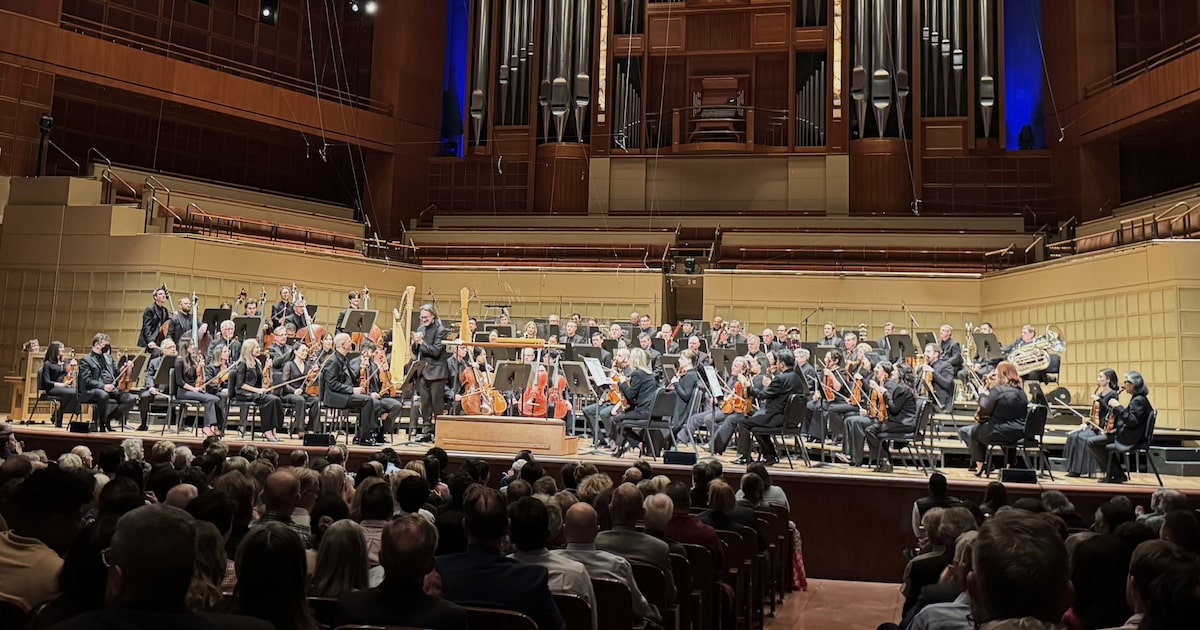
Why certain compositions are put together on Dallas Symphony Orchestra programs isn’t always clear. And at first glance one might have wondered at Saturday night’s sequence of a French appetizer and two major servings of Russian music. (The Dallas Opera’s Don Carlo won the competition for a Friday night review.)
But both the opening and closing pieces were Ravel orchestrations of solo piano works: Ravel’s own Pavane for a Dead Princess and Mussorgsky’s Pictures at an Exhibition. There were also French connections to Prokofiev’s Second Violin Concerto, begun in Paris and composed for the French violinist Robert Soëtens — who went on concert tours with both Ravel and Prokofiev.
Leading the concert was the violinist-conductor Leonidas Kavakos, who’s currently a DSO artist-in-residence. The Mussorgsky-Ravel got a somewhat unorthodox interpretation, although it was convincing in its way until a ponderous final “Great Gate of Kiev” (with way too loud a bell). The concert’s first-half performances didn’t seem fully cooked.
The good news first.
News Roundups
Pictures is usually presented as a display of Ravel’s orchestrational virtuosity, deftly contrasting bright and dark colors, always with a certain French clarity and elegance. Kavakos made the music sound more Russian, its darker textures given extra weight, brighter colors rendered more garish.
A couple of times I thought trumpets a little too aggressive, but there were beautifully intoned and shaped solos from Alexander Kienle (horn) and Tim Roberts (saxophone). Winds and violins twittered and chattered brightly in “Ballet of Unhatched Chicks” and “Limoges.” The fierce poundings of “The Hut on Fowl’s Legs” were hair-raising in the Meyerson Symphony Center acoustics.
These oddly titled movements were inspired by fanciful paintings by the Russian artist Viktor Hartmann. Today, when even churches increasingly have video screens, it seemed a shame not to project the pictures.
I recently saw a brilliant St. Louis Symphony realization of Stravinsky’s Firebird with projections narrating the ballet’s play-by-play action, with images from the original production. Even Elgar’s Enigma Variations could benefit from projected identifications of the composer’s friends portrayed therein.
Ravel imagined his Pavane not as a lament for a dead princess, but as a gentle dance for a little girl in a 16th century painting. Ravel’s own piano recording proves it’s meant to move along, but Kavakos made it dull and lifeless, with little sense of forward motion. Horns and winds tended to be a little too present.
Balances were a recurrent problem in the Prokofiev, and, with big and often distracting gestures, Kavakos didn’t always keep up with the soloist, the DSO’s excellent concertmaster, Alexander Kerr. Kerr’s instrument didn’t project huge sounds, but in his hands it produced silvery clarity. He supplied nimble precision where called for, soaring sweetness elsewhere. (The middle movement is Prokofiev at his most romantic.)
But winds and brasses were sometimes out of proportion to the solo part’s sound world. Even in this second performance in a series of three, the piece sounded in need of more careful rehearsal.
Details
Repeats at 2 p.m. Sunday at Meyerson Symphony Center, 2301 Flora St. $33 to $184. 214-849-4376, dallassymphony.org.