
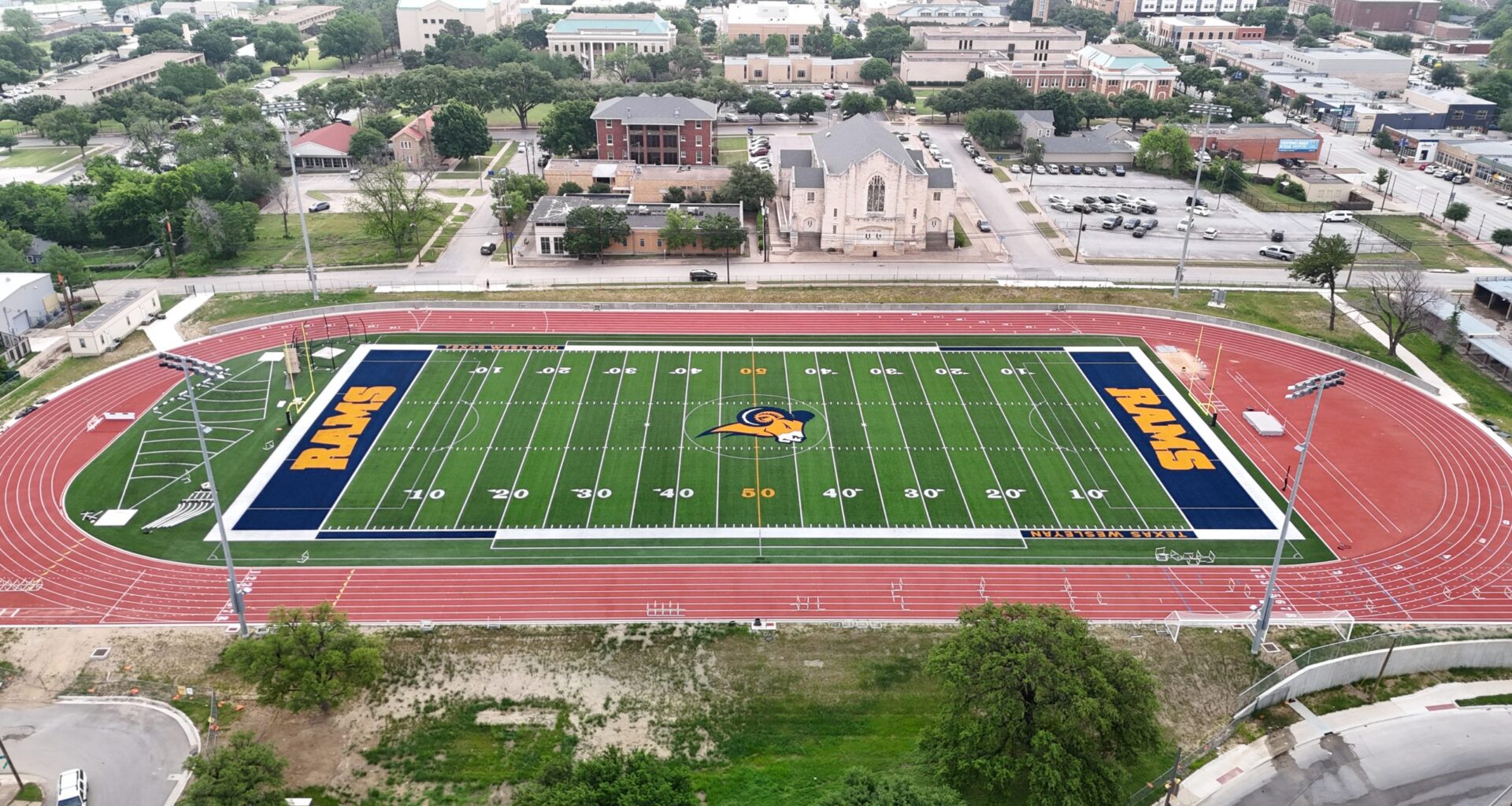
In January, Fort Worth-based Paragon Sports Constructors became a 100% employee-owned company.
Originally founded over four decades ago as a family business doing asphalt tracks, the company expanded as the sports industry evolved to include installing polyurethane rubberized running track surfaces and turf products.
Now, Paragon Sports Constructors is a turnkey athletic facility contractor with nearly 200 employees and in-house services including design-build contracting, stadium construction, synthetic turf installation, natural grass athletic fields, running track surfacing, building ball courts and turf maintenance.
The company was privately owned for 16 years until the recent shift to an Employee Stock Ownership Plan. Paragon has posted year-over-year growth nearly every year since 2010.
“Over the years, while clients were buying the PSC brand and services, they were really buying into our people and our culture,” president William Chaffe said in a statement. “As we plan for the future of Paragon, we couldn’t think of any better way to protect what we have built, while also ensuring long-term stability and independence, other than giving beneficial ownership in the company to those who have built it.”
If you’ve attended sporting events in the area or viewed a local team’s broadcast, you’ve likely seen Paragon’s work. The company clients include Fort Worth Country Day School, Aledo ISD, Mansfield ISD, several local parks and recreation departments as well as professional teams, including FC Dallas and the Texas Rangers.
5001 Saunders Road
Fort Worth 76119
Business editor Bob Francis spoke with Katie Markovich, vice president of marketing for the company.
Bob Francis: How did the business begin?
Katie Markovich: We were originally founded as a family-owned asphalt paving business for running tracks. That evolved over time as the sports industry evolved.
We now have a natural grass fields division that builds and maintains such fields. We also do courts and maintenance, and then address other small facility upgrades, like pre-engineered press boxes and bleachers and dugouts and things like that. We can handle the scoreboard, the lighting. We’re venturing into the covered pavilion work now that’s becoming popular across Texas. So we’re really a turnkey contractor of everything for outdoor athletic facilities.
Francis: Where has your growth come from?
Markovich: It’s really a multitude of things. First and foremost is just putting down good work and providing a professional experience for our clients, with the feeling that they’re being treated with integrity and that they can trust us. We have a large number of repeat and referral clients, so putting down good work that gets more work at the end of the day. That’s been No. 1 for us.
There’s also been changes in the industry over the years, various consolidations of competitors and things like that. That has led to clients seeking out people who are more stable in their business and have a more long-term mindset.
Obviously, here in Texas, we do have a growing population. And we do have an affinity for sports here — whether it’s cities and their rec leagues and parks departments, professional sports clubs or private sports clubs. There’s no shortage of interest in having athletic facilities here in Texas.
Francis: Do you manufacture any of your surfaces or do you partner with manufacturers?
Markovich: We do not manufacture. We like to say we focus on what we do best and partner with those who focus on what they do best. Manufacturing products for athletic facility surfacing for turf and running track materials is very complicated and needs to be done in a certain way to maintain long-term quality.
Our primary surfacing partners are Shaw Sports Turf. Shaw is a division of Shaw Industries — flooring — which is a Berkshire Hathaway company. If you try and imagine what big American manufacturing looks like, that’s what Shaw’s facilities are. They’re really impressive, and they have a lot of science behind everything they do and invest in quality. They produce a great product for us.
With running tracks, we do white label our running track surfaces as a Paragon Track Surfaces brand, but we use exclusively materials manufactured by a company called Conica. They’re a Swiss-based company that specializes in polyurethane manufacturing.
Francis: Do you think Paragon will feel any impact of the World Cup?
Markovich: We are already seeing some of it. Our natural grass division is building and installing the new natural grass field at the Mansfield stadium. Our natural grass team has a relationship with the Cotton Bowl. They’ve done some work there recently. I don’t know how much they’ll be doing over the coming months. We do have a relationship with FC Dallas, and so I believe we’ll be doing some work there.
Francis: Any really unique or unusual installations Paragon has done?
Markovich: What comes to mind is actually a trend in running tracks over the last couple of years to do colored exchange zones. For the longest time, you just put down the classic. In our ever-changing world, everyone wants to show off their brand and the pride of their organization or their community. Running tracks do create opportunities for coloring. You can probably see a number of facilities on our website that have had that. I think Lorena ISD did one. We’ve done them at a number of school districts, large and small. It just really makes a unique pop to it, and so that’s been fun to kind of master that over the last few years and provide that option for our clients.
I’d say one of the more unique things that we do is our turf partner, Shaw, has a unique technology called Game On that provides custom graphics, fewer seams, faster installs and a safer, high-performance field. It means that when we roll out your field, the hash marks, the logos, the numbers are already in place. When you don’t have to cut in every single 350-something hash marks, that’s a huge headache reduction for the client long term. On the flip side, what this technology also allows is for more designs in fields, and so you’ll see on a lot of our baseball softball fields, because those clients tend to like it.
Now that that’s been in the market for a couple of years now, and people are catching on to it, they’re getting more creative with designs. If you watch Big 12 sports, KU replaced the turf at their football stadium, and they have that wheat pattern in their end zone. All of that is Shaw’s Game On. It’s fun to see those kinds of things.
Francis: How did the company decide to become 100% employee-owned?
Markovich: William Chaffe has been our president for the last 16 years, and he’s very highly respected across the industry and here at our company. Thinking about the future of the company, we’ve built this great thing. So how do we ensure it keeps going for the long term?
We’ve seen a lot of consolidation or private equity step into our industry over the last several years, whether it’s manufacturers buying up regional contractors, or private equity stepping in. What ultimately happens with private equity is you tend to lose a little bit of your local focus. We wanted to really preserve our culture. We wanted to preserve and protect our people for the long term. We have very low turnover here. We have a really high number in the field and in the office of employees who have been here for 10-plus years. So we looked at how to ensure that the people who built this brand have a way of carrying it on.
That’s what it was rooted in. It was the right thing to do by our people for the long term.
It’s a real sense of ownership as we go about our work and our daily lives and saying, “Now I’m making the right decision for all of us long term. And I just think it is an incredible motivator for everyone.
Francis: I have to ask about pickleball courts. How’s that business going?
Markovich: We kind of stepped into the court world around 2017. We had always kind of stayed out of it. It was a very low bid and we kind of said we’re gonna stick with fields and tracks for a long time. But we had a lot of clients who had positive experiences with us through doing their field and track work, and they just asked us to manage their tennis court work. We just kind of tiptoed into it by request. We didn’t advertise it for a long time, and it kind of just took off like wildfire.
We have a full on courts division now where we install and maintain and renovate tennis and pickleball courts. Pickleball courts are really tennis courts painted differently. At the end of the day, the equipment’s the same, the materials are the same. And we have done a number of pickleball courts for municipalities and even some private clients. We’ve done some residences here and there. Schools aren’t putting in pickleball. We do school tennis courts and things like that.
Francis: The demographic seems a little bit older, I think.
Markovich: It definitely is. But we’ve had a growing pickleball participation group here. Our president plays pickleball. He used to play tennis. Now he plays pickleball. We’ve got a handful of people at our company who have taken to the sport, and we’ve even done some company outings with pickleball. The great thing is everyone can wade into it. It’s great team building.
Bob Francis is business editor for the Fort Worth Report. Contact him at bob.francis@fortworthreport.org.
At the Fort Worth Report, news decisions are made independently of our board members and financial supporters. Read more about our editorial independence policy here.
This <a target=”_blank” href=”https://fortworthreport.org/2026/03/01/made-in-tarrant-paragon-sports-stands-out-in-the-field-in-fact-they-likely-built-it/”>article</a> first appeared on <a target=”_blank” href=”https://fortworthreport.org”>Fort Worth Report</a> and is republished here under a <a target=”_blank” href=”https://creativecommons.org/licenses/by-nd/4.0/”>Creative Commons Attribution-NoDerivatives 4.0 International License</a>.<img src=”https://i0.wp.com/fortworthreport.org/wp-content/uploads/2021/04/cropped-favicon.png?resize=150%2C150&quality=80&ssl=1″ style=”width:1em;height:1em;margin-left:10px;”>
<img id=”republication-tracker-tool-source” src=”https://fortworthreport.org/?republication-pixel=true&post=427573&ga4=2820184429″ style=”width:1px;height:1px;”><script> PARSELY = { autotrack: false, onload: function() { PARSELY.beacon.trackPageView({ url: “https://fortworthreport.org/2026/03/01/made-in-tarrant-paragon-sports-stands-out-in-the-field-in-fact-they-likely-built-it/”, urlref: window.location.href }); } } </script> <script id=”parsely-cfg” src=”//cdn.parsely.com/keys/fortworthreport.org/p.js”></script>