
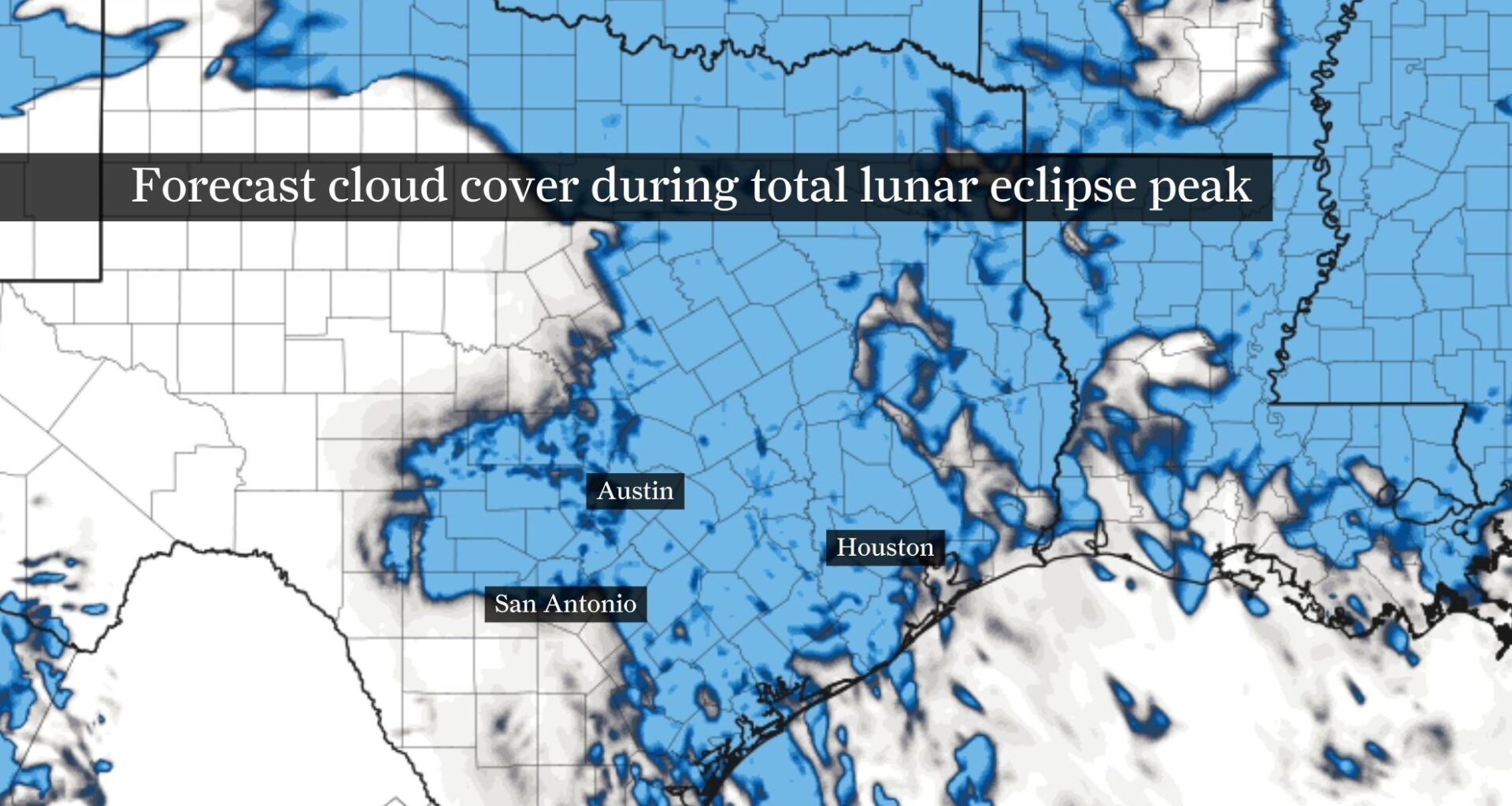
This map of Central Texas shows forecast cloud cover (blue) during the peak of Tuesday morning’s total lunar eclipse.
Pivotal Weather
Eyes across Central Texas will turn toward the sky overnight Monday into early Tuesday as a lunar eclipse turns the moon a rusty, blood-colored hue.

The lunar eclipse begins shortly after 3:30 a.m. Tuesday, peaks between 5:30 and 6 a.m., and finishes around 7:30 a.m. While it occurs when many of us are asleep, it may be worth waking up early, as it will be the last lunar eclipse until New Year’s Eve 2028.
Article continues below this ad
Austin’s eclipse forecast
A new work week starts in Austin with dry weather, despite mostly cloudy skies early in the day.
Skies gradually clear through the afternoon as temperatures rise into the lower and middle 80s. Unfortunately, the return of clouds overnight could make viewing Tuesday morning’s eclipse difficult.
Most forecast models show a blanket of clouds over Central Texas during the height of Tuesday morning’s lunar eclipse. Low-level clouds, like cumulus and stratocumulus, could block out large portions of the sky.
Article continues below this ad
TEMPERATURE CHECK: This Texas town just tied a heat record for winter in the United States. How hot did it get?
Even so, viewing totality is still possible through brief breaks in cloud cover. For the best chance at seeing the moon turn red, head away from city lights if possible and find a location with a clear view of the western horizon. Unlike solar eclipses, lunar eclipses are safe to view without special glasses.
Eclipse forecast: 4.5/10 (1 = fully obscured; 10 = clear skies)
Article continues below this ad
Rain returns by midweek
The pattern turns more active as an upper-level trough of low pressure moves over the Central Plains.
By Wednesday, as southerly winds bring plenty of moisture to the region, scattered showers and storms are expected to develop. Some of the storms that develop Wednesday could pack a punch, with gusty winds or large hail. The ingredients needed for severe storms will be most abundant north of Austin, but you should monitor daily forecasts through midweek as the latest data becomes available.
This map of Texas shows where storms could develop Wednesday afternoon.
Pivotal Weather
Regardless, beneficial rainfall is expected, especially near and north of Austin. Locally, most neighborhoods should see less than a half inch of rain through Friday.
Article continues below this ad
What causes the moon to turn red?
Lunar eclipses are often called “blood moons” because they can turn the moon a deep shade of red. That dramatic color appears during a total lunar eclipse, when the sun, Earth and moon line up with Earth positioned in the middle.
As the moon moves into Earth’s outer shadow, called the penumbra, the dimming is subtle. The more noticeable change begins when it enters the darker inner shadow, or umbra, and a visible “bite” begins to appear along the moon’s edge.
This image shows how the total lunar eclipse will appear early Tuesday morning.
National Aeronautical Space Administration
During totality, the moon doesn’t disappear — it glows copper, rust or crimson. The red color comes from Earth’s atmosphere.
Article continues below this ad
As sunlight passes through the atmosphere, shorter blue wavelengths scatter while longer red and orange wavelengths bend into Earth’s shadow and illuminate the moon — the same reason sunsets appear red. In effect, every sunrise and sunset around the world is projected onto the moon’s surface.
Over the course of the eclipse, the moon gradually darkens, turns red at peak totality, then brightens again as it exits Earth’s shadow before setting.