
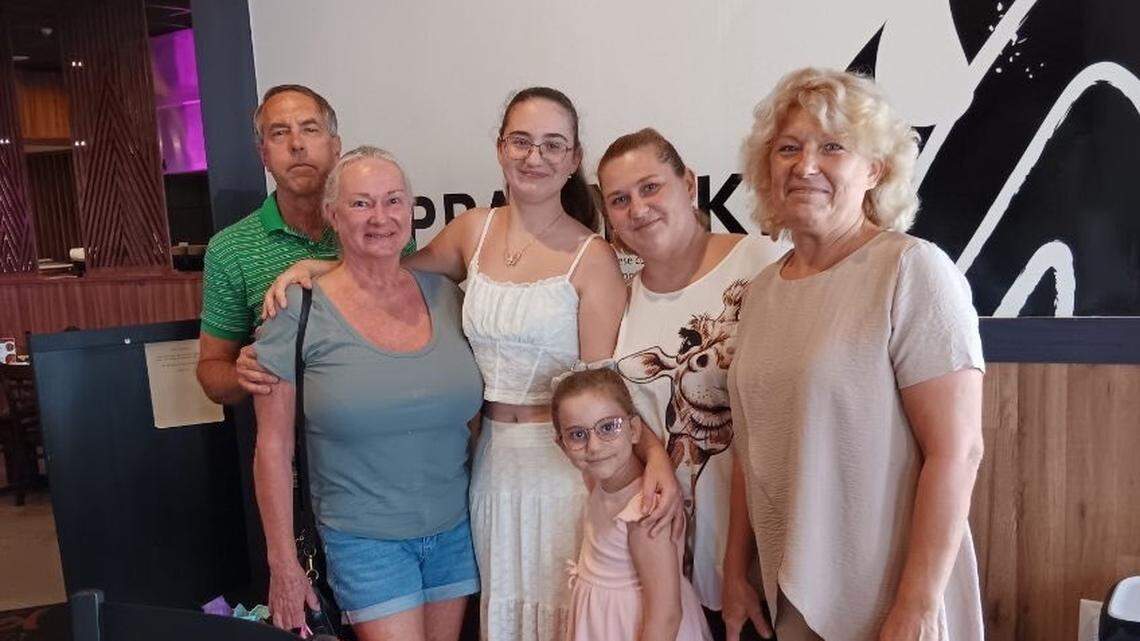
The Tenney family is the host family for Alina Lytvynenko and her family.
Alina Lytvynenko
This article is part one of a two-part story. See the second part here.
Alina Lytvynenko remembers Ukraine vividly — warm summer days, where she woke up and smelled the wet grass from a rainy night, winters with the delicate snow-covered ground, the smell of fresh bread she’d eat on her walk home from the market.
These are only memories for her now that her motherland is at war with Russia.
In 2022, Alina, her daughters and her mother had no choice but to leave their village Zavorychi, about an hour northeast of Kyiv, when Russia invaded Ukraine.
The family found refuge in Fort Worth, where they now live. However, it took nearly a year for them find a permanent place where they could start over. Their journey was like crossing a desert with no map.
Alina, Tetiana, Lera and Liza never thought it would happen to them. And then one day they woke up to a real life nightmare.
Feb. 24, 2022, Ukraine: the day that divided lives
It was a little after 6 a.m. Alina was about to wake up for work. Her mother, Tetiana Kholod, was already on her way to Kyiv for work. Alina’s two daughters, 14-year-old Lera and 5-year-old Liza, were planning on going to school.
Alina did not wake up to the usual sound of her alarm, but rather, the ringing of her phone. Her friend called to see if she knew a war had begun.
Lera’s alarm sounded off shortly after. She groggily woke up to text messages from her classmates about how they refused to go to class because the sky in Kyiv was “orange from bomb explosions,” she said.
Though Tetiana was on the train to work, she was unable to go to Kyiv that day because there was a missile attack that morning. This was one of many missile and air strikes attacks that kicked off Russia’s full-scale invasion of Ukraine.
Tetiana was finally able to make it home safely to their village later that night, after experiencing the panic of Ukrainians running to banks and grocery stores.
The local government assured Alina and her family that their village would be safe and that they would do everything they could to block the Russian military from entering.
One of these efforts included the detonation of a bridge to keep Russians from crossing over. No villagers were made aware of this, so when Alina first heard a loud explosion — so loud their house windows broke — she panicked. The local government assured them the blast was from blowing up the bridge.
But the demolition was unnecessary. The Russians found another way to get to their village in Zavorychi.
From the left Liza Novosolova, Alina Lytvynenko, Tetiana Kholod and Lera Lytvynenko celebrating Christmas at Choctaw Stadium. Alina Lytvynenko A quiet village turned into a Russia-Ukraine war frontline
Alina saw Russian military equipment barreling over the snow with her own eyes. The Russian military used a smaller bridge by Alina’s house to cross into the village.
To survive, Alina, Tetiana, Lera and Liza sought protection in their freezing underground basement. They had no heat, and layered up in multiple jackets and hats. They only had a little water and cookies as a food source.
After a week, they moved to their neighbor’s basement and spent another two weeks in the cold darkness, listening to the sound of rattling Russian bombs and shellings, while Ukraine fought back doing the same. Their only source of light was a small candle.
“Our homes and fields were the first line, the shield that protected the Russians from our soldiers’ missiles,” Alina recounted to the Star-Telegram through an interpreter. “After each of these sounds, I prayed to God that the bomb wouldn’t hit the place where we were hiding. We would have simply died on the spot … or burned alive, since a wooden structure had been built over the cellar where we were hiding.”
In addition to the destructive military activity, the Russians also ransacked village houses, including Alina’s, stealing jewelry from Lera and other valuable belongings. Tanks ran over and demolished other farms and house, and soldiers burned down St. George’s Church — a 149-year-old church that withstood the Germans during World War II.
Alina and her family wanted to leave, either to a neighboring country or a safer village. But when Alina asked Ukrainian soldiers for help, they simply told her she would have to find someone willing, because they could not evacuate her family.
It had been weeks since Lera and Liza had showered or slept in a bed. So, Alina and Tetiana took their family to friends in a farther village that seemed safer.
There, Alina finally found someone who was willing to drive them. They were set to leave in two days. But the night before the escape, Alina found out their driver was killed by shelling in a missile attack.
“It seemed to me that with this man’s death, everything within me had died,” Alina said. “All our hopes for salvation were gone.”
But Alina couldn’t give up. She called almost every contact in her phone until someone agreed to help them. That person said if Alina and her family were still alive in the morning, he would drive them to a safer village.
Alina prayed through the whole night until dawn.
Alina Lytvynenko (left) with her mother, Tetiana Kholod (right) celebrating Christmas in Fort Worth in 2024. Alina Lytvynenko March 13, 2022, Germany: Interim peace
The family survived. The four of them left with one backpack and drove as fast as they could to another village that had evacuation buses.
Alina and her family hopped on a bus that they thought was going to Brovary, a town outside of Kyiv, but instead took them to the main train station in Kyiv. Once in the capital, Alina, Tetiana, Lera and Liza took a train for more than 12 hours to western Ukraine. And after that, they took another train to Hungary.
But once they got to Hungary, their passports posed issues. Since the family did not bring international passports with them, they spent nearly a day in border control waiting to be released, only to find out that Hungary was only accepting refugees who have friends or family in the country. Alina did not know anyone in Hungary, so they had to find the next option, which was Germany. Luckily, Alina knew some friends who lived there who welcomed them in.
After days of border control, fingerprints and train rides, the family got a minute of peace. Alina, Lera, Liza and Tetiana finally had access to bare necessities. Food and water. A roof. A bed. A shower.
If Alina and family had stayed in Ukraine, their everyday would consist of living under constant threat. Constant rumblings of artillery, taking cover in bunkers, shattered glass and rubble from ruined schools and libraries. What used to be a tranquil sky of quiet rain and stars was taken over by Russian missiles and sonic booms.
Eventually, they made their way to Fort Worth, Texas.
This article is part one of a two-part story. See the second part here.
Related Stories from Fort Worth Star-Telegram

Fort Worth Star-Telegram
Ella Gonzales is a service journalism reporter for the Fort Worth Star-Telegram. She is part of a team of local journalists who answer reader questions and write about life in North Texas. Ella mainly writes about local restaurants and where to find good deals around town.