
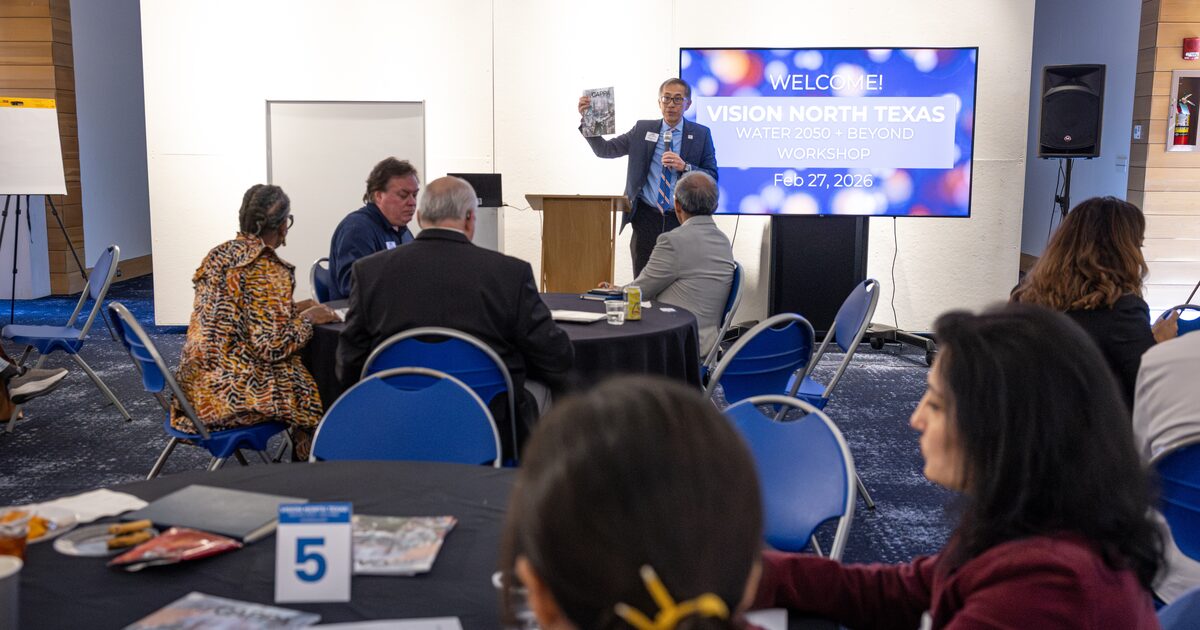
Dozens of North Texas officials are voicing their worries, ideas and dreams about the area’s water resources, as a regional influx of businesses and residents ramp up pressure to address looming scarcity concerns.
On Friday, experts and decision-makers participated in a “water workshop” at the University of Texas at Arlington as part of Vision North Texas 2.0, a revamped public-private-academic partnership.
The event brought together representatives from water utilities, regional groups, municipalities, consulting firms and more to discuss the region’s long‑term water supply, infrastructure, growth pressures and resilience challenges.
Related

Breaking News
North Texas’ population is expected to surge to more than 12 million by 2050. That raises the stakes for the group, which is working to address regional growth while enhancing economic vitality, quality of life and long-term sustainability across 16 counties.
This was the first in a series of workshops that will have different themes, but leaders said beginning with a look at the state of water in the region made the most sense.
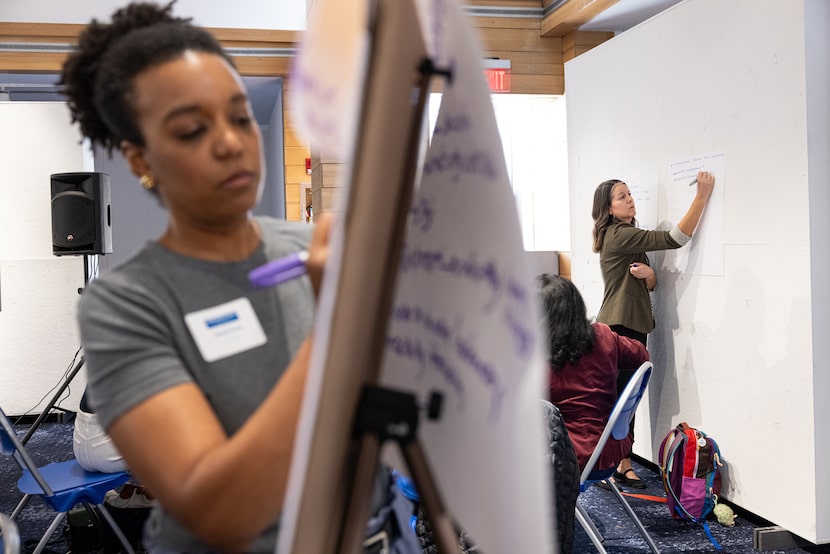
Alyssa Knox, left, and Erin Blackman, with North Central Texas Council of Governments, write ideas on paper during a breakout session at the Vision North Texas 2.0 “Water Workshop” at University of Arlington, Feb. 27, 2026.
Angela Piazza / Staff Photographer
“Our region is growing at a pace that few parts of the country can match,” Ming-Han Li, dean of the College of Architecture, Planning and Public Affairs (CAPPA) at UT at Arlington, told the crowd. “That growth comes with extraordinary opportunities and responsibilities.”
No one is bringing water with them, Li said, before posing questions to the group on how leaders can anticipate future drought rather than react to it.
“How can we build a future when water is not a constraint but a catalyst for the thriving, equitable and resilient region we aspire to create?,” Li said.
CAPPA is a Vision North Texas 2.0 partner along with the North Central Texas Council of Governments, Urban Land Institute Dallas-Fort Worth and the North Texas Commission.
Related

“With the pace of growth we’re seeing, there have to be some very different ways that we, as a community, start thinking about water utilization,” ULI-DFW executive director Tamela Thornton said.
NCTCOG executive director Todd Little said officials are hoping the re-engagement of Vision North Texas can result in a living, breathing document that can be used to guide the region for the next 30 years.
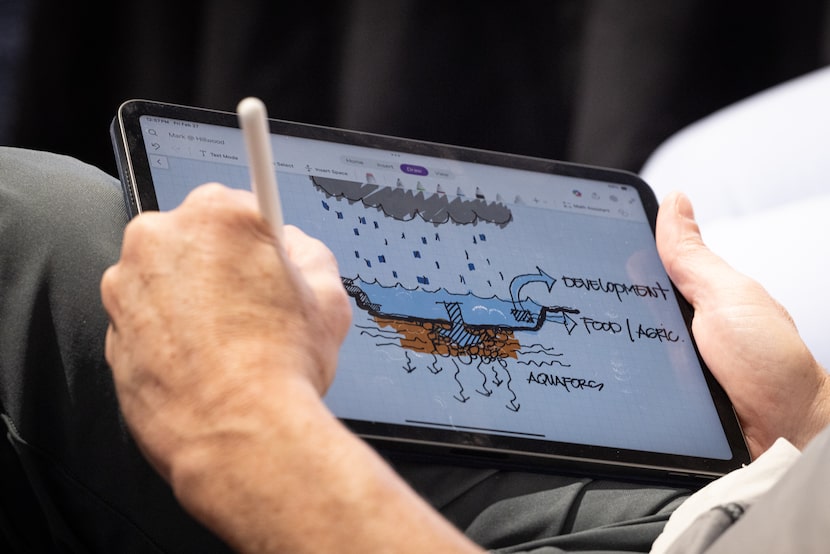
Mark Meyer, Hillwood Communities director of planning and innovation, sketches on a tablet during the Vision North Texas 2.0 “Water Workshop” at University of Arlington, Feb. 27, 2026.
Angela Piazza / Staff Photographer
“We look forward to hopefully solving a major problem that will then create lots of solutions for other things that we’re going to talk about as part of this vision,” Little said, a nod to economic development, transportation, workforce and more.
The speed discussions between the dozens of officials touched on several topics. They included saving water during flood for times of drought, aging infrastructure, green infrastructure, the need for regional communication and planning.
Additionally, the group broached regulation versus incentives, forever chemicals, conservation and reuse, among other topics.
Related

This reporting is part of the Future of North Texas, a community-funded journalism initiative supported by the Commit Partnership, Communities Foundation of Texas, The Dallas Foundation, the Dallas Mavericks, the Dallas Regional Chamber, Deedie Rose, Lisa and Charles Siegel, the McCune-Losinger Family Fund, The Meadows Foundation, the Perot Foundation, the United Way of Metropolitan Dallas and the University of Texas at Dallas. The News retains full editorial control of this coverage.