
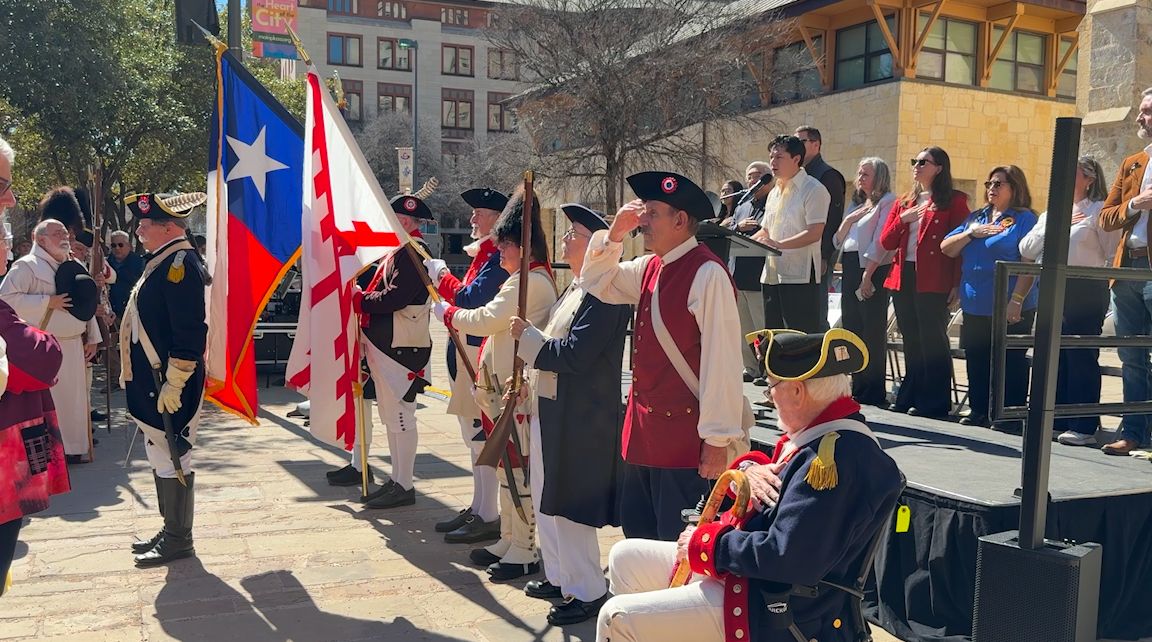
TEXAS — Two-hunded-and-fifty years ago, the American Revolution shook the 13 colonies. At that time, Texas was a part of New Spain, sending assistance to the colonists as they fought for independence.
A recent San Antonio celebration called Bexar America250 served as an ode to 1776, featuring the Sons of the American Revolution color guard and a new historical exhibit.
“You cannot legitimately talk about the founding of America without talking about the West,” said Margaret Koch of the Texas America250 Commission. “Specifically, Texas. And to get even more specifically, Bexar County.”
While the 13 colonies battled against the British in the east, ranchers in the Spanish-controlled territory of Tejas, known today as Texas, sent aid to support the revolutionaries.
“This region sent between 9-10,000 head of cattle to support the colonists in the American Revolution,” said Mari Tamez, outreach manager of the Bexar Heritage Center.
Tamez said this little-known history is now on display inside the Bexar Heritage Center. The exhibit also features maps of San Antonio ranches and tribal land before statehood, highlighting the Native American impact on the region.
“All the different foods, mesquite beans — we taught them,” said Issac Alvarez Cardenas, an American Indian. “They learned, and then they taught us. We became the first cowboys.”
Tamez noted the the contributions of others throughout history.
“It wasn’t just a pure Spanish force. You had African Americans, you had Native Americans,” Tamez said. “Individuals that were diverse who heeded the same call of liberty for the colonists.”
This region’s story dates back over 300 years, and Tamez hopes that when visitors see ranchers’ names like Delgado or Rodriguez, they see themselves reflected.
“Bexar is where people came to fight for their idea of America,” said documentarian Brandon Seale.
Seale said Bexareños, the Spanish term for San Antonio residents, wrote both the Texas and Mexican declarations of independence.
“Bexar County was never the place where people came to leave behind their history,” said Seale. “Bexar County was the kind of place that people came to be a part of something that started a long time ago.”
For generations, Texans have refused to accept the”‘13 colonies America” origin story as the only story, Seale said.
“America has always been a nation in search of its history,” said Seale. “Two-hunded-and-fifty years in, I think America is choosing ours. Because here in Bexar County, the past is always present.”