
You grew up in a working Midwest family. How did that shape you into who you are today?
Well, I think my parents were Depression-era, World War II, Greatest Generation people. And the way you approach things is to figure it out. So I think that has a lot to do with how I approach everything. It’s like, ‘Well, I’ll just figure it out.’
You led a long career in the business world. How did that shape your advocacy?
It’s kind of a take on what I said about my parents. Texas Instruments is a great company, and they give people leeway to stretch themselves. And we used to have a saying, ‘Make it happen.’ So you didn’t wait for a promotion. You didn’t really wait for someone to tell you what to do. They just wanted your ideas, and they wanted you to be innovative and implement. So that was a good fit for me, and I learned a lot from them. Then I went into business development and started negotiating with other companies, learned how to negotiate, and we had customers around the world. I learned how to negotiate in multicultural environments. Just great people skills that you learn in management.
So you weren’t involved in volunteering until after retirement?
Well, we had one son, and I kept up as best I could with his school while (my husband and I) were both flying around the world. It was just home and work, that was it. And so when I retired, I thought, ‘Well, this is my chance to give back to the community, see what I can do for them,’ because they’ve been so good to me. Lake Highlands is a great place to raise a family and have a career.
It’s the early 2000s at the Skillman-635 intersection. Set the scene.
The Advocate wrote an article on it, and they called it the Bermuda Triangle. That’s exactly what it was. When the freeway was built, it was in the middle of nowhere, nothing but farmland far as you can see. The 635 path Skillman and Audelia intersected exactly where LBJ freeway had to move across going east to west. So they had so much room with all this farmland, they threaded the two streets together and then threaded them back on the other side. It was an expansive, spaghetti-like structure to move traffic out in the farmland.
We quickly went from being a first ring suburb to an urban town, and we have so much density around there now that the street infrastructure was never really built to handle, and so it was a mess. People couldn’t figure it out. They couldn’t see buildings were there and couldn’t navigate it. There were accidents. It looked bad, and it couldn’t sustain any economic activity.
Was it daunting to take the first steps?
Well, again, my work experience was doing a lot of long-range planning. I remember training my coworkers and saying, ‘If you’re not sitting at your desk staring at the ball, totally bemused, you’re not doing your job.’ You got to start there and then get the juices going, figure out how to creatively fix the problem. I didn’t really know where I was going, but I had it easy because nobody was paying a lot of attention. The only skin in the game was my sweat equity. I thought, ‘Well, let’s just try it. If nothing happens, so be it, but I’ll just keep going.’ And Council member Bill Blaydes was a gem. He was amazing, and he started opening doors for me, introducing me to the right people. He was quoted once as saying the smartest thing he did get was me to work on that intersection. When I heard him say that, that meant a lot.
A major bump came when lawmakers decided to shelve the project in 2018. What was that like?
That was a major unexpected thing. It was all about defining priorities, getting a good solution, authorizing the money and getting in implementing it. Those are all basic business steps when we got involved with 635 East, and then the governor’s office decided that they were going to put an end to toll roads. That was a political bump in the road that I did not expect, and (I) did not understand that there were special interest groups that had that as their primary objective to cancel all these projects.
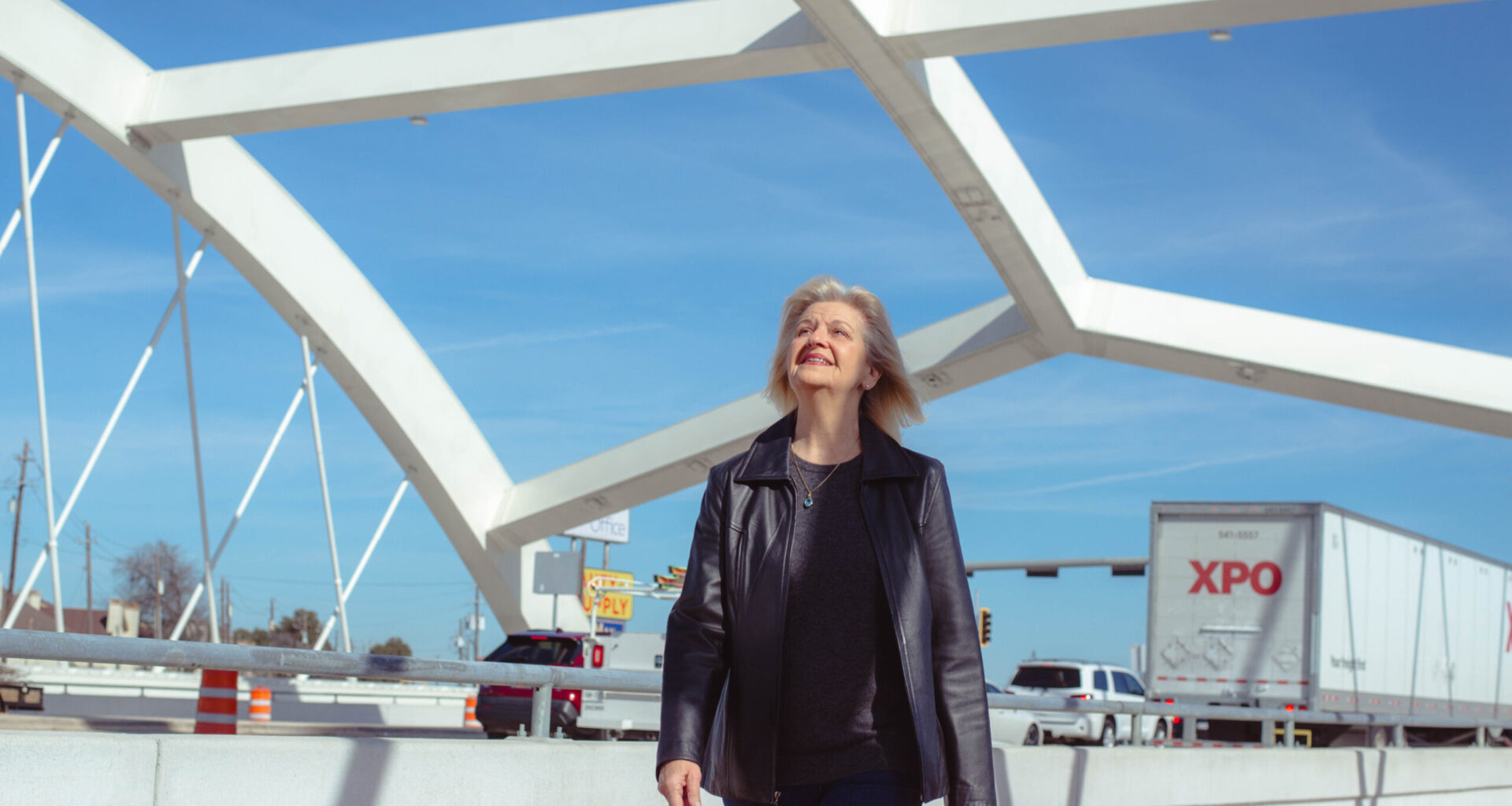
I was amazed that there were people on the 5 o’clock news that were campaigning against toll roads, which I understand in some situations, it is a problem, and those people need help. So sure enough, I found myself on the 5 o’clock news in front of a camera and a reporter explaining why this was different and why it should be treated differently. And it was kind of crazy, like I never thought I’d be on TV standing next to a freeway.
What was ribbon-cutting day like for you?
It was hard to talk to me that day. I was just floating. And even my son, they took the book cover and made a plaque for me and presented it to me on my 70th birthday. It’s got a little thing that says something like, ‘Community champion, beloved mom, grandma.’
In the book, you talk about a decline in community involvement. How concerning is that to you?
I don’t feel like it is because I live in Lake Highlands, and we have so many great volunteer organizations. But statistically, across the country, and I worry about it, are people really losing interest in getting together with their neighbors and having community and just working on improving their communities. Because that’s where it starts, grassroot efforts in the neighborhoods. What I learned from my neighbors, because we were a small, growing community, and it was new, so you kind of had to pitch in and figure out, ‘We need a stoplight in the center of town, right?’ And that’s the kind of thing that we need people to have a perspective on and get involved with. So I hope maybe it inspires somebody.
This interview has been edited for clarity and brevity.