
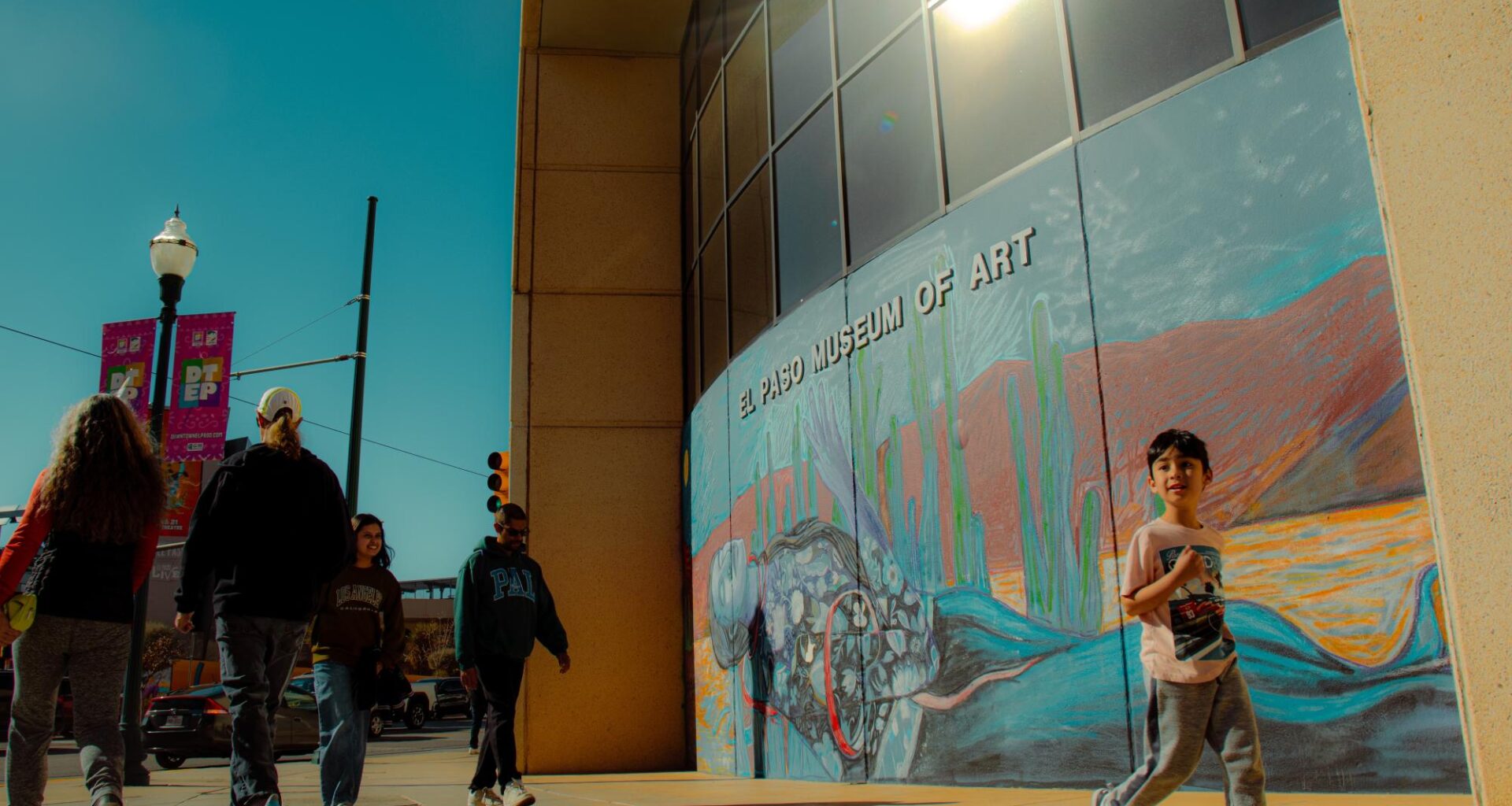
The El Paso Museum of Art was alive with music and movement on Feb. 14 as it reopened its doors after a five-month closure. Guests gathered to celebrate the museum’s grand reopening and debut of its newest “Frida Kahlo: Sus Fotos,” exhibit. With vendors lining the hall and a lively performance by the Ballet Folklorico Tonatiuh in the lobby, the museum was once again filled with a crowd.
After being closed for a $3.5 million infrastructure overhaul designed to better preserve and protect the museum’s collection, the reopening ran from 10 a.m. to 3 p.m. The museum welcomed visitors back into the newly upgraded gallery spaces with activities, photobooths and dancing which added to the celebratory atmosphere.
The traveling exhibit, curated roughly 15 years ago, is made up of selected photographs from Kahlo’s personal archive. Many of which were taken by herself and her family, even acting as inspiration for her paintings.
Out of the nearly 3,000 images, curators selected 241 photographs for the exhibit now on display through May 17, offering guests an intimate look at Kahlo’s life.
Her story captures moments from her childhood, travels, relationships and health struggles, a story that resonated with guests like Elizabeth Hernandez.
“When she was in bed, she had that accident on the bus, and she could not walk. She didn’t even give up. She said, ‘I’m going to paint. Keep on painting.’ And she was right there with her portraits and everything, and she took out something positive about that,” Hernandez said.
Michael Reyes, the senior curator of the El Paso Museum of Art, described Kahlo as one of the most iconic artists of the 20th century.
“I like to say it’s a love letter to the city, to the greater communities of El Paso and Ciudad Juárez, and that we serve them. This is their cultural heritage, and we’re so grateful to be here and having it safe, kept and presented in a proper manner,” Reyes said .
Reyes added that the exhibition was designed to present a fuller portrait of Kahlo beyond her paintings. Acting as part of a photographic biography where guests can begin to understand the complexities of her life, her politics, family, relationships, celebrations and triumphs in every sense. Whether or not they’re able to travel to visit her art works hanging in other museums.
After surviving childhood illness and a bus accident, Kahlo was left with chronic pain and lifelong medical complications. While still bedridden during her recovery, Kahlo would begin painting the self-portraits that would later become some of her most recognized works.
The self-portraits and surrealist works Kahlo would become famous for were often deeply personal and rooted in her identity. Depicting pain, love and her cultural heritage while drawing inspiration from her lived experiences, relationships and personal struggles.
“A lot of her work depicts her identity and who she was and what she was going through. I think a lot of people can relate to that,” Reyes said.
Reyes pointed to one of his favorite Kahlo paintings, “The Two Fridas” as an example. The painting portrays two versions of Kahlo, their connected hearts symbolizing her German and Mexican roots.
Although Kahlo is frequently labeled as a surrealist painter, it was a term she rejected, insisting she painted her own reality rather than dreams. A perspective that Reyes echoed, describing Kahlo’s work as grounded in her lived experience, even when presented through symbolic and dreamlike imagery.
“Historians and art historians, critics, you know, they can go bat to bat of what it meant. Sometimes we’ll never know, but that’s the beauty of art, right? We kind of interpret it in our own right, and we take it as we see it,” Reyes said.
Reyes described Kahlo’s paintings as warm and deeply captivating, requiring viewers to study every detail. Her photographs had a similar effect, inviting guests to see and learn about her and her world beyond the paintings.
Something that was reflected in visitors like Adriana Maciel who recognized some of the places in Kahlo’s photographs and even sharing the artist’s birthday.
“I think it tells us a little bit more about her, not too much on her work… more than her life, not into her work. So, that’s why, we do enjoy it,” Maciel said.
More visitors made their way upstairs and into the main exhibit, pausing frame by frame to read the plaques, studying her photographs as they would her paintings.
Jewel Ocampo is a staff reporter and may be reached at Jnocampo
