
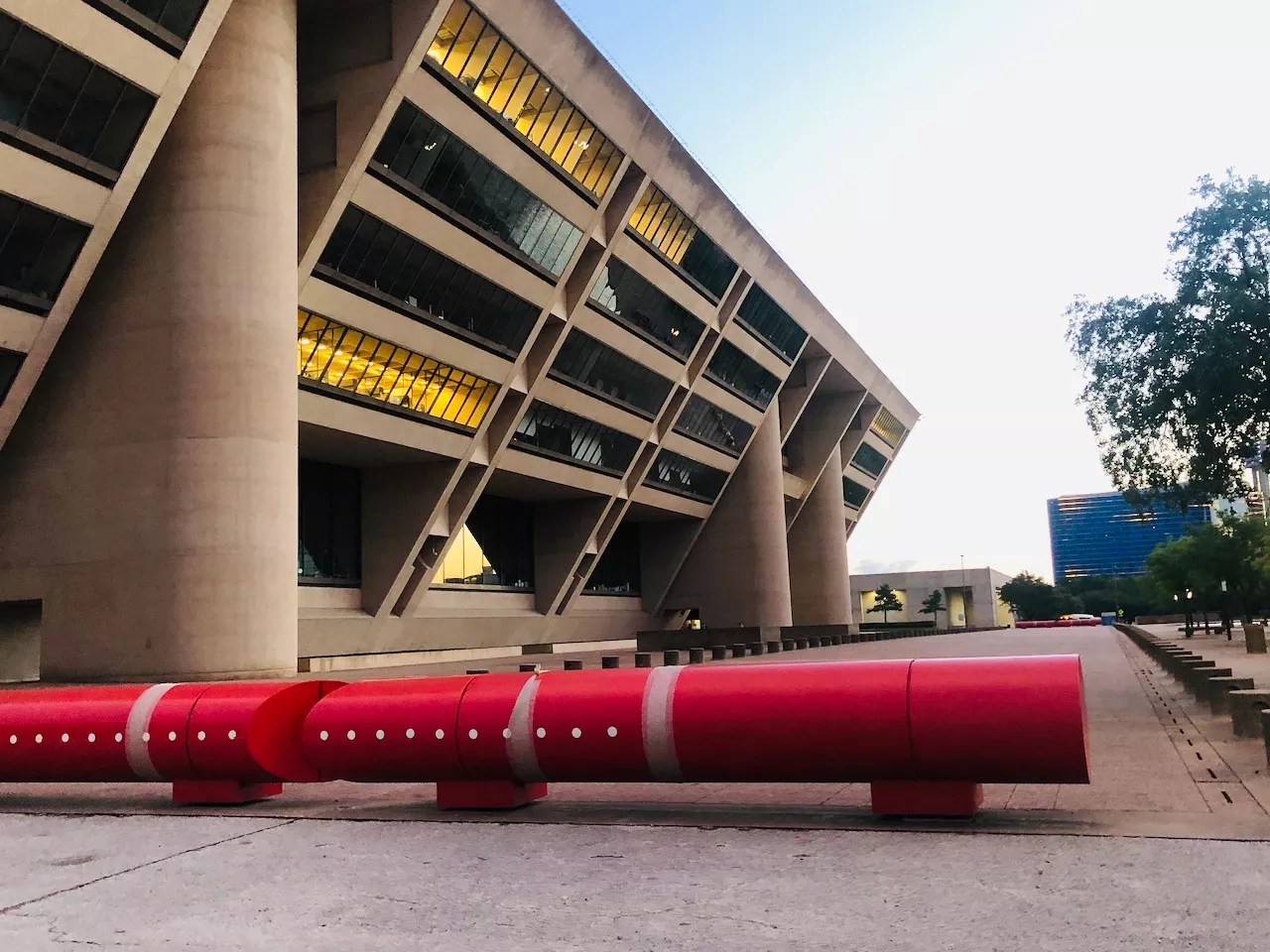
Dozens of public speakers voiced opposition to potentially vacating Dallas City Hall as projections for repair costs soar.
Over two hours on Monday, speaker after speaker at the City Council Economic Development Committee meeting questioned plans to relocate from the I.M Pei-designed structure to another venue, possibly including at least one leased office building downtown. Many wore “Save Dallas City Hall” pins and waved their hands in the air in silent applause of arguments against the potential move.
According to an Economic Development Corp. report delivered to the City Council Finance Committee in late February, costs to repair and modernize City Hall could exceed $1 billion. Some council members have questioned the validity of the figures, while Council member Zarin Gracey said it is “NOT a functional building” in a recent Facebook post.
Proponents of the move have cited the sky high figures and pointed to the city’s financial burdens elsewhere. They also argue that redevelopment of the site would stimulate growth downtown, which is facing high vacancy rates that will be compounded by AT&T’s move to Plano.
The Finance Committee voted to recommend that city staff explore options for potential relocation and redevelopment, as well as moving emergency call centers to a new facility at an earlier date.
Monday’s committee meeting was the first opportunity for public comment on the topic since the report’s release on Feb. 20.
Against the Move
“That is embarrassing. No one should think that the purpose of this building is no longer valid, that this is prime real estate, and so we need to use it,” resident and local architect Jessica Stewart Lenvay said at the meeting. “We are using it. This is the people’s house. This is the heart of our city. We need to do more to engage constituents. We need to be we need to do more education.”
The EDC report estimated that upwards of $345 million would be needed to address City Hall’s most pressing needs, including sprinkler systems, HVAC, the roof, exteriors, unfinished basements and plumbing systems.
Speakers questioned the report’s transparency and independence, with some pointing out that major construction firms tied to downtown development had led market analysis for relocation options.
“The consultant report is inadequate, misleading, incomplete and not an independent assessment,” Melanie Von Landingham said. “It provides no phased option or the data required by your November 12 resolution. Revenue streams were not explored to offset costs.”
At the Finance Committee meeting, EDC Chair Linda McMahon said she has confidence in the $1 billion evaluation, further stating that “This is not about sentiment, it’s about stewardship of taxpayer money.” The report also found no major structural damage to the building.
“City Hall is a paid-for asset. It belongs to all of us,” Mike Northrup said. “And in this room and beyond, the report was very clear, this building is not falling down.”
The Economic Development Committee met to discuss redevelopment options for the roughly 15-acre site at 1500 Marilla St. Assistant City Manager Robin Bentley told committee members that a call for concepts would provide clarity on potential options for redeveloping the property and surrounding areas, adding that city staff “don’t know what options are even out there for our ideas for redevelopment.”
‘Your Luka Doncic Trade’
One possible option, however, has been reported on extensively. With a lease at the American Airlines Center expiring in 2031, the Dallas Mavericks have narrowed their search for a new home to two properties: the former Valley View Mall site and an undisclosed downtown location. The Mavericks are looking for a basketball-centric arena with a surrounding mixed-use entertainment district, similar to development surrounding the Dallas Cowboys and Texas Rangers’ stadiums in Arlington.
In a recent opinion column run by the Dallas Morning News, former Mayor Mike Rawlings wrote that “this is about keeping the Dallas Mavericks and the Dallas Stars in Dallas and seeing a historic renaissance downtown that we all want. Rawlings further said that the relocation would offer the Mavericks an opportunity to build around the new Kay Bailey Hutchinson Convention Center, which is expected to be finished as early as 2029.
Bentley told council members that the city had not received a proposal from the Mavericks for the property and that there was “no deal.”
“It is a complete betrayal to the taxpayers and residents of this city, and you’re going to ask the taxpayers to help fund yet another stadium in this city,” Cydney Walker told council members at the meeting. “They’re going to come back in 20 to 25 years and ask the taxpayers to pay for another stadium. Do what’s right, do what’s right by the taxpayers, because you ask them to do too many things and to receive too little for what they pay in taxes.”
Matthew Mabel, who said he plans to renew his season tickets at the Mavericks’ new arena, likened the potential deal to swap City Hall for a new stadium to another often-maligned trade involving the Mavericks.
“A few people making a decision, rushing it through before they really understand how people feel about that decision,” Mabel said. “That’s this process that I see before me as a citizen and a taxpayer, and I urge you to correct it. The Mavericks were ridiculed nationally. Still are. Worst trade in the history of the NBA. The decision to abandon this building and knock it down without getting all the facts and allowing people of Dallas to make the decision is your Luka Doncic trade.”
Speakers also questioned whether council members had received enough information to make informed decisions about City Hall’s future and said the discussion felt “rushed.” In a statement last week, Council member Paul Ridley echoed those concerns, calling it “an externally pressured process.”
“I’ve lived in Dallas for over 43 years now, and every time I’ve watched City Hall rush an issue or rush a decision, it usually means someone’s going to benefit other than the taxpayers,” said Stan Aten.
For the Move
A few speakers voiced support for relocating City Hall. Downtown Dallas Inc. President Jennifer Scripps said the city must prioritize essential services, which have been threatened by budget constraints. Dallas is currently considering library closures due to budget constraints.
“These are the essential services that taxpayers expect to be prioritized ahead of pouring millions of dollars into a building that most residents have never visited,” Scripps said. “As such, this is a generational decision. DDI supports the direction to continue exploring alternative government center options.”
Scripps also said the reimagination of the site would provide for better connectivity to ongoing development in South Dallas.
Howard Dennie said he supported the potential move for its potential to invigorate downtown.
“We can turn this site into an asset, redeveloping downtown, generating tax revenue, tracking private investments and creating jobs,” Dennie said. “This kind of economic growth and activity puts money back into the city’s budget. We’ve seen it work before. Look at the growth that happened at the American Airlines Center.”
What’s Next?
At the meeting, council members questioned the proposed call for concepts and expressed concern about the amount of information they had received.
“Right now, you basically are telling me, y’all are not willing or able to give us the necessary information to make sound decisions, but we’re supposed to make one of the biggest ones I’ve been asked to since being on council,” said Adam Bazaldua.
Council members also pressed for greater community engagement, including town halls and surveys. No action was taken at the meeting.
The full council will vote on the Finance Committee’s recommendations at a meeting on Wednesday.