
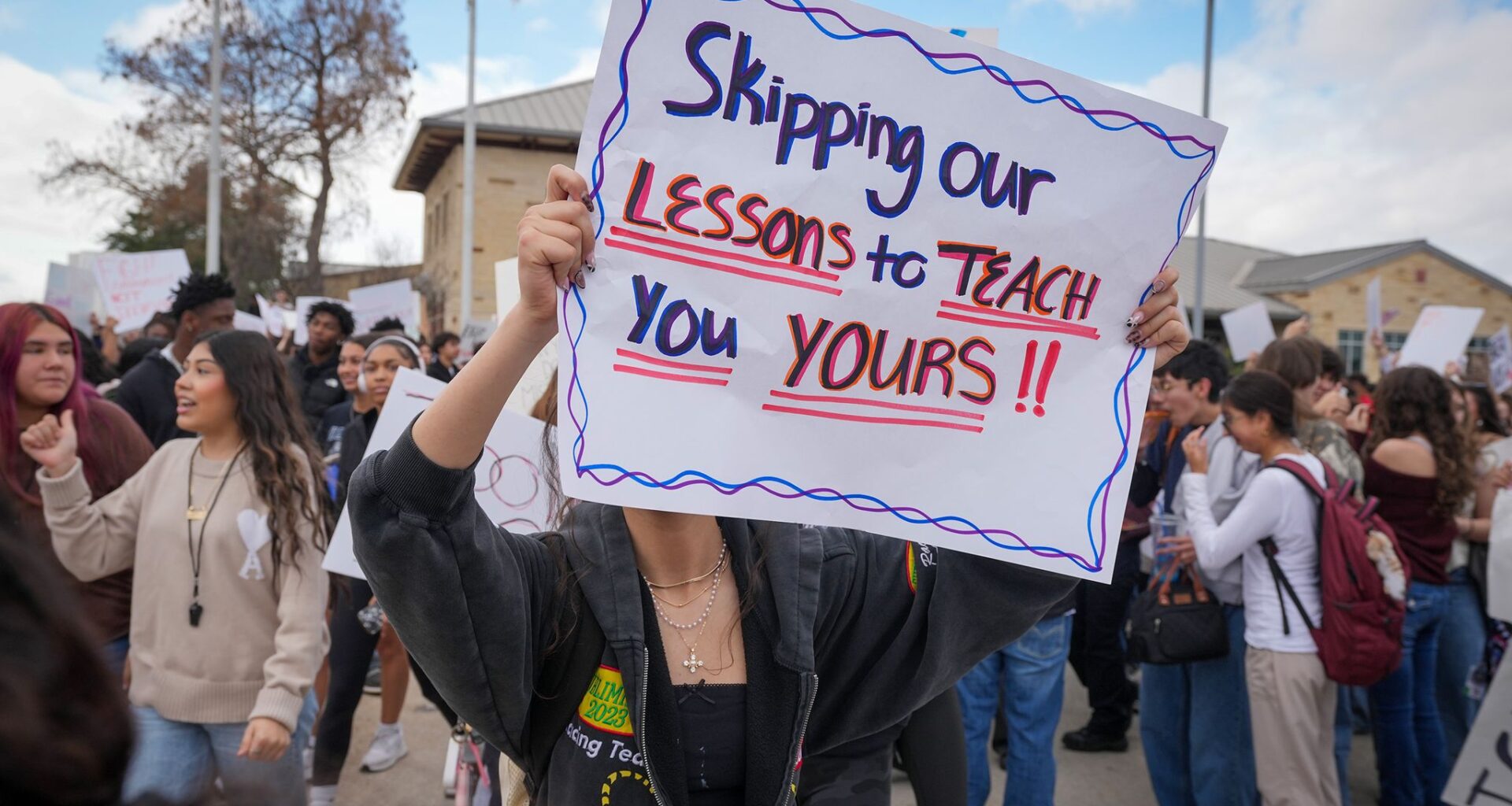
Students protest U.S. Immigration and Customs Enforcement outside the Pflugerville Justice Center in Pflugerville on Monday, Feb. 2, 2026. Hundreds of students walked out of classes and marched from Pflugerville, Hendrickson, Connally and Weiss high schools. They converged at the justice center and rallied for more than an hour before dispersing as a large law enforcement presence arrived.
Jay Janner/Austin American-Statesman
As they watched students nationwide walk out of class to protest immigration enforcement and federal officers’ actions, Jaylynn Cavazos and her classmates understood this was an important moment.

Immigration policies have touched the lives of so many families in the Hays area, Cavazos, a high school junior, said.
Article continues below this ad
Crockett High School students walk out of school in Austin on Friday, Jan. 30, 2026, as part of a nationwide protest of the actions of U.S. Immigration and Customs Enforcement. Hundreds of students participated in the walkout, which was among similar student demonstrations held at other Austin-area schools.
Jay Janner/Austin American-Statesman
“All the students were using the opportunity to speak out for their family members that were affected by this and their friends who were affected by this,” Cavazos said.
As she and some of her classmates at Hays High School watched one demonstration after another, they decided to join the thousands of young people around the state and the country who used the power they had available — their presence in class — to join the protest movement.
“We don’t have much political influence on who’s in power in this administration,” Cavazos said. “We did have the ability to use our voice.”
Article continues below this ad
Hundreds of Hays High School students marched off campus Feb. 2, joining peers from nearby Moe and Gene Johnson High School. While the walkout was mostly uneventful, an altercation occurred during the Johnson High protest between a student and a man, who the Buda Police Department later arrested and charged with two counts of assault causing bodily injury.
Though the wave of student-led protests were otherwise largely peaceful, they drew immediate scrutiny from state leaders, who warned school districts of consequences — including a state takeover — if they were found to be aiding or encouraging the walkouts. In late January, Gov. Greg Abbott blasted Austin ISD online on over the walkouts. A few days later, he insisted that “it’s about time students like this were arrested,” referencing news that two minors were arrested during a Kyle protest. Police later clarified those arrests were unrelated to the demonstration.
Under pressure from state elected officials, local school district leaders pled with students to remain in class. The intense scrutiny on student walkouts thrust young people into new roles navigating the pitfalls, logistics and emotional debate of speaking out on a divisive political topic.
Article continues below this ad
Hays students responded to the challenges by pivoting to after-school protests. However, for many students, the pressure was worth it to amplify their voices on immigration, an issue they say speaks specifically to their generation.
Organizing walkouts
Student-led protests began after the January killings of Alex Pretti, Renee Good, Silverio Villegas González and Keith Porter Jr. — four civilians who died during encounters with federal agents. Their deaths galvanized young people across the country.
Aeden, left, and Kat Pruett-Ponvert, 17, protest U.S. Immigration and Customs Enforcement outside the Pflugerville Justice Center in Pflugerville on Monday, Feb. 2, 2026. Hundreds of students walked out of classes and marched from Pflugerville, Hendrickson, Connally and Weiss high schools. They converged at the justice center and rallied for more than an hour before dispersing as a large law enforcement presence arrived.
Jay Janner/Austin American-Statesman
But even before January, immigration enforcement was already affecting high school students directly, said Adeleah Cardenas, a senior at Akins High School in Austin ISD. She knows classmates whose family members have been swept up in heightened immigration enforcement, including a friend whose father was detained. While her friend’s father was eventually released, the separation was challenging for her friend to navigate, Cardenas said.
Article continues below this ad
Some students were scared to speak publicly out of concern for retaliation, but many wanted to show they deeply disagreed with how federal immigration tactics were upending the lives of people they knew or shared a community with. That’s why Cardenas and three other classmates helped organize a Jan. 29 walkout at Akins.
“A lot of people really wanted to do something,” she said.
A growing desire to act threw many students into organizing roles for protests that drew hundreds of students. Many used social media to get the word out. Students created Instagram accounts with posts to share walking routes, protest times, last-minute changes and ground rules for the demonstrations, such as a prohibition on violence.
Natalie Mathews, a senior at Hendrickson High School in Pflugerville ISD, previously attended protests when she worked with Beyond Boundaries, a youth-led advocacy group that helps teens and young people learn about civic engagement. When she learned her classmates were hosting a walkout, she reached out to help.
Article continues below this ad
“There’s an elitism around protests and boycotts where you need to know what you’re doing all the time,” Mathews said.
The students planned where they would walk once they left classes, contacted law enforcement to ensure they’d be safe, gathered snacks and water and raised money to buy safety vests for a small group tasked with monitoring the demonstrators. Developing a multilayered plan, Mathews learned about the many ways someone who wants to contribute to a social cause can help, she said.
“I realized that there’s a lot more nuance,” Mathews said. “There’s a lot of other ways that people can make a change, aside from just giving loud speeches.”
Students protest U.S. Immigration and Customs Enforcement outside the Pflugerville Justice Center in Pflugerville on Monday, Feb. 2, 2026. Hundreds of students walked out of classes and marched from Pflugerville, Hendrickson, Connally and Weiss high schools. They converged at the justice center and rallied for more than an hour before dispersing as a large law enforcement presence arrived.
Jay Janner/Austin American-Statesman
It hasn’t been easy for Hays student Cavazos or others who took on leading roles in the protest movement. On top of pressure from state elected officials and school district leaders, students had to navigate disagreements between classmates at school, where not everyone agrees on immigration issues.
Article continues below this ad
At Hays High School, students had tough conversations on the topic. Some fundamentally disagreed with their peers. Cavazos and her classmate, who helped organize the protest, lost friends, she said.
Cardenas, at Akins, said she faced online bullying from other students over her role organizing the protests. The online rhetoric targeted her specifically.
“I got a lot of hate for it,” Cardenas said.
State attention
Student walkouts have a long history across the country and in Texas. The 1986 student walkouts in San Antonio’s Edgewood ISD over abysmal education conditions sparked change in Texas’ public school funding system. That same year, students around the country left class to protest the Vietnam War. More recently, in 2018, students nationwide walked out of class after students and teachers were killed at Parkland High School in a mass shooting earlier that year.
Article continues below this ad
But state leaders treated recent protests over immigration enforcement as far from ordinary — they issued sharp rebukes and pressured local school districts to tamp down on the student movement. The Texas Education Agency threatened educators who help students leave class for political activism with harsh consequences. Teachers who encourage the protests could lose their teaching license, TEA officials said.
Jacob Saldaña, a senior at Bowie High School in Austin ISD, felt Abbott and other state leaders’ allegations that adults and school district leaders persuaded students to protest were “misinformed.”
Abbott is “scared of us being smart,” Cardenas said. “He’s been defunding our education and taking things away from us. It has taken a toll on teachers and staff at our school.”
Crockett High School students participate in a walkout of school in Austin on Friday, Jan. 30, 2026, as part of a nationwide protest of the actions of U.S. Immigration and Customs Enforcement. Hundreds of students participated in the walkout, which was among similar student demonstrations held at other Austin-area schools.
Jay Janner/Austin American-Statesman
The TEA also told district officials they could lose state funding if they violated state attendance requirements. Some district officials pled with students directly, asking them to keep these consequences in mind when deciding to protest.
Article continues below this ad
“The (state) money pays for student opportunities, supplies, and salaries to keep the best teachers and staff in the state working in our district,” Hays Superintendent Eric Wright wrote in a Feb. 4 statement to parents. “I don’t want your local tax dollars to remain in the hands of the state.”
After hearing that their district could lose funding, Cavazos and her friends at Hays High adjusted their plans for future protests. Instead of holding another walkout during the school day, they advertised a protest after school, concerned that Hays CISD’s state funding could get taken away. The funding threat frustrated them, since the students care about their education.
Abbott “is just trying to distract from the fact that we had a legit message that is trying to be expressed and reached and he did not agree with that message,” Cavazos said. “He wanted to oppose it and shut it down.”
In his letter, Wright also encouraged students to stay in class, and voice their opinions in another way. On Feb. 11, Austin ISD posted a video with a similar message, in which campus principals said that “passion is what gets your voice heard, but education is what gives your voice power and influence.”
Article continues below this ad
This was also disheartening to Cavazos and part of the reason she and her classmates organized the afterschool protest, “to prove that we still care after school.”
‘You’re not alone’
On Feb. 16 or President’s Day, when many school districts were closed to students, about 100 students and community members from several districts gathered to march from City Hall to the Texas Capitol.
Central Texas high school students and community members protest ICE outside the Texas Capitol in Austin Monday, Feb. 16, 2026.
Mikala Compton/Austin American-Statesman
Many of them said they wanted to prove that their cause wasn’t about skipping class but really about drawing attention to a national issue reshaping the lives of families in their communities.
Article continues below this ad
Students in Central Texas are directly affected by immigration issues, Saldaña said. For many young people, this is personal.
“When you see a bunch of people coming out and supporting your cause, you realize, ‘Wow, you’re not alone,’” Saldaña said. “That’s great. It’s the power of unity.”