
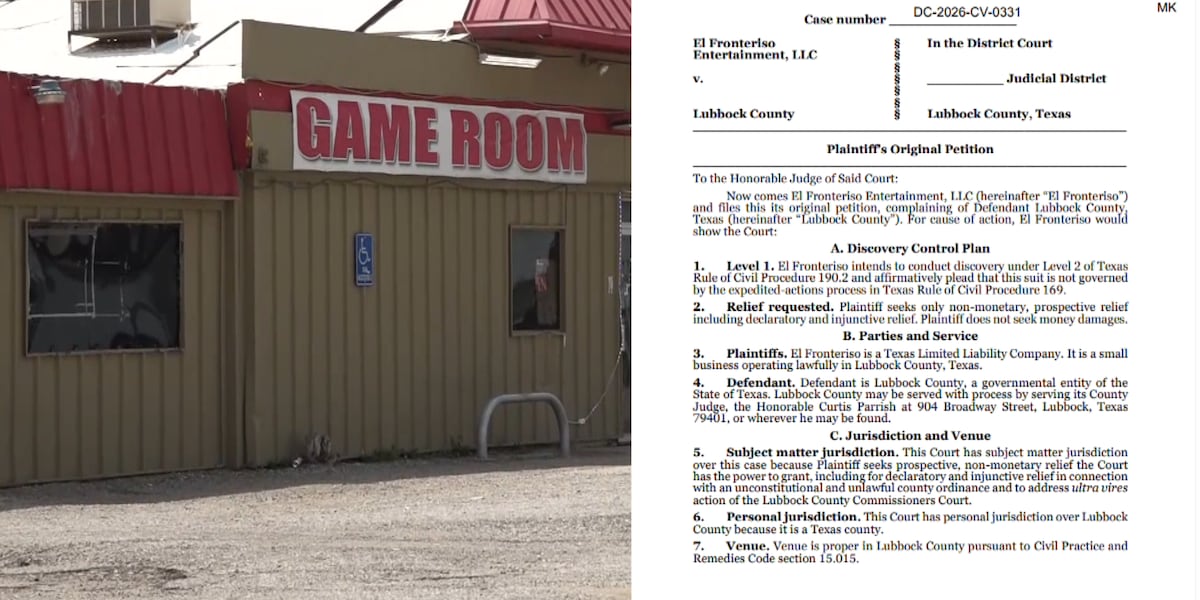
LUBBOCK, Texas (KCBD) – A game room owner is suing Lubbock County, alleging county commissioners overstepped their authority when they amended the 2024 game room ordinance.
Eric Thompson, owner of El Fronteriso, located just east of the interstate near County Road 73-40 in southeast Lubbock County, filed the lawsuit – not for monetary relief, but to overturn the amendments he describes as unconstitutional and unenforceable.
The lawsuit focuses on three changes passed by county commissioners in February: a requirement that facilities keep their doors unlocked, signage stating that gambling is illegal in Texas, and new restrictions that shorten hours of operation.
Previously, game rooms were allowed to operate from 10 a.m. to 11 p.m. Sunday through Thursday, and 10 a.m. to 2 a.m. Friday through Sunday morning.
County commissioners changed those hours to 8 a.m. through 5 p.m., and only Monday through Friday.
Thompson says those restrictions are negatively affecting his business.
“Since the hours change, you’re looking at 50 or 60 people a day coming in and that’s it,” Thompson said. “Definitely a gross income drop; it definitely affects how you pay your bills and again it just makes it harder.”
Lubbock County Sheriff Kelly Rowe and his designated deputies are responsible for inspecting game rooms and ensuring compliance. Rowe said the hours change was driven in part by some game rooms’ proximity to family facilities.
“Some of these game rooms have ended up near sports complexes for kids and we’ve heard from some parents and some folks there that they’re kind of appreciative of that point,” Rowe said.
Thompson’s lawsuit also alleges that County Judge Curtis Parrish and Sheriff Rowe hold animosity toward the game room industry, claiming their sentiment “resulted in an attempt to regulate the game room industry out of existence.”
“You read the sheriff’s article and he calls people that goes to those places ‘scumbags,’” Thompson said. “They’re not. They’re grandmas, they’re grandpas, they’re working people.”
Rowe said that while not every game room is actively engaging in illegal conduct, all of them are, by nature, illicit enterprises.
“These are criminal organizations,” Rowe said. “Gambling is illegal, not only by statutes of the state of Texas, but by the constitution of the state of Texas. And it’s a real challenge to reconcile trying to, quote unquote, legalize or create a framework to legalize these types of businesses when by their very nature they’re illegal.”
Thompson said his operation works to stay in compliance with both state law and the ordinance, and to prevent crime on the premises.
“We go to great lengths to keep drugs out of our business. We don’t really have to deal with prostitution or human trafficking, but that stuff is not allowed at our business,” Thompson said. “So for them to just sit there and categorically say this stuff goes on — that’s not true.”
Thompson’s attorney, Benjamin Garcia, even offered to train deputies with the sheriff’s office on what compliance looks like. He said he did not receive a response.
Sheriff Rowe is responsible for reporting violations and citations back to the Tax Assessor Collector’s Office, which acts as the permit office for game rooms. The Tax Assessor Collector reports it has not been notified of any citations or fines since the original ordinance was passed in 2024.
Still, Sheriff Rowe says compliance and safety is something his team, and other area law enforcement, needs to stay on top of.
“There’s still no shortage of individuals trying to bypass legal limitations, particularly when it comes to cash payouts,” Rowe said. “We will have to continue to investigate for as long as we don’t have an absolute prohibition against these types of game room operations.”
Thompson said he supported the ordinance when it first passed two years ago but says the county is no longer in conversation with game room owners. Judge Les Hatch has been assigned to the case.
Copyright 2026 KCBD. All rights reserved.