

As we head toward the 250th anniversary of the signing of the Declaration of Independence and recognize how far our nation has come since 1776, let’s take a few minutes to reexamine the lives of George Washington and Thomas Jefferson, who made the founding of our country possible.
Our first and third presidents have drawn their share of criticism recently over their support of slavery. Like many of their peers with southern plantations during the 18th and early 19th centuries, Washington and Jefferson owned hundreds of slaves and did nothing to bring an end to the evil institution. This inconvenient truth produces a stain on their otherwise pristine legacies and in recent years has caused the removal of their statues from prominent places in Portland, Ore., and New York City.
Despite being slaveholders, they are still revered by most Americans. Most of their statues still stand in place. No one has blasted their faces off Mount Rushmore. The Washington Monument and Jefferson Memorial retain their names and structures in the nation’s capital. They are both still on our coins and paper currency. And Mount Vernon still draws over a million visitors a year, while Monticello attracts 500,000 annually.
With Jefferson as the original draftsman of the Declaration of Independence in 1776, Washington as the unanimously chosen chairman of the Constitutional Convention in 1787, and both landmark documents standing strong over the test of time, coupled with the fact that both men had productive presidencies during 16 of our nation’s first 20 years, this semiquincentennial year is a good time to take a deeper dive into these two most celebrated founders.
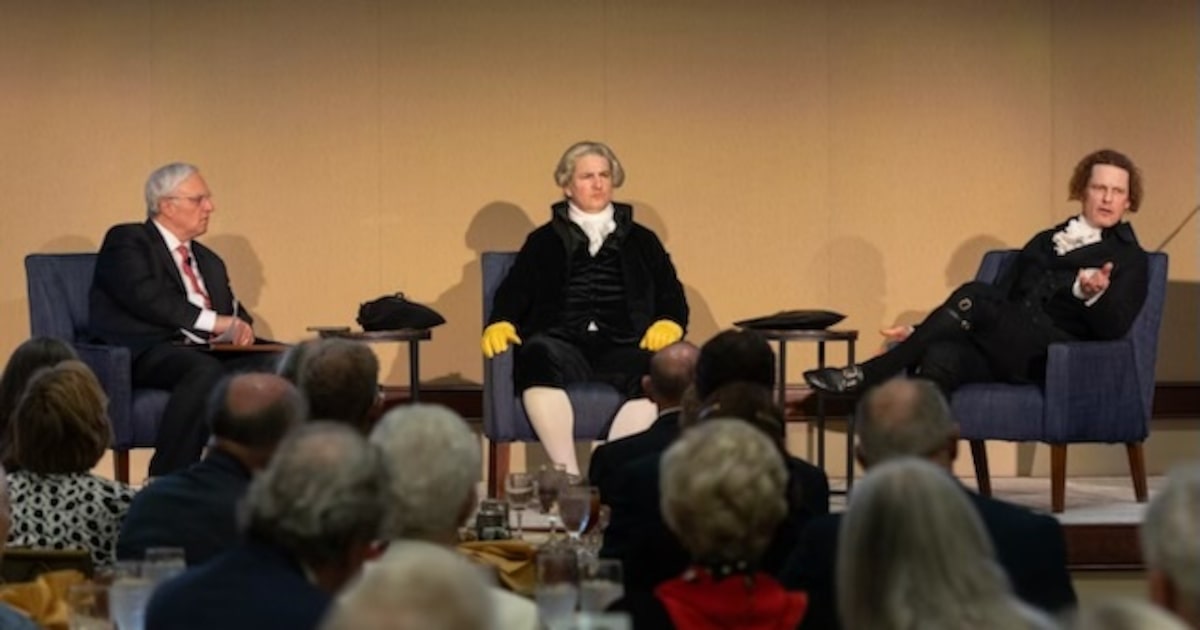
What if we could encounter Washington, who died in 1799, and Jefferson, who died in 1826, as flesh-and-blood men, and ask them questions about their achievements and flaws, face-to-face? This not-so-humble scrivener got to do the next best thing at the “Declaration Dialogue” program that took place on Feb. 24 at the 55th Annual George Washington Dinner sponsored by the Dallas Area Chapter of the civic nonprofit Founding Forward.
Opinion
Washington’s dramatic understudy, Doug Thomas, took the general’s place at the program, and Mr. Jefferson came back to life through his look-alike and act-alike, Steve Edenbo. For the last three decades, Thomas and Edenbo have schooled themselves on every aspect of their subjects by studying the leading biographies of the top two founders. They have delivered compelling presentations to great acclaim at Mount Vernon, Monticello, the National Archives and patriotic events all over the country. Since their answers to my questions were grounded in history, interviewing them was the closest thing I’ll ever get to chatting with the actual founding fathers. Here’s the ground we covered:
I asked them about presidential rhetoric. Neither man was an especially good public speaker at a time when oratory, not rage-tweets, was important to political ambition.
Washington said he listened to others’ positions before he spoke, which usually caused his final words on issues to be more impactful. Jefferson was a dazzling writer and a relentless relationship builder with people on all sides of the spectrum, which allowed him to connect with a broad constituency.
Though both felt regret over their ownership of slaves, they wouldn’t accept or promote any other source of labor to do the work necessary for their plantations to grow crops. Thus, they let their financial needs prevail over their moral consciences. This ultimately gave Washington such torment that in his final days, he changed his will so that his slaves would be freed upon his death. And Jefferson, in his final years, freed the slave children he fathered with Sally Hemings, while Sally became freed after Jefferson’s death.
Regarding the interwoven and, in places, conflicting relationship between the Declaration of Independence and the Constitution, they explained the Declaration was the “hypothesis” upon which the revolution and future American government were based. After the war was won, the hypothesis became the full “American Experiment” that was encapsulated in the Constitution.
They had totally opposite opinions of Alexander Hamilton. Washington viewed Hamilton as a battle-tested colleague who had been by his side during the war and had skills in developing economic policy that Washington knew he lacked. Hamilton’s ego and desire for a strong presidency made Jefferson believe Hamilton preferred having a king over a president, which would lead to a reimplementation of the British system that the new nation had rejected in the Declaration of Independence.
After being friends and political colleagues for decades, the two men’s relationship soured during Washington’s presidency because of their conflicting feelings toward Hamilton and their disagreement about the need for political parties, which Washington opposed and Jefferson favored. Both men regretted their failure to reconcile before Washington died.
I asked the men about their legacies. Washington hoped he would be remembered for having led the nation by the principles covered in his Farewell Address: the necessity to maintain national unity, avoid self-destructive partisan conflict, minimize foreign entanglements in our global affairs, keep the nation out of debt, and abide by the Constitution. Jefferson hoped he would be remembered as the primary author of the Declaration of Independence, architect of the Louisiana Purchase, and leader of the nation during its formative years, when compromise and mutual respect for people’s conflicting views made government work.
Having studied American presidents for many years, at the end of the evening, I felt the conversation was an accurate representation of what might happen if we were able to raise Washington and Jefferson from the grave in 2026.
History travels along many different paths that lead to the kingdom of knowledge. It’s found in well-researched books, impartial documentaries, insightful lectures by scholars and sometimes getting answers to questions from unusual but reliable sources.
We welcome your thoughts in a letter to the editor. See the guidelines and submit your letter here.
If you have problems with the form, you can submit via email at letters@dallasnews.com