
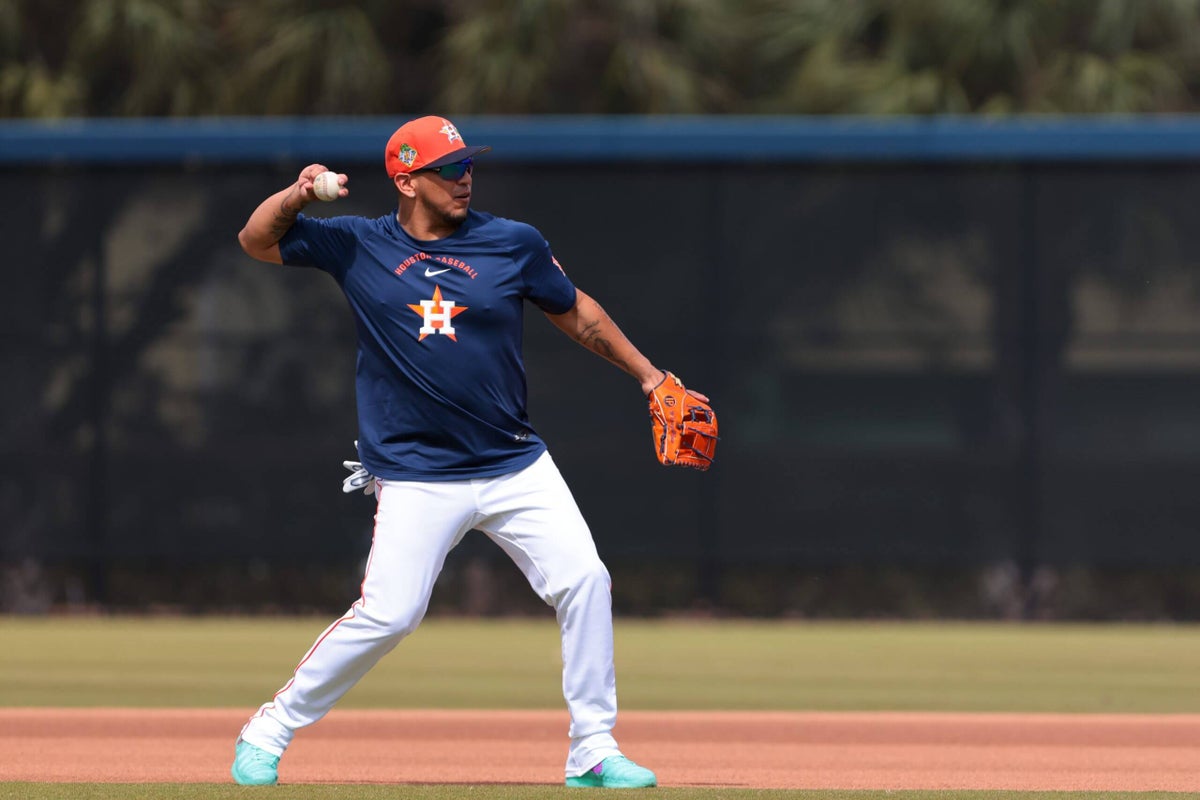
WEST PALM BEACH, Fla. — The Houston Astros’ infield surplus is untenable. General manager Dana Brown needs to resolve it by Opening Day, or he will create tension in his clubhouse and put manager Joe Espada in an uncomfortable spot.
The necessary move is to trade third baseman Isaac Paredes for a left-handed-hitting outfielder, an idea the Astros have discussed most thoroughly with the Boston Red Sox, according to people briefed on the discussions. Talks stalled, however, and the clubs have not been in recent contact.
Brown, after saving more than $6 million by trading outfielder Jesús Sánchez to the Toronto Blue Jays for outfielder Joey Loperfido on Feb. 13, signaled his desire to make at least one more deal.
“We’re not done yet,” Brown said. “This is just one of those moves that we’re locking into as we continue to focus on left-handed bats and the future of this organization.”
Now, Brown must follow through. He and Espada are in the final years of their contracts. Owner Jim Crane, forever hellbent on winning, is not likely to accept an explanation of, “Sorry, Jim, no trade made sense,” if an overstuffed infield creates any form of dissension and compromises the club.
When baseball people talk about a surplus, they often say things have a way of working themselves out. Brown is essentially adopting such a position, saying the Astros can create enough at-bats for Paredes, Christian Walker, Jose Altuve, Carlos Correa and Yordan Alvarez. Barring an injury — hardly the desired solution — the team could be looking at a mess.
As Correa memorably said on Feb. 13, “I’m not a GM, but I know that only four infielders can play at one time.” Correa will be at third. Jeremy Peña is entrenched at short. Altuve is back at second. Walker, who is owed nearly twice as much as Paredes over the next two years and is more difficult to trade coming off a down season, is at first.
Alvarez, of course, is the DH, though the Astros again plan to play him some in left field. Where this leaves Paredes, assuming everyone stays healthy, is anyone’s guess. Neither he nor Espada is about to complain publicly. Part of Brown’s problem is that the entire industry is aware of the Astros’ logjam. It has cost him leverage.
True, Walker turns 35 later this month, Altuve 36 in May. Alvarez, 29 in June, appeared in only 48 games last season due to hand and ankle injuries. Correa, 31, lost two free-agent deals during the 2021-22 offseason because of long-term concerns about his health. Paredes, 27, missed nearly two months in the second half of last season with a severe right hamstring strain, prompting the deadline trade for Correa.
“We do have veteran players,” Brown said. “We have guys like Altuve, who doesn’t have to play second base all the time. We can put him in left field, at DH. The at-bats are there. We have to give guys proper rest. The way I calculated the scenario, these guys could play 120-145 games, depending on how they are physically. That’s a lot of games.”
Tell that to Altuve, who is 612 hits short of 3,000; he has played 153 and 155 games the past two seasons and said on multiple occasions this spring that he wants to approach those totals again. Tell it as well to Paredes, who signed a one-year, $9.35 million contract with a $13.35 million club option to avoid arbitration, but surely does not want to risk diminishing his value when he is two years away from free agency. Under the current setup, Penã and Alvarez are the only Astros likely to be in the lineup most days.
The strength of the Astros’ infield compared to the outfield is not the most lopsided in the league; that distinction, based on projected fWAR totals, belongs to Kansas City, with Philadelphia, Baltimore, Tampa Bay, Cincinnati, San Francisco and Toronto all facing greater disparities than Houston. Still, center fielder Jake Meyers is the only Astros outfielder with more than two years of service time. Loperfido, Zach Cole and Cam Smith all remain unproven.
The Red Sox, even after acquiring Caleb Durbin from Milwaukee, still look like the best fit for Paredes — they could play him at third and Durbin at second without needing to rely on Marcelo Mayer. The Astros are not getting back Wilyer Abreu, whom they traded in 2022 for catcher Christian Vázquez. A deal constructed around Jarren Duran should remain within reach. By moving Duran, the Red Sox would create DH at-bats for Masataka Yoshida and eventually Triston Casas, who could return in May from a ruptured patellar tendon in his left knee.
The problem is that the Red Sox’s trade for Durbin improved their negotiating position while weakening the Astros’. Brown, then, might need to get creative, possibly involving a third team, possibly pivoting from the Red Sox entirely.
The St. Louis Cardinals have two left-handed hitting outfielders who might interest the Astros, Lars Nootbaar and Alec Burleson. Paredes isn’t a fit for a rebuilding club like St. Louis, so the Astros would need to find a taker elsewhere in a three-team arrangement. That’s the kind of concept Brown should be revisiting. Earlier in the offseason, before the Seattle Mariners acquired utilityman Brendan Donovan, Brown engaged in serious discussions about a deal that would have brought Donovan to Houston and sent Paredes to Boston.
“I don’t know what they’re going to do. I do know Paredes is a big bat that produces a lot,” Correa said. “He walks. He knows the strike zone. He can slug, especially at Daikin Park. And then Walker, you’ve seen what he’s done in Arizona. When he’s healthy, he’s right, he’s tremendous, too.
“You’re going to have play some people in left field, DH some of them and see how it plays out. Also, during the season, things happen where guys miss 10 games here and there. Having the depth is really good. If we can figure out a way to have Yordan, ‘Tuve, Paredes, Walker, me and Peña in the lineup, all of us at the same time, plus Cam Smith and Zach Cole, you’re talking about a legit lineup.”
As Correa said earlier, he’s not a GM. The only way to get the six veterans into the lineup at the same time is if Alvarez plays left field regularly, opening the DH spot, or if Paredes can prove capable of handling second base on occasion, with Altuve moving to left. The Astros are trying Paredes at second this spring, but he hasn’t played the position since 2023 and is not exactly a darling of evaluators at that spot.
Forcing square pegs into round holes is never a desirable strategy. But that’s where the Astros will be unless Brown fulfills his pledge to make another move.
“When I said, ‘we’re not done yet,’ it was with the vision of looking for a potential left-handed bat,” Brown said. “We’ve also been talking about a backup catcher. The ‘not done yet’ is, we’re still in the grind. Even though spring training has started, we’re still in the grind.”
He needs to keep grinding. For the sake of his players and his manager. And for his own sake, too.