

Artificial intelligence is rewriting the rules of getting a first job.
A new report from the Federal Reserve Bank of Dallas finds AI is doing two things at once in the labor market. It is squeezing opportunities for young and entry-level workers in fields most exposed to AI while boosting pay for more experienced employees whose know-how is harder for software to imitate.
The data suggests it is getting tougher to land that first job in industries that rely heavily on AI tools, even as those who build experience and the right mix of skills can eventually benefit from higher pay and more resilient careers.
That tension is what Laura Ward, president and CEO of Workforce Solutions Greater Dallas, University of North Texas President Harrison Keller and Ben Magill, UNT’s chief economic development officer and executive director of the Texas Talent Accelerator, are all seeing from different vantage points in North Texas.
Business Briefing
Ward said national researchers have long documented a basic digital skills divide. Many people are comfortable on smartphones but not with the tools modern jobs rely on, such as email and office software.
“AI adds a layer of complexity to a digital skills divide that’s been here for a long time,” she said.
The Dallas Fed report helps explain why that layer matters for young workers. It draws a line between codified knowledge, which is the textbook material and procedural instructions AI can already master, and tacit knowledge, the judgment and intuition that comes from experience.

The Stargate artificial intelligence data center complex is in Abilene. A new report from the Federal Reserve Bank of Dallas finds AI is doing two things at once in the labor market: squeezing opportunities for young and entry-level workers while boosting pay for more experienced employees.
(Matt O’Brien/File Photo/The Associated Press)
Matt OBrien / AP
For new hires, most of the expert part of the job is codified. They lean on what they learned in class or training. For seasoned workers, those same tasks are often the simplest part of the day. Their real value lies in tacit knowledge, the experience-based work of solving problems, coordinating with others and recognizing patterns.
Magill said conversations with employers in North Texas fit that picture. Some are already testing whether AI can do work that used to fall to junior staff. One employer told him that “AI is absolutely replacing jobs,” and that the company sent a “company wide communication” telling managers, “before you hire anybody, see if AI can do it.”
He said those accounts are not universal across every sector, but they are real enough that the Texas Talent Accelerator wants to study which parts of the regional economy are most affected. Magill also hears from employers who say AI is creating new roles further up the ladder, such as people who “check the work that AI is doing and verify that it’s doing everything correctly.”
AI taking entry-level jobs
That creates a quandary for young workers, Magill said. It leaves workers wondering how they can ever get the experience they need for a higher level job if they cannot start in the kinds of entry-level roles where people used to start before working their way up.
Keller said what he is hearing from employers across North Texas is similar. At a recent UNT conversation with Dallas Fed President Lorie Logan and employers from real estate, health care and banking, he said all of them reported hiring fewer entry-level workers but projecting considerable long-term growth driven by productivity gains tied to automation and AI.
“That is not great news for new and recent college graduates,” Keller said. Employers “expect a new hire to be able to perform more complex tasks.”
If software can take over routine documentation or data entry, it can free up people with tacit knowledge to focus on higher value work. It also means fewer traditional entry-level positions where young workers learned how to apply classroom skills, pick up a company’s culture and start climbing the ladder.
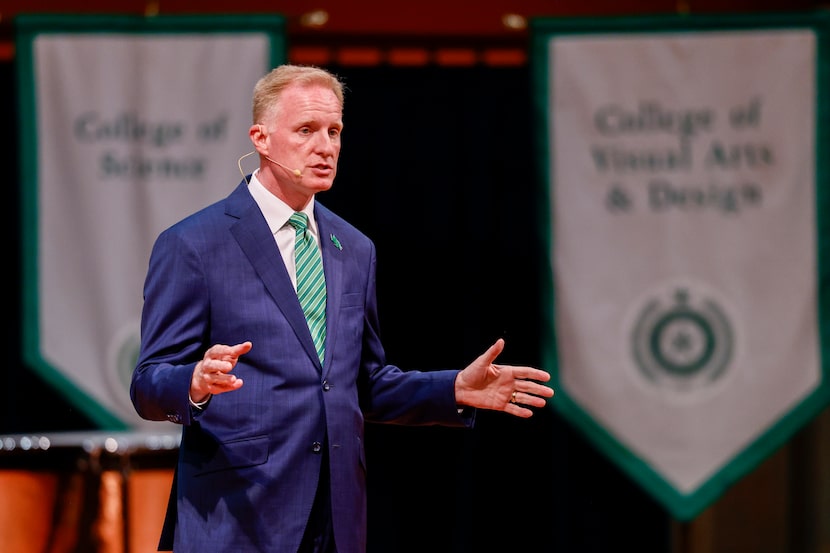
UNT President Harrison Keller said real estate, health care and banking employers all reported hiring fewer entry-level workers but projecting considerable long-term growth driven by productivity gains tied to automation and AI.
(2025 File Photo/Elias Valverde II)
Elías Valverde II / Staff Photographer
Keller said UNT is participating in a new national Work Integrated Learning Accelerator led by Arizona State University to build more meaningful work experiences directly into degree programs, starting with a project in the history department. UNT also plans to have internships integrated into all of their undergraduate degree programs at the G. Brint Ryan College of Business by next year, he said.
The numbers in the Dallas Fed report bear out employers’ concerns. Since the launch of ChatGPT in late 2022, overall U.S. employment has grown, but jobs in the most AI exposed sectors have slipped. Employment in computer systems design and related services has declined even as total employment has risen.
Across the 10% of industries most exposed to AI, employment is down roughly 1% while the broader economy added jobs. That decline has landed mostly on workers under 25, in part because employers are hiring fewer young people into AI intensive roles.
At the same time, wages in AI exposed industries have grown at least as fast as the rest of the economy and, in some cases, far faster. Since late 2022, average weekly wages nationwide have risen about 7.5%, while pay in computer systems design has increased about 16.7%.
Looking across more than 200 occupations, the report finds that in jobs where experience barely affects wages, AI exposure is associated with weaker wage growth. In jobs where experience commands a large premium, AI exposure is associated with stronger wage growth.
Magill said that is why the accelerator will not rely on data alone. He wants “more consistent dialog with employers” to test what the numbers show against what companies see inside their workplaces. He then wants to share what he hears with educators and workforce leaders so the region is “more aligned with the labor market.” That matters because even the best labor market data can lag reality by months or years.
Job skills that AI can’t replicate
Keller said employers are also pushing harder on skills that are harder to automate. That is true for technical capabilities in fast changing fields and for what he and Ward both call durable skills that travel across jobs. Ward said those include “critical thinking, character, mindfulness, metacognition, leadership, persistence, team motivation and self discipline.”
Magill said employers often know which technical skills they need, but are more concerned that students are having trouble with communication or problem solving.
Those human skills matter because the hiring process itself is changing. Online applications and automated screening tools can filter out candidates who miss a keyword, even if they might succeed on the job. Magill said that’s why “networking is even more important than ever,” so young workers are not relying only on filtered postings and algorithms to be seen.
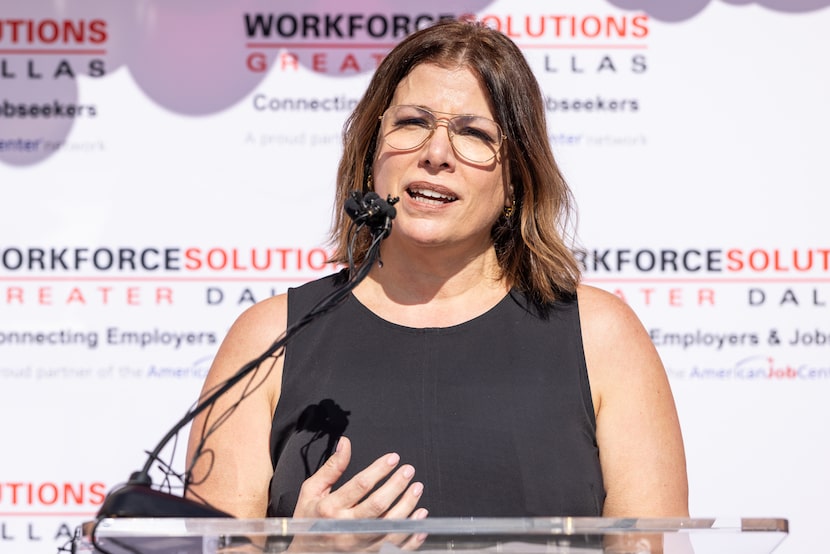
Laura Ward, Workforce Solutions Greater Dallas president and CEO, said the need for durable skills persists. Ward said those include “critical thinking, character, mindfulness, metacognition, leadership, persistence, team motivation and self discipline.” (Angela Piazza/Staff Photographer)
Angela Piazza / Staff Photographer
Ward sees similar shifts in frontline jobs. In Dallas County, she said, many entry level roles now require a baseline of digital comfort as AI and automation spread through advanced manufacturing, logistics and health care.
“When the technology is not working properly, someone has to go in and fix that,” she said. “Being able to troubleshoot and navigate when things are not working the way they should requires the level of digital skills that a lot of people are struggling to find.”
Developing AI skills for the workforce
Workforce Solutions Greater Dallas wants to make digital learning a standard part of the experience for job seekers, through computer labs at its job centers and partnerships such as the Goodwill Community Foundation’s free online training.
UNT is making similar bets inside the classroom. The university launched the first master’s degree in artificial intelligence in Texas and is standing up a bachelor’s degree in AI. It also offers AI certificates at both the undergraduate and graduate levels so students in any major can add a credential.
Keller said the key for students is learning which AI models fit which tasks, how to write useful prompts and how to check results for errors. Some UNT faculty require students to use AI tools in their courses for exactly that reason.
Higher education and industry will have to work together “across the traditional institutional boundaries” to keep up, Keller said.
“It feels like we are just on the front edge of what could be the greatest disruption in our economy since the industrial revolution,” he said. “There is going to be a lot of hard lessons learned along the way.”
This reporting is part of the Future of North Texas, a community-funded journalism initiative supported by the Commit Partnership, Communities Foundation of Texas, The Dallas Foundation, the Dallas Mavericks, the Dallas Regional Chamber, Deedie Rose, Lisa and Charles Siegel, the McCune-Losinger Family Fund, The Meadows Foundation, the Perot Foundation, the United Way of Metropolitan Dallas and the University of Texas at Dallas. The News retains full editorial control of this coverage.
Texas leaders link state’s growth to child care, skills and adaptable workersBank of America invests $1M in North Texas job skills programs