
When the Texas Department of Transportation pledged up to $25 million for a new boardwalk along Lady Bird Lake, the offer seemed simple: a long-desired safety upgrade on Austin’s busiest trail paid for by the state as part of the I-35 expansion.
Nearly three years later, construction still hasn’t begun. And now TxDOT is warning the city of Austin it must accept the terms of an agreement or risk losing the project altogether.
A KUT News review of thousands of pages of emails and other documents obtained under the Texas Public Information Act helps explain how negotiations got to this point.
Records show a power struggle over who would control the project, who would receive the money and how much authority a nonprofit partner should have in shaping a major decision involving public land.
Why a boardwalk?
Manoo Sirivelu
/
KUT News
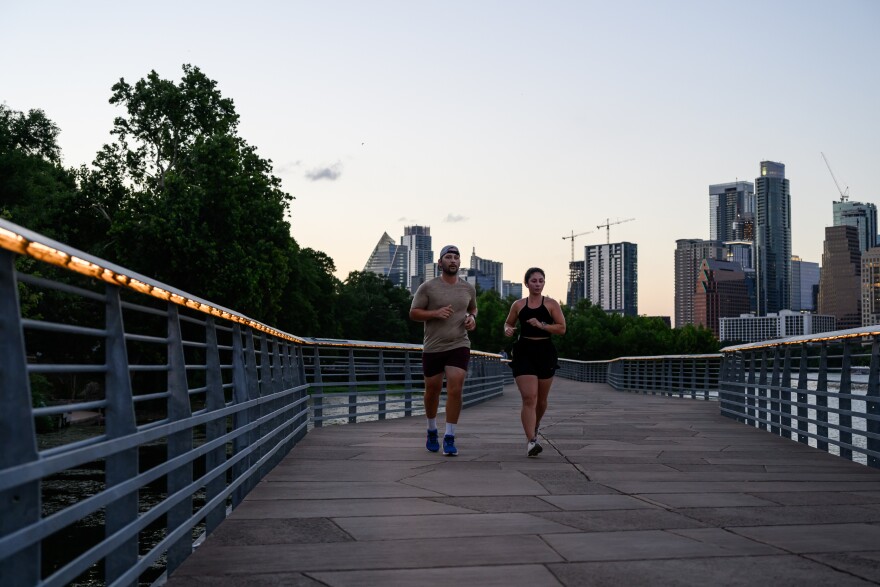
David Hope and Adria Saldivar run along the boardwalk that opened in 2014. The $28 million project was mostly funded with city property taxes and constructed as a public-private partnership with the Trail Conservancy.
The boardwalk would run along the south shore of Lady Bird Lake between South First Street and South Congress Avenue, where the Ann and Roy Butler Hike and Bike Trail narrows in front of the Hyatt Regency. A residential tower, One Lady Bird Lake, is under construction there now.
TxDOT has described the boardwalk as “over and above” what is legally required mitigation under the $4.5 billion I-35 Capital Express Central Project. The highway expansion is permanently absorbing about 0.8 acres of parkland and temporarily occupying another 2.5 acres during construction.
For some East Austin residents living near the parkland directly affected by the I-35 expansion, the boardwalk’s location never made sense.
“We are looking at funds being allocated to a different area,” said Bertha Delgado, president of the East Town Lake Citizens Neighborhood Association. Some of the impacted parkland bears her grandfather’s name, Edward Rendon Sr. “It’s not a fair system.”
Paul Saldaña, a founder of Hispanic Advocates Business Leaders of Austin, said the boardwalk reflects a familiar pattern of investment flowing west of the highway.
“I think this is another yet example of how we’re not taking into consideration the immediate needs east of I-35,” Saldaña said.
Behind the scenes, city parks officials were questioning whether the boardwalk was needed at all, even as TxDOT and the Trail Conservancy (TTC) — the nonprofit that operates and maintains the Butler Trail under a contract with the city — were trying to push it forward with limited city involvement.
How it started
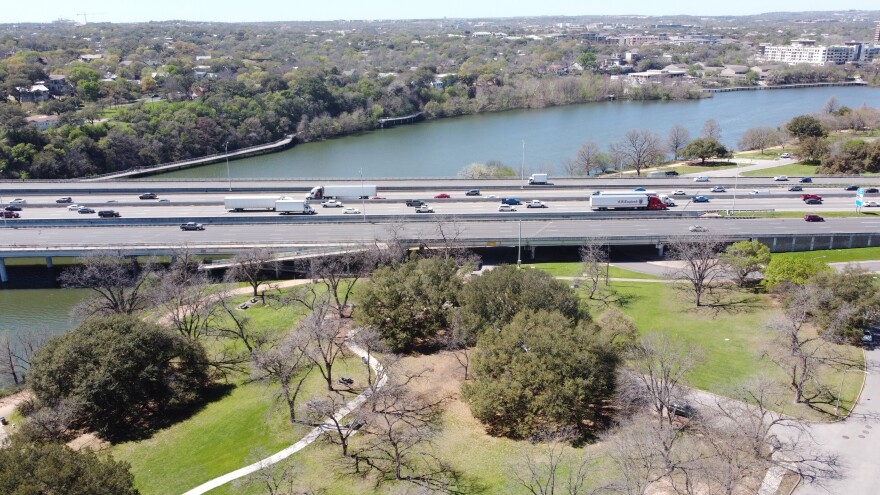
TxDOT is rebuilding the I-35 bridge over Lady Bird Lake to make it wider. The project requires using public parkland, some of it permanently.
The idea gained momentum in early 2023.
In March of that year, TTC board member Matt Harriss emailed Tucker Ferguson, the engineer overseeing TxDOT’s Austin district, after reading online reactions to a KUT News story about parkland being absorbed into the highway’s footprint.
“Tucker – can we visit re this when you have a moment?” wrote Harriss, who’s also a CapMetro board member and served as chief financial officer of the Butler family’s estate. “Have a couple of ideas that will get TxDOT the space it needs and yet preserve the Trail long term.”
Within days, TxDOT officials were meeting with TTC leaders.
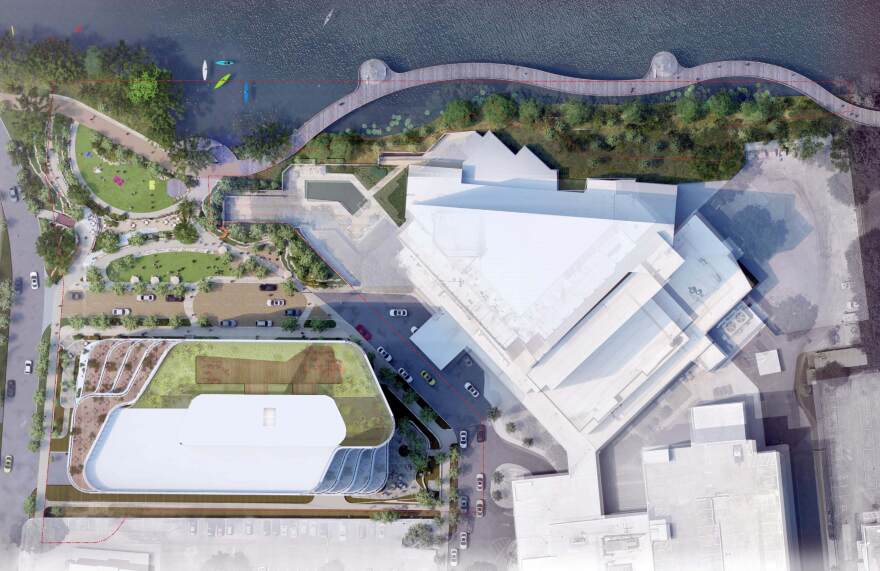
The nonprofit pointed to a 2021 safety and mobility study that identified the Hyatt stretch as a pinch point. In 2022, TTC had developed a concept for the boardwalk with Related Companies, the developer now building One Lady Bird Lake.
The Trail Conservancy
/
Related Companies
This “proposed concept plan” for the boardwalk was developed by the Trail Conservancy with the developer of One Lady Bird Lake, New York City-based Related Companies. The Trail Conservancy shared this graphic with TxDOT’s Austin District in May 2023, saying it was greatly needed.
By May 2023, TxDOT was briefing city department heads. In July, Mayor Kirk Watson listed the boardwalk in a letter to opponents of the highway expansion. The following month, the project appeared in TxDOT’s final environmental study.
What wasn’t public was how the money would move.
A ‘unique potential agreement’

Two people strolling the Butler Trail at Vic Mathias Shores on a hot summer day. The 10-mile loop is Austin’s most popular trail, drawing an estimated 5 million visits per year.
Internal emails show that in late 2023, TxDOT’s Austin district and TTC staff planned to route the $25 million directly to the nonprofit, even though the city owns most of the Butler Trail and the underwater land where the boardwalk would be built.
TxDOT’s Austin district staff described this as a “unique potential agreement” in emails to TxDOT’s contract division.
TTC’s then-CEO Heidi Anderson wrote to TxDOT engineer Heather Ashley-Nguyen that she had been working with the Parks Director Kimberly McNeeley, and that McNeeley had “informally agreed (yay!)” to the nonprofit leading the project.
But inside TxDOT’s statewide headquarters, contract staff were raising red flags about the agency contracting directly with a nonprofit.
Emails from the Austin district reflected frustration at the prospect of routing the money through the city instead.
“Forgot we might have to give the boardwalk money to [the city of Austin] and not the Trail Conservancy…. Ugh,” Ashley-Nguyen wrote in October 2023.
Asked about that email, TxDOT spokesperson Brad Wheelis told KUT News that working directly with TTC would have been a “more streamlined process than going through the formal city council process.”
Ultimately, the plan collapsed.
“We need to involve a local government,” Ken Stewart, an attorney who leads TxDOT’s contract unit, explained to the Austin District in Jan. 2024. “We cannot just pick the Non-Profit because we do not have authority to just go pick firms to do business with.”
TxDOT’s Austin district and TTC worked to find a new way to direct the $25 million that would technically involve the city, but avoid routing the money through the Parks Department or City Council.
A new path for the $25 million
Michael Minasi
/
KUT News
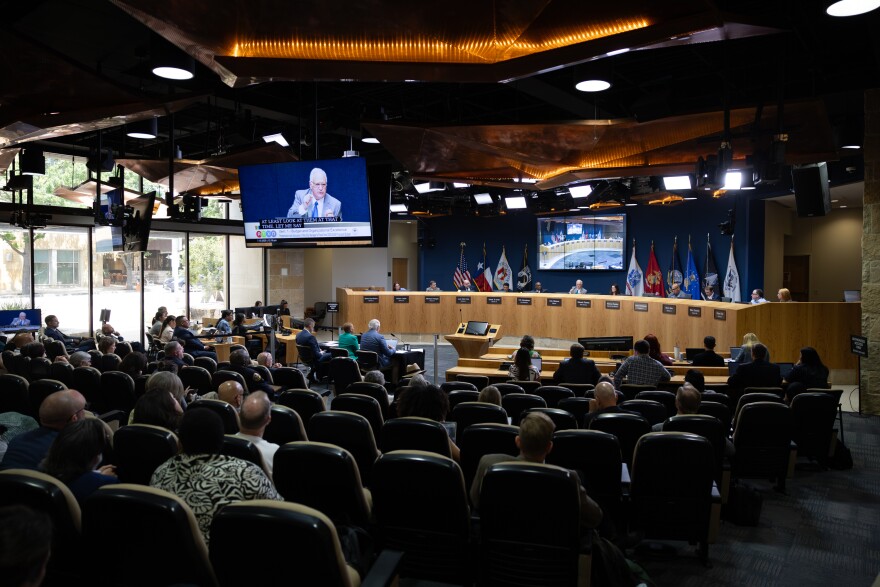
For more than two years, TxDOT and TTC explored ways to route the $25 million to the nonprofit in a way that would avoid any City Council vote. Now, TxDOT says the council can accept the agreement as is or the boardwalk project will be canceled.
Around the same time, TTC was undergoing leadership changes. Anderson stepped down as CEO at the end of 2023. Five months later, the nonprofit announced that McNeeley, Austin’s Parks director, would become its new leader.
As TTC’s CEO, McNeeley played a leading role in advancing the boardwalk, emails show. But she would resign after less than six months. McNeeley did not respond to requests for comment.
Meanwhile, a new passthrough funding structure emerged.
Under the plan, TxDOT would send the $25 million to the Austin Public Facilities Corporation, a city-created entity with more flexibility than a typical city department. The APFC would then transfer the funds to TTC, again avoiding Austin Parks and Recreation or the City Council.
TTC presented the proposal to the APFC board of directors in July 2024.
“[The boardwalk] would not be feasible as a city of Austin project,” TTC’s chief marketing officer Mandi Thomas told the board. She said TxDOT chose TTC in part to save on project management costs and because the nonprofit had carved out enough staff to start the work.
“TxDOT’s budget for this project is based on TTC being the project manager,” Thomas said.
TTC told KUT News that it can deliver projects faster than the city, which reduces inflation costs. The nonprofit argued that its staff capacity could help move the boardwalk forward more efficiently while still following the required city permitting and approval processes.
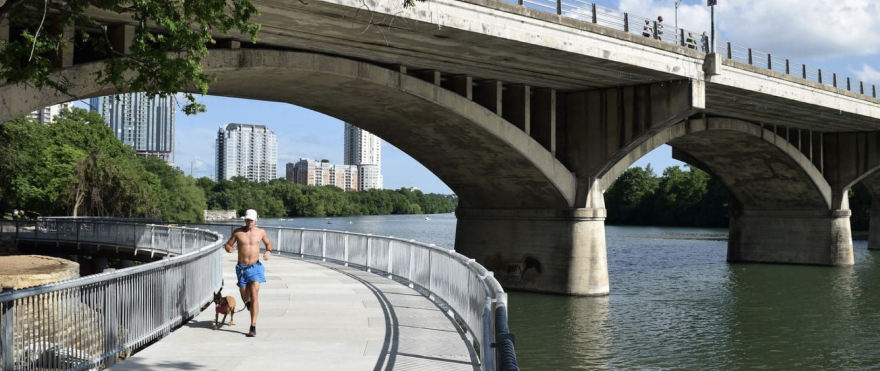
A trail bridge along the north shore of Lady Bird Lake, completed in May 2018. The image was presented to APFC as one several major trail projects overseen by TTC.
The APFC board said it would vote on the plan at its next monthly meeting. It did not.
The boardwalk plan would stay on ice for months.
Parks staff thought TTC was “misleading” TxDOT
While those discussions were underway, senior staff inside Austin Parks and Recreation were still trying to understand what had been decided.
In July 2024, Parks Manager Ricardo Soliz wrote to Assistant Parks Director Liana Kallivoka that the $25 million boardwalk plan was “news to me,” adding that TxDOT was “dictating the [mitigation] without our input.”
Soliz, after meeting with McNeeley in her capacity as the new TTC CEO, wasn’t even sure who would own the boardwalk after it was built.
As Kallivoka reviewed the environmental documents for the I-35 project, she found a memo from TTC telling TxDOT its contract with the city had “transferred to TTC the primary day-to-day stewardship” of the trail and surrounding Town Lake Metropolitan Park.
“This statement is misleading, in my opinion,” Kallivoka wrote. “TTC, in effect, eliminated [Parks and Recreation’s] input and involvement. How on earth!”
By January 2025, Kallivoka went further. In internal emails, she wrote the Parks Department “does not not see a need for the boardwalk.” Kallivoka argued a land donation tied to approval of the One Lady Bird Lake project could widen the trail without building over water.
Austin Parks and Recreation now says that land donation will be used to straighten and widen the existing trail next to the Hyatt.
“The boardwalk will be additive to the stretch of trail,” Austin Parks and Recreation Dan Manco told KUT News.
Parks staff even asked TxDOT to redirect the $25 million to high-priority parks projects. Those include a plan City Council approved in 2014 to upgrade some of the same parkland affected by the I-35 expansion.
They were ultimately unsuccessful.
Where things stand now
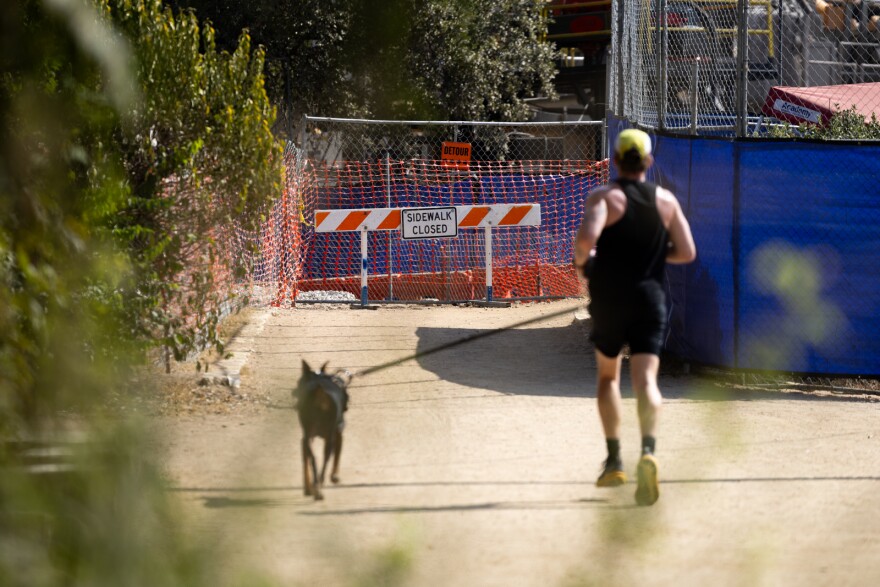
Construction on the One Lady Bird Lake development has affected sections of the trail close to where the boardwalk would go. TTC had originally hoped to get the boardwalk built while this construction was underway.
Since then, the path for the $25 million has changed again.
Now, the money is expected to flow through Austin Parks and Recreation, which would contract with TTC to design and build the boardwalk.
The city would own the boardwalk after it’s built.
The city’s agreement with TTC will “include milestones and accountability to ensure the project is designed and delivered in a way that meets required expectations,” the Parks Department said in a statement.
The agreement with TTC for design and construction of the boardwalk would require City Council approval, Austin Parks and Recreation spokesperson Kanya Lyons said.
TTC told KUT News it works closely with Austin Parks and Recreation to support the safety of all Butler Trail users.
“TTC serves as a collaborative partner and advocate for the City,” the statement said. “As with all TTC capital projects, TTC must follow City of Austin processes and code requirements and obtain final City approval, and this project is no different.”
But TxDOT has drawn a line, saying the City Council can accept the deal as written or walk away from the $25 million entirely.
“If the city elects to not sign the [funding agreement] for the boardwalk with TxDOT, the mitigation will be removed,” Ferguson wrote to Mayor Watson on Feb. 5.
TxDOT’s funding agreement appears to leave the city on the hook for any boardwalk costs that exceed $25 million. Parks Director Jesús Aguirre said at a public meeting in March 2025 that he had hoped to avoid such an arrangement “to make sure that the department isn’t taking capital dollars away from somewhere else to fund that.”
TTC told KUT News that if it serves as a project manager and total costs exceed $25 million, the nonprofit — not the city — would be responsible for security additional funding, for example, through private or philanthropic dollars.
TxDOT says if the boardwalk costs less than $25 million, it would keep the extra funds.
There is still no timeline for when the boardwalk would be constructed.