
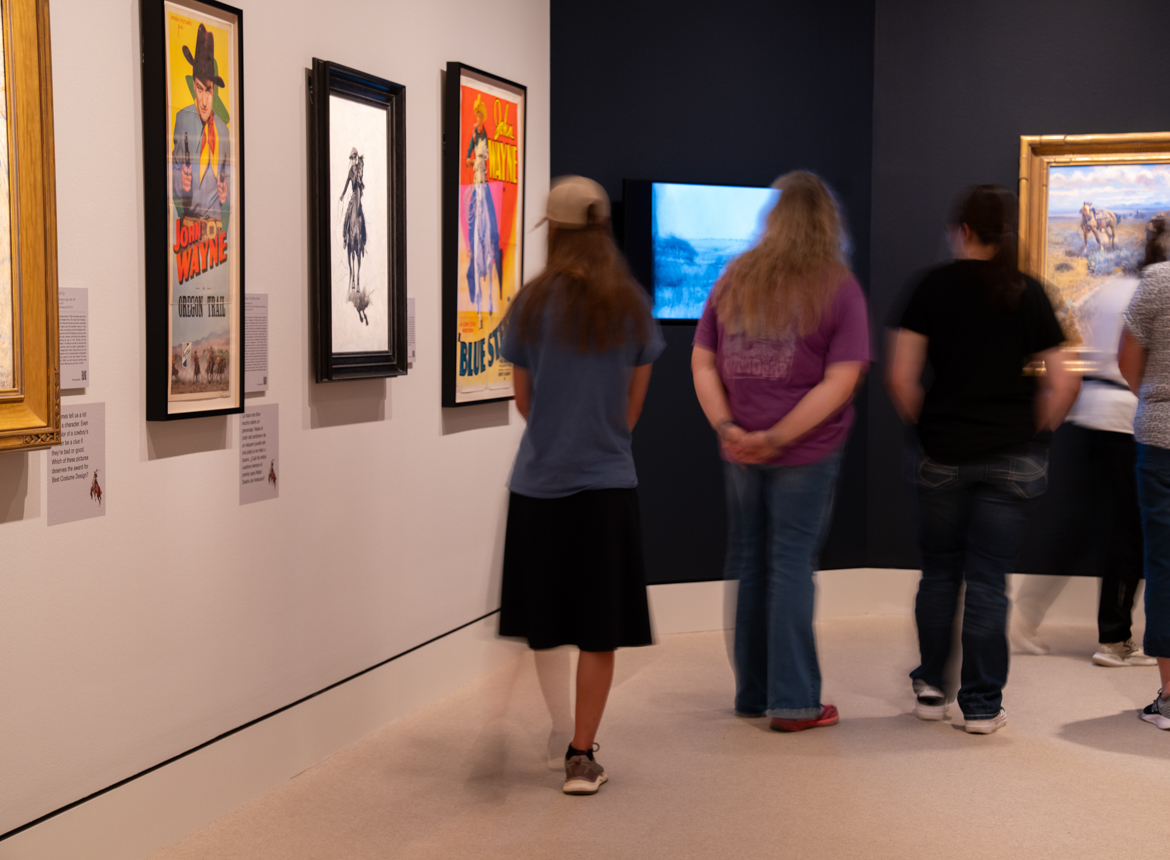
Before there was John Ford and John Wayne on the silver screen, there was Charles Russell and Frederic Remington on canvas and in bronze. Before stories of the American West were brought to life in moving pictures, its mythology was spread through paintings, illustrations, and sculptures. So when filmmakers first set out to tell stories of the American West on screen, they had ample sources from which to draw inspiration.
The Sid Richardson Museum’s current exhibit, The Cinematic West: The Art That Made The Movies, tells the story of Western art’s influence on early silent Western films by pairing works from the museum’s permanent collection with rare silent film footage, vintage movie posters, and Hollywood memorabilia. Every piece offers its own rich story and insight into the fascinating connection between Western art and cinema.
On display through April 20, 2026, The Cinematic West: The Art That Made The Movies is a must-see for any fan of Western art, film, or American history.
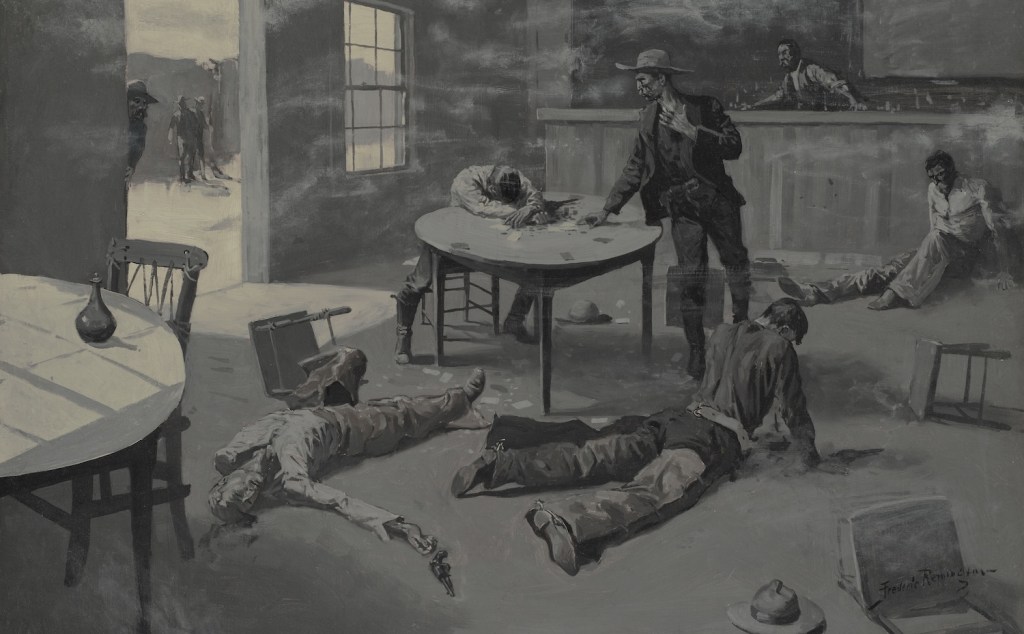 A Misdeal, Frederic Remington, Oil on canvas, ca.1897, Private Collection
One Painting’s Substantial Influence
The exhibit’s centerpiece painting, A Misdeal by Frederic Remington, serves as a perfect example of Western art’s direct influence on Hollywood.
Depicting the aftermath of a card game gone wrong, the painting is a captivating scene of violence and implied betrayal set in a smoke-filled saloon. A Misdeal invites its viewers to use their own imagination and understanding of frontier life to conjure up the rest of the story themselves.
The scene depicted in A Misdeal provided inspiration for countless saloon shootouts in Western cinema throughout the 20th century. In this instance, the painting is woven into the film’s story.
Take for instance John Ford’s 1918 silent film Hell Bent, which begins with a novelist receiving a letter requesting that his next story’s hero should be “a more ordinary man, as bad as he is good.” The character is then seen studying a re-creation of A Misdeal when the camera zooms in on the painting, and suddenly, its subjects come to life.
The film’s story picks up where the painting leaves off, taking viewers on a journey filled with complex heroes, criminals, and corruption in the American West. This narrative structure not only puts Western art at the center of its story, but also highlights the cyclical nature of Western legend, artist depiction, and public perception of life on the frontier.
The painting’s ownership also tells its own compelling story of influence. First painted and sold in 1897, the painting was purchased by Western film star Douglas Fairbanks at an unknown date. Fairbanks and his estate likely owned the painting for at least 20 years before it was sold in 1953 to Hal Wallis—a producer of several blockbuster films, including The Maltese Falcon, Casablanca, Gunfight at the O.K. Corral, and True Grit. The painting was again featured prominently in the final scenes of the Wallis-produced 1961 film All in a Night’s Work, starring Dean Martin and Shirley MacLaine.
Western Stories Recapturing America’s Attention
While firsthand accounts and legends of life in the American West inspired countless works across artistic mediums, over a century’s worth of Western cinema has shaped our collective understanding of that era in our history.
As the success of shows like Yellowstone and 1883 bring cinematic depictions of the American West back into the mainstream, The Cinematic West offers an opportunity to explore the roots of Western art, cinema and the impact they’ve had on our cultural consciousness.
Modern depictions of the West often challenge older tropes, offering more nuanced portrayals of Indigenous peoples and frontier women, as well as more critical depictions of the heroes’ motivations. However, they still borrow heavily from the visual style and storytelling traditions established well over a century ago by the Western artists and filmmakers featured in The Cinematic West: The Art That Made The Movies.
To explore The Cinematic West, visit the Sid Richardson Museum in downtown Fort Worth before the exhibit closes on April 20, 2026. The Sid Richardson Museum is open to the public daily, except on major holidays, and admission is always free.
About The Sid Richardson Museum
The Sid Richardson Museum is an art museum located in Fort Worth’s historic Sundance Square, featuring permanent and special exhibitions of paintings by premier Western artists. The Sid Richardson Museum educates, engages, and inspires its visitors to find meaning and enjoyment in exploring artists’ depictions of the American West.
This <a target=”_blank” href=”https://fortworthreport.org/2026/03/05/explore-western-art-and-hollywood-history-through-the-cinematic-west/”>article</a> first appeared on <a target=”_blank” href=”https://fortworthreport.org”>Fort Worth Report</a> and is republished here under a <a target=”_blank” href=”https://creativecommons.org/licenses/by-nd/4.0/”>Creative Commons Attribution-NoDerivatives 4.0 International License</a>.<img src=”https://i0.wp.com/fortworthreport.org/wp-content/uploads/2021/04/cropped-favicon.png?resize=150%2C150&quality=80&ssl=1″ style=”width:1em;height:1em;margin-left:10px;”>
<img id=”republication-tracker-tool-source” src=”https://fortworthreport.org/?republication-pixel=true&post=427049&ga4=2820184429″ style=”width:1px;height:1px;”><script> PARSELY = { autotrack: false, onload: function() { PARSELY.beacon.trackPageView({ url: “https://fortworthreport.org/2026/03/05/explore-western-art-and-hollywood-history-through-the-cinematic-west/”, urlref: window.location.href }); } } </script> <script id=”parsely-cfg” src=”//cdn.parsely.com/keys/fortworthreport.org/p.js”></script>