
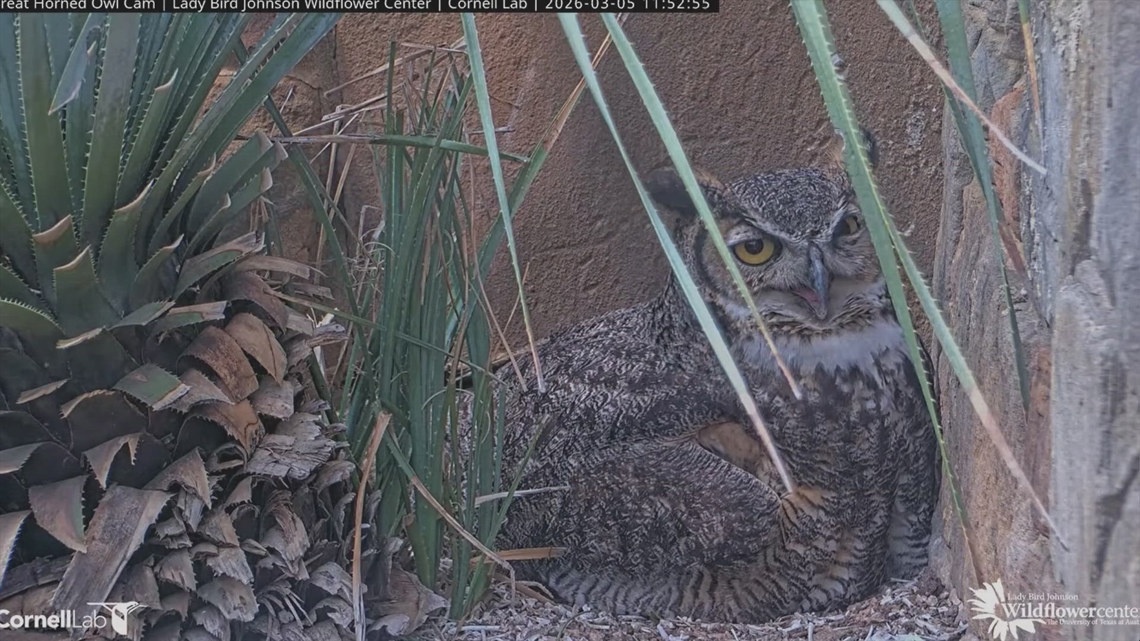
The great horned owl laid her first egg of the year on Thursday, according to the center.
AUSTIN, Texas — One of Austin’s well-known feathered animals has officially returned.
Athena the great horned owl flew back to the Lady Bird Johnson Wildflower Center on Wednesday for the 16th year in a row. She laid her first egg of the year at around 1:30 a.m. Thursday in a planter above the courtyard entrance.
Each year, Athena can be seen on a livestream set up in partnership with the Cornell Lab of Ornithology, which is part of Cornell University. The camera is displayed less than 10 feet away from Athena’s nest and uses infrared technology, according to the center.
“Athena has become part of the spring experience at the Wildflower Center,” the center’s executive director Lee Clippard said in a statement. “What began as a remarkable wildlife moment has grown into a shared tradition. Through our partnership with the Cornell Lab of Ornithology, people around the world can experience this front-row seat to nature. It’s inspiring, it’s educational and it’s deeply moving.”
The center said Athena typically lays two eggs annually, roughly three days apart, but great horned owls can lay up to four per year. Last year, Austin Mayor Kirk Watson named Athena as the city’s Official Owl Ambassador.
The iconic Austin owl returned to the center roughly one year ago on March 5, laying her first egg the following day. Her owlets hatched roughly one month later before leaving the nest for good.
Athena was first seen at the wildflower center back in 2012, then returned in 2015, when she laid three eggs. In 2019, she only laid one egg, but has laid two ever since. The center said Athena raised her owlets each year, except for once when “she abandoned her nest and eggs.”
About great horned owls
Great horned owls can be seen in most of North America, including in Texas. They can also be found in portions of Central and South America, and they typically live in places including forests, farmland and sometimes city parks.
Despite their name, these animals don’t have horns; instead, they have ear tufts atop their heads. They typically hunt prey at night, consuming animals like mice, rabbits, squirrels and ducks, and occasionally cats and small dogs.
Females typically weigh between 3-4 pounds, while males are slightly smaller, weighing about 2-3 pounds, according to the International Owl Center.
They typically live to be about 13 years old in the wild but can live longer in captivity.