
Editor’s note: To view this story as it appeared in Community Impact’s February Northwest Austin print edition, click here.
City of Austin officials held a groundbreaking March 5 to kick off efforts to redevelop Burnet Road with $64 million worth of various safety and mobility improvements, marking a major milestone for the corridor project.
The overview
The project is slated to reach completion in three segments between mid-2027 and late 2028, bringing upgraded traffic signals, pedestrian and bike infrastructure, bus stop improvements, and more.
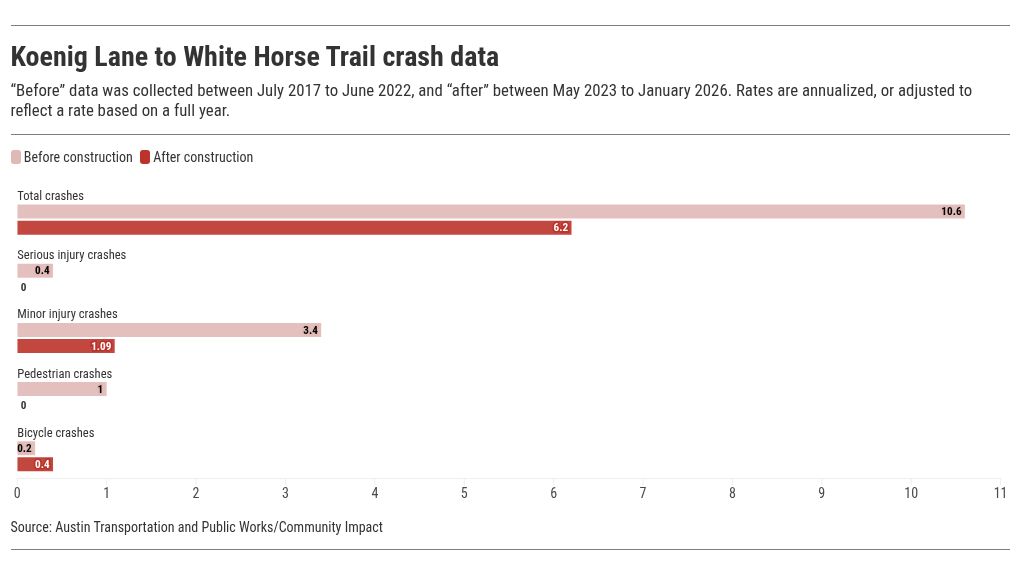
The segment from Koenig Lane to White Horse Trail was completed three years ago and has shown a reduction in crashes in the area following construction, according to city of Austin data.
Austin’s 2016 Mobility Bond allocated $482 million toward corridor improvements across the city, with Burnet Road being one of the nine corridors identified.
City officials had a rough concept of what improvements to make on Burnet prior to the passage of this bond as the roadway is notably missing proper drainage infrastructure, sidewalks and bike facilities, said Anna Martin, assistant director of Austin’s Transportation and Public Works department.
“Burnet Road has been experiencing a lot of growth and redevelopment over the past decade or so,” Martin said. “Especially north of [US] 183, it very much feels like an old highway. … Knowing the kind of development that was happening, this was put in the queue for mobility improvements. So it’s really taking what is an old state highway and bringing it up to urban standards.”
“>
Breaking it down
According to TPW, Segment C2 is slated to cost $12 million, with construction lasting from February 2026 to July 2027. Key improvements will include traffic signal upgrades at the White Horse Trail, Justin Lane/Pegram Avenue, Northcross Drive/St. Joseph Boulevard and Anderson Lane intersections.
C3 is slated to cost $29 million, with construction lasting from June 2026 to December 2028. Key improvements will include intersection and traffic signal improvements at Bright Verde Way, Braker Lane, Kramer Lane, Esperanza Crossing, Solaris Street, Palm Way, Gault Lane and Gracy Farms Lane.
C4 is slated to cost $23 million, with construction lasting from March 2026 to October 2027. Key improvements will include intersection and traffic signal improvements at Research Boulevard, Waterford Center Boulevard, Longhorn Boulevard and Rutland Drive.
Each segment is expected to see other safety and mobility improvements, including:
8-foot-wide shared-use pathsAccessible bus stops and other safety improvementsLandscape enhancementsDrainage improvementsDriveway reconstructionSomething to note
Improvements between Koenig Lane and White Horse Trail were completed in 2023 as part of the mobility program. Work included bus stop improvements, traffic signal upgrades, new turn lanes, shared-use paths and improved crossings.
According to Martin, the area has seen a 42% decrease in crashes post-construction compared to pre-construction data collected between 2017-22.
The city of Austin has also saved $1.7 million in comprehensive crash costs, calculated by combining economic and quality of life costs.
Annualized data shows that crashes along this segment cost $2.5 million between July 2017 and June 2022. As of January 2026, crashes have only cost $764,796 since construction was completed in May 2023.
“I think that’s a good visual of maybe what we can expect for the rest of the corridor,” Martin said.
The local impact
Dozens of businesses line Burnet Road, and some owners have voiced concerns with the city’s communication about the project, including Cinthya Romriell of Cinful Sweets along C4, and Tom Rosen of Rosen’s Bagel Co. along C3. While both owners said they support the project’s intent, Romriell said communication has not been informative.
“Thoughtful [construction] mitigation strategies could go a long way in ensuring that my small business is not intentionally left behind during the process,” Romriell said.
Quote of note
“The reality right now makes it so any non-car-based transportation … is dangerous. … I think most business owners will be in favor of [the project], but we would love to … have a little bit more proactive communication.” Tom Rosen, owner of Rosen’s Bagel Co.
Looking ahead
Martin said the city has recently been working with businesses along Burnet that could be impacted by driveway reconstruction or the new sidewalks and bike lanes, and said all business access will be maintained throughout construction.
District 7 council member Mike Siegel also said that the project is in line with the broader vision for the district.
“We regularly hear that there is strong community interest in improving safety and mobility along Burnet Road,” Siegel said. “Many residents expressed support for the project because they want safer streets, better pedestrian and bicycle access, and more connectivity.”
Some parts of the project have even been fast-tracked and completed ahead of schedule to facilitate mobility and safety, such as pedestrian improvements along Burnet and Braker Lane ahead of Q2 Stadium opening in 2021.
“I do expect that the corridor will function better for drivers overall, but a really key piece of this is also there’s a lot more foot traffic in the area with Q2 and The Domain and the J. J. Pickle Research Campus,” Martin said. “Having those complete sidewalk and bike networks is really just going to open up ways for people to move around.”