
The local Republican Party’s decision to revert Dallas County to precinct-based voting caused hundreds of voters to go to the wrong polling sites on Tuesday – but it also triggered a cascade of problems within county operations that further derailed voters.
Some Democrats and Republicans within the same precinct, or the same household, were required to report to different polling sites due it being the GOP’s push for a separate primary.
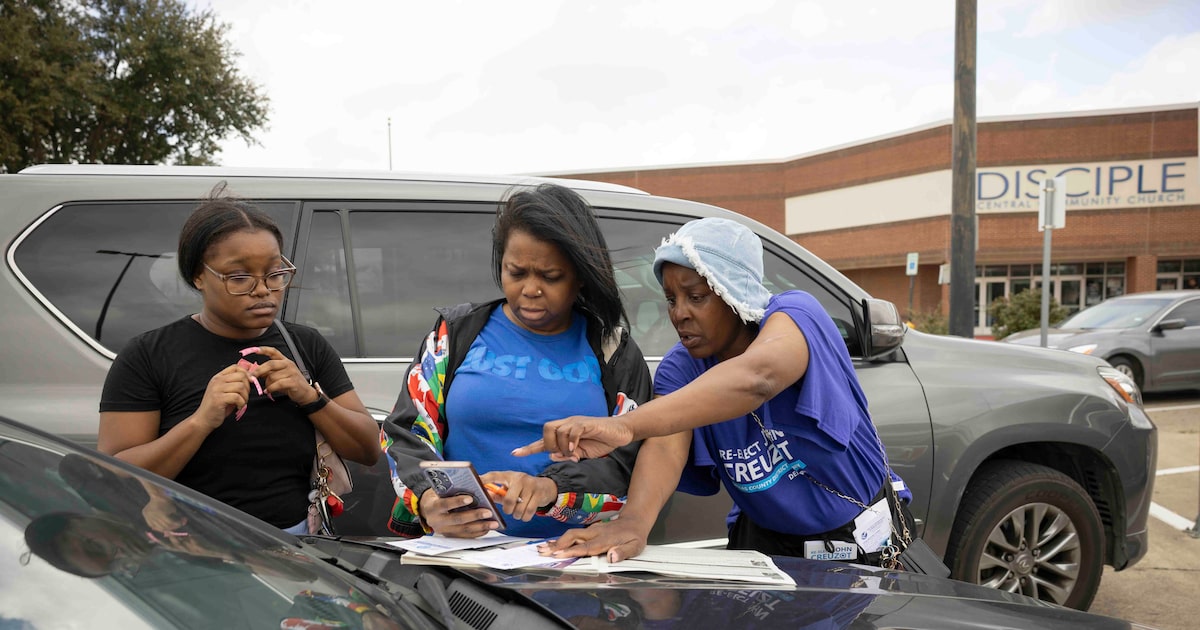
The county stationed navigators at the doors of 75 polling locations with party-specific tablets to look up voters’ precincts and redirect them accordingly. Election workers at more than 270 locations without navigators were provided with the same Democratic and Republican tablets for that purpose.
But if navigators failed to ask for a voter’s party affiliation before searching for their precinct, some people were sent to the wrong site. The same problem occurred when election clerks used their check-in poll books instead of party-programmed navigator tablets.
Breaking News
Elections Administrator Paul Adams said safeguards were in place to avoid such missteps, but the compressed timeline the county had to accommodate separate primaries complicated operations and messaging. It led to election workers sending some people to another incorrect polling place after already arriving at the wrong one.
“The problem was there wasn’t enough time,” Adams said. “This election was incredibly challenging, not just for me but for everyone in the elections department.”
Countywide voting, where people can cast a ballot at any location regardless of their address, remained in place during the primary’s 10-days of early voting, as it had for years, because county officials control that period under the election code.
But state law gives greater authority to the parties during a primary’s election day. In December, GOP Chair Allen West confirmed Republicans would proceed with precinct-based voting and a separate primary from Democrats on March 3. Countywide voting requires agreement from both parties, so the change to precincts applied to all voters.
West declined Thursday to comment on the operational problems that unfolded.
Both parties contracted with the county to run their primaries. Adams said the non-joint setup put tremendous strain on the elections department, though he was uncertain whether state law would have allowed him to refuse to accommodate separate primaries due to logistical constraints.
He said election workers were instructed during training to only confirm voters’ polling places by using the navigator tablets – not the poll books used to check-in voters and print their ballot.
This is because the check-in devices did not isolate polling places by party like the navigator tablets. Adams said reminders were sent throughout the day through the poll workers’ messaging system.
But the messages got buried in the chaos of the day for some election workers. Meaders Ozarow was a clerk at Arlington Park Recreation Center, a Democratic-only site that was short two clerks on election day. Her polling place did not have people working as navigators, and Ozarow said she does not recall being provided the special navigator tablets.
She said her only option was to search for a lost voter’s precinct in her check-in poll book, which displayed a message directing clerks to use a navigator or see an election judge. But it also showed them a map identifying the voter’s precinct, which she believed was the appropriate information at the time.
It wasn’t until later in the evening, after a judge granted the Democratic Party’s motion to extend voting by two hours due to the confusion, that Ozarow said an earlier message directing clerks to use the navigator devices began to make sense to her. (The Texas Supreme Court promptly blocked the voting extension).
“I felt terrible because I realized I unknowingly was part of a problem that was disenfranchising voters because of the way it was set up,” Ozarow said. “We honestly thought we were telling them to go to the right place.”
In previous interviews, Democratic Party Chair Kardal Coleman said such confusion is why he pushed for a joint primary with Republicans and universal voting on election day.
“This situation is what we knew and what we anticipated and what we warned chair Allen West and the Republican Party would happen and it’s all coming to bear today,” Coleman told The Dallas Morning News on Tuesday.
The Commissioners Court allocated $1 million in January to fund home mailers and other advertisements to alert voters to the change to precincts for election day.
Adams said he wanted the mailers personalized to each resident and provide two addresses for them to go to depending if they were voting as a Republican or Democrat.
But because both parties were finalizing their polling places through the end of February, Adams said there wasn’t enough time to do that. Instead the mailers, sent out after early voting started Feb. 17, included a QR code that routed people to the county website to find where to vote.
“If they would have seen it in writing — this is where I have to go — that would have been very helpful in alleviating much of this,” Adams said.
Voters who searched for their polling place using the Secretary of State’s votetexas.gov may have also been directed to the wrong location. This is because the state website did not reflect changes to Dallas County’s precinct maps that were finalized in December after the state legislature’s redistricting.
Secretary of State spokesperson Alicia Pierce said the polling location data on votetexas.gov is maintained by counties, not the state. Adams said his office emailed polling place changes to the state as they were being finalized through February and could not explain why the website didn’t reflect the updates.
For Nyki Caston, it took visiting four polling places on Tuesday over three hours to finally cast her ballot.
She first headed to Fretz Park Library at 9:30 a.m. because that’s where she has always voted.
A woman at the door showed her a QR code that routed her to the county website, which directed her to go to Nathaniel Hawthorne Elementary School 20 miles away.
“It was very frustrating but I was 100% committed,” Caston said.
At the school, she presented her ID to the clerk at the check-in desk, who told her she needed to vote at a different school near downtown. Once she got there, a navigator in a green shirt at the door told her she needed to vote at Booker T. Washington High School instead.
Back to her car she went.
When she got to the fourth polling site at 12:30 p.m., she was tired and frustrated, but not willing to surrender her vote.
“I was very emotional and I felt like the whole process was created to dissuade people from voting,” she said.