
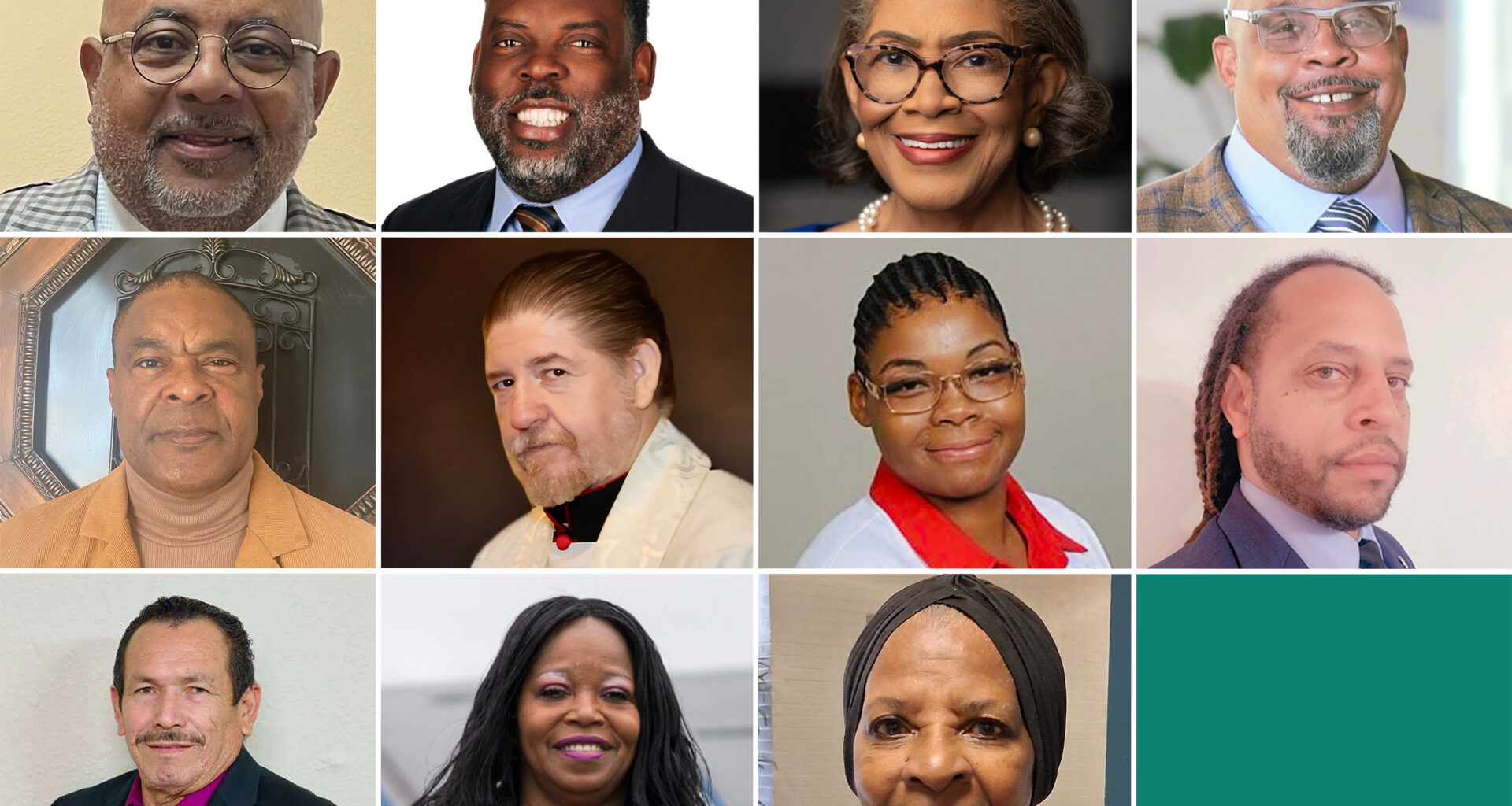
In a conference room near the back of the Brighter Outlook multipurpose center in Stop Six, a group of prominent east Fort Worth leaders slowly trickled in.
They ranged from pastors to community activists, a group of Black and Hispanic Fort Worthians who all know each other well.
The purpose of that early February meeting? To talk about the second most important factor in maintaining quality of life, according to a comment made by Rev. Edward Justice before the meeting began.
“The most valuable thing in your life is time,” he said in a side comment. “The second is health.”
Since 2021, the Stop Six Community Corps has been fighting medical misinformation in east Fort Worth, one conversation at a time.
Though corps members are well-known in a variety of fields, only a handful of the 11 have medical backgrounds. Nevertheless, the group works to answer questions posed by their neighbors about vaccines, seasonal illnesses, the CDC and more.
“We’ve convinced many individuals that this was a positive program that we were part of,” said Christene Moss, a retired nurse and former longtime FWISD school trustee.
Filling a need
During the strains of the pandemic in 2021, Linda Fulmer noticed much of the health information dispensed in east Fort Worth was from local government officials.
Vaccine rates in communities of color were low. From December 2020 to November 2021, 47.3% of Hispanics and 46.3% of Black people received the COVID-19 vaccine nationwide compared to 59% of white people, according to the Centers for Disease Control and Prevention.
Who is part of the Stop Six Community Corps?
Doris Curvey, retired educator.
Rev. Bruce Datcher, pastor of Ebenezer Missionary Baptist Church.
Rev. Sergio Diaz, vicar of Iglesia San Miguel.
Roger Foggle, barber and activist.
Rev. Edward Justice, pastor of Christ Centered Missionary Baptist Church.
Benito Leiva, North Texas coordinator of U.S. Christian Chaplain’s Association and owner of Leiva’s Towing.
Lisa McDaniel, owner of Lisa’s Little Angels Day Care & Learning Center and Generation Uplift.
Jonathan Morrison, owner of Be Levereged, employee at Dunbar High School and activist.
Christene Moss, retired nurse and school board trustee.
Shuntoyia Shaw, owner of Top of the Line Technician.
Carlos Walker, director of FWISD Family Action Center and owner of Akachi Ranch.
De’Borah Brandi-Brown, the former administrative assistant of Ebenezer Missionary Baptist Church, was the 12th member of the Stop Six Community Corps before her death in late January. Fulmer said she is currently in the process of finding an individual to take her place in the project.
To fight the spread of medical misinformation, Fulmer, the executive director of Healthy Tarrant County Collaboration, enlisted faith leaders and familiar community faces to provide truth to east Fort Worth.
“We needed to have a way to have a group of people who are trusted in the community already become the messengers,” Fulmer said.
The idea was novel in nature but echoed similar projects nationwide. Several communities during the pandemic tapped figureheads outside of medicine to dispense information, according to the American Health Association.
With an 18-month grant from Tarrant County Public Health, Fulmer asked leaders in Stop Six to help. Not a single person has left the initiative since it started in November 2021.
Each leader has a personal motivation for the work.
Rev. Bruce Datcher was the first person Fulmer contacted. The pastor of Ebenezer Missionary Baptist Church said at the end of 2020, he was one of five North Texas ministers hospitalized because of COVID-19.
He was the only one who stepped out of the hospital.
“Ministers from across this country that were associates of mine died from COVID during that time,” Datcher said, recalling a lot of funerals at that time.
Moss, the former nurse, notes that much of the misinformation in the community is rooted in Black people’s historical mistreatment by the medical establishment, specifically with vaccines.
But by building trust, you can change minds, she said.
“Once you can break that barrier and they start listening to you, then I was able to convince others about the disease and how dreadful it was,” Moss said of encouraging neighbors to get vaccinated.
Carlos Walker got involved because of his desire to change health outcomes in east Fort Worth.
“Just looking at data for this area, that was a concern for me,” said Walker, the director of FWISD Family Action Center. He wanted “to see how I could be a part of helping change that trajectory for people.”
Building trust
Corps members tracked the number of conversations they had — about 30,000 over the 18 months of the grant period.
They dispensed information in different ways to catch people’s attention.
Justice, for example, would play health videos provided on a screen in his church. Rev. Sergio Diaz and Datcher passed out flyers provided with true/false statements and clear bullet-point responses. Shuntoyia Shaw’s work as a mobile phlebotomist took her from home to home, where she would try to dismantle any medical misinformation her clients believed.
For some corps members, it was simply pestering neighbors to get vaccinated.
“I always ask everybody the same thing. Matter of fact, I asked them Sunday, ‘Have y’all had your shots? I can’t express to y’all how important this is — did y’all have these shots?’” said Doris Curvey, a retired Fort Worth educator.
The initiative’s work shifted from exclusively fighting COVID-19 misinformation to becoming a beacon of trusted medical counsel.
The corps project now addresses general health concerns and disparities.
Some brought up are seasonal — inquiries about cedar fever, norovirus and general allergies. Others are directly related to health news they see online, such as the COVID-19 surges that occurred in the summer of 2024.
 The monthly questions provided to corps members from the community from June 2024 to December 2025.(Maria Crane | Fort Worth Report/CatchLight Local/Report for America)
Over time, as corps members have answered a wide range of questions, the community’s trust has grown. Benito Leiva, the North Texas coordinator of the U.S. Christian Chaplain’s Association, has seen that manifested within the Hispanic neighborhoods in east Fort Worth.
“Sometimes, Hispanics like to see results before committing,” Leiva said. “Through the time that we’ve been in this program, we’ve seen more people listening.”
A continual resource
After the initial funding for the project ended, Fulmer was able to continue the project in April 2024 as a member of the National Institutes of Health Community Engagement Alliance, or CEAL, a research network developed to provide support to communities struggling during the pandemic.
The Stop Six Community Corps is one of six projects that are currently part of Texas CEAL Consortium, said Palak Desai, a senior project coordinator at UNT Health Fort Worth’s Institute for Health Disparities.
Since starting in 2020, the Texas teams have worked with 62 partner groups and addressed six social determinants and health topics.
“We have reached over 2 million people throughout the project in Texas through many different methods,” Desai said. “Two million may not seem like a lot in Texas, but it’s still 2 million more than before. And that has shown that we’re actually making an impact on these people’s lives.”
Desai emphasized that despite being funded in part by the NIH, the conclusions of research and community engagement through Texas CEAL Consortium are independent and do not represent the federal department’s views or policies.
She notes the community work has made an impact.
“We just try to make the world a better place, and to do that, it starts at the nitty gritty in the communities that are not seen as much in the spotlight,” Desai said.
Who is a part of the Texas CEAL Consortium?
Stop Six Community Corps — Tarrant County.
Community-Engaged Development and Implementation of the South Asian Community Health Ambassador Program for Type II Diabetes Prevention and Management — North Texas.
Bexar County Community Engagement Alliance — Bexar County.
A Randomized Control Trial of Conversations Advancing Resilience and Empowerment (CARE) — Harris County.
South Texas CEAL — South Texas.
Advancing Health Equity through Multi-level, Community-led Interventions Addressing Social Determinants of Health — Harris County.
Find out more about these projects here.
In the long run, Fulmer hopes the community work continues in east Fort Worth past the Stop Six Community Corps’ current project timeline — which is set to end in 2028.
“It’s important to always have, particularly a community that tends to be disproportionately impacted by poor health, chronic diseases, social determinants of health, a network of people that the community knows they can turn to for information,” Fulmer said.
Interviews for this story were translated from Spanish.
Ismael M. Belkoura is the health reporter for the Fort Worth Report. His position is supported by a grant from Texas Health Resources. Contact him at ismael.belkoura@fortworthreport.org.
At the Fort Worth Report, news decisions are made independently of our board members and financial supporters. Read more about our editorial independence policy here.
This <a target=”_blank” href=”https://fortworthreport.org/2026/03/05/these-east-fort-worth-leaders-fight-medical-misinformation-one-conversation-at-a-time/”>article</a> first appeared on <a target=”_blank” href=”https://fortworthreport.org”>Fort Worth Report</a> and is republished here under a <a target=”_blank” href=”https://creativecommons.org/licenses/by-nd/4.0/”>Creative Commons Attribution-NoDerivatives 4.0 International License</a>.<img src=”https://i0.wp.com/fortworthreport.org/wp-content/uploads/2021/04/cropped-favicon.png?resize=150%2C150&quality=80&ssl=1″ style=”width:1em;height:1em;margin-left:10px;”>
<img id=”republication-tracker-tool-source” src=”https://fortworthreport.org/?republication-pixel=true&post=435763&ga4=2820184429″ style=”width:1px;height:1px;”><script> PARSELY = { autotrack: false, onload: function() { PARSELY.beacon.trackPageView({ url: “https://fortworthreport.org/2026/03/05/these-east-fort-worth-leaders-fight-medical-misinformation-one-conversation-at-a-time/”, urlref: window.location.href }); } } </script> <script id=”parsely-cfg” src=”//cdn.parsely.com/keys/fortworthreport.org/p.js”></script>