
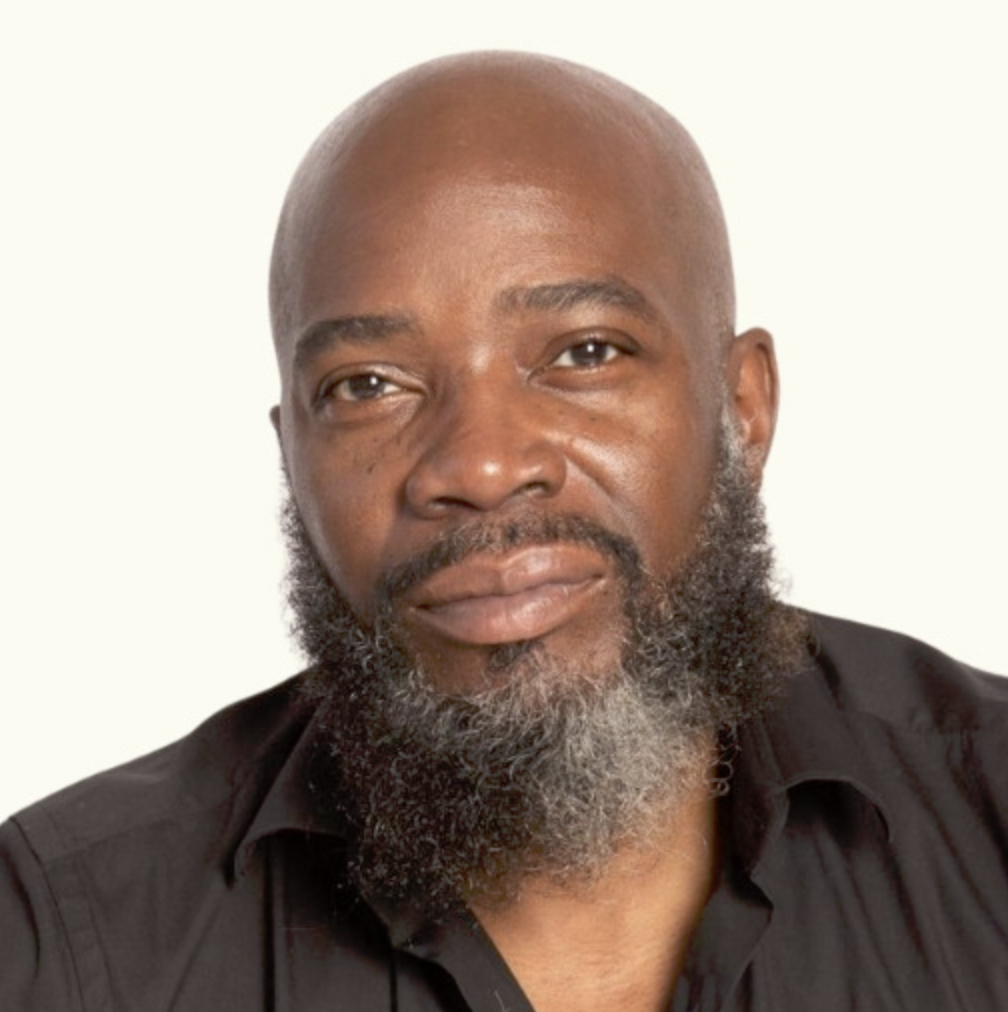
Last Tuesday evening at Friendship-West Baptist Church, faith, history and activism came together as the Texas Organizing Project hosted award-winning journalist and bestselling author Michael Harriot for a conversation about his book Black AF History.
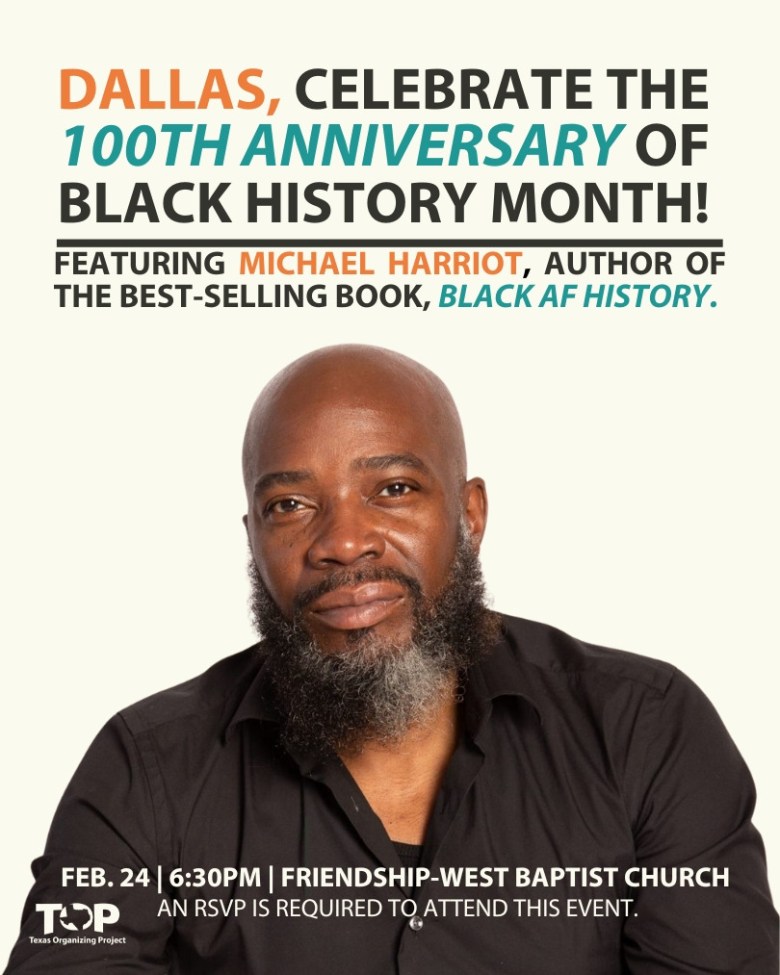
The gathering marked the 100th anniversary of Black History Month and served as both celebration and challenge. In a moment when Black history is increasingly contested in classrooms and public spaces, organizers made one message clear throughout the evening. Black history is American history.
From opening prayers and poetry to a lively discussion with Texas Organizing Project Executive Director Brianna Brown, the program blended spirituality, community reflection and political urgency.
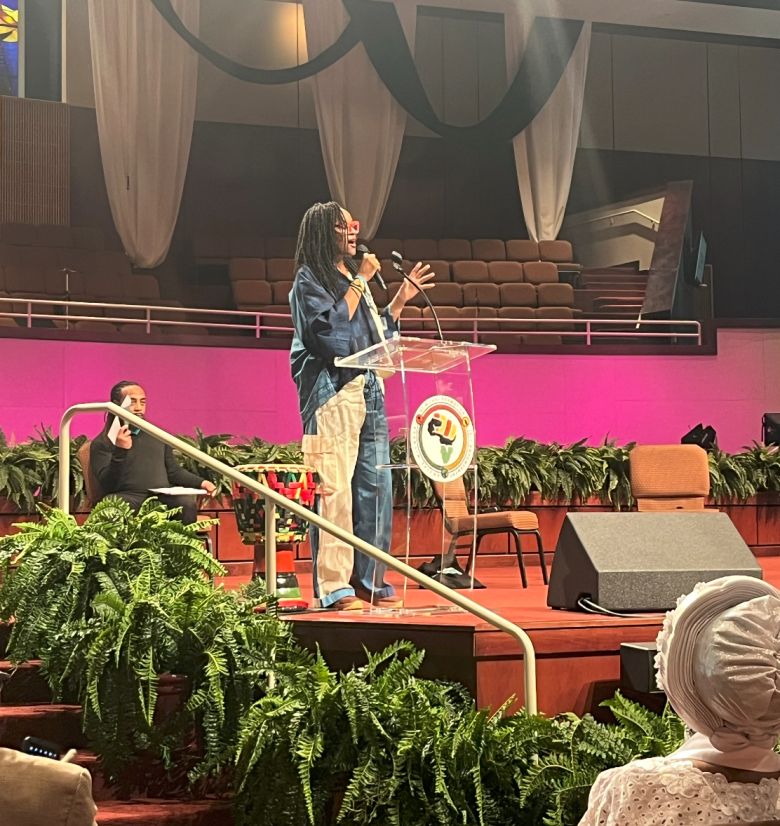 TOP Executive Director Brianna Brown speaks to attendees during a Texas Organizing Project event commemorating the 100th anniversary of Black History Month at Friendship-West Baptist Church in Dallas. Photo by Ceara Johnson
Harriot’s presence brought humor, candor and historical clarity to a packed sanctuary eager to hear the unfiltered version of the American story.
Reclaiming the Narrative
Harriot’s work is known for its fearless tone and storytelling style that blends scholarship with sharp wit. In Black AF History, he unpacks the myths that have long defined traditional history books while highlighting the overlooked people and movements that shaped the nation.
For Harriot, the problem with many mainstream narratives is not just what they say but what they leave out.
American history, he argued, has often been sanitized to protect national myths. But removing the uncomfortable truths about race, power and resistance does not change the reality of how the country was built.
Instead, Harriot encourages readers to confront the past honestly. Only then can communities understand the forces that shaped the present and determine how to shape the future.
His writing reflects that philosophy. It mixes historical fact with storytelling that feels like a conversation at the barbershop or the family table, where history lives in memory as much as in textbooks.
History Told Without the Filter
Harriot’s storytelling style often moves fluidly between the personal and the historical. One moment he is recounting a moment from his own life. The next he is tracing the legacy of Black leaders who changed the course of the nation.
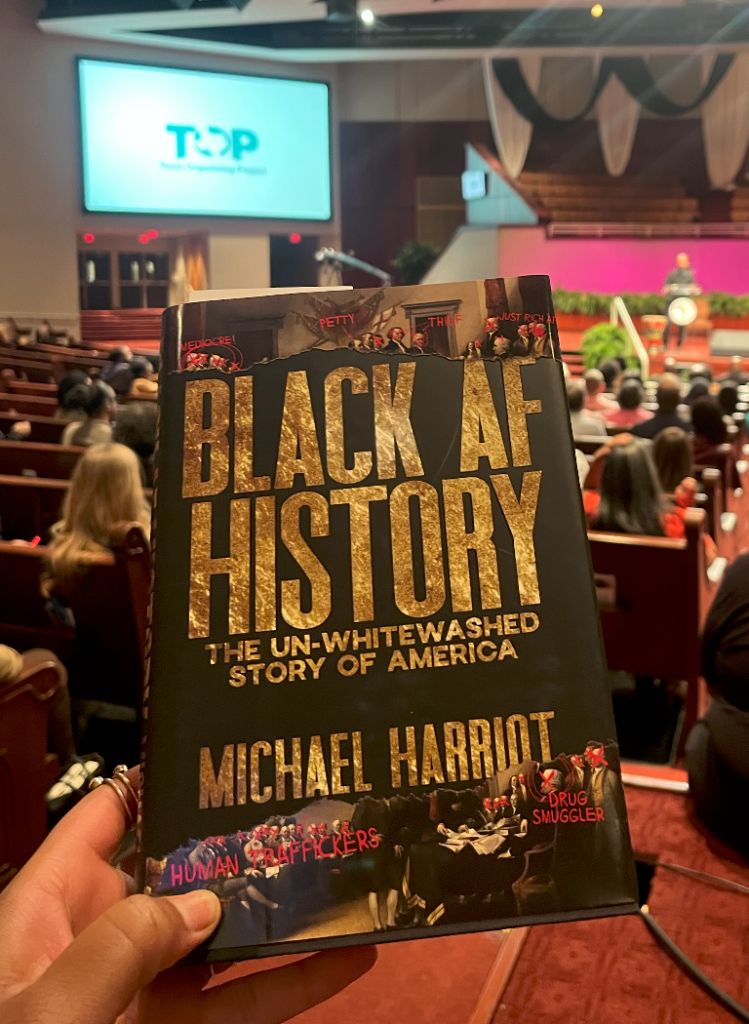 Michael Harriot’s bestselling book Black AF History.
In one passage from Black AF History, Harriot describes how First Lady Eleanor Roosevelt’s visit to Tuskegee helped open doors for the legendary Tuskegee Airmen. The moment captures his signature approach: meticulous research delivered through narrative that feels immediate and refreshingly human.
The story highlights the influence of educator and civil rights strategist Mary McLeod Bethune, whose organizing helped secure resources that made the Tuskegee training program possible. Through storytelling like this, Harriot shows how Black leadership shaped pivotal moments in American history long before those contributions were widely acknowledged.
The point is simple. The American story has always been incomplete without Black voices.
Organizing as the Next Chapter
The event was not only about history. It was also about what comes next.
Harriot reminded the audience that the struggle for justice has always depended on organizing, not just remembering. He pointed to Texas as a powerful example, noting that the state holds one of the largest populations of eligible but unregistered Black voters in the country.
Organizing, he said, has historically been the force that pushed democracy forward.
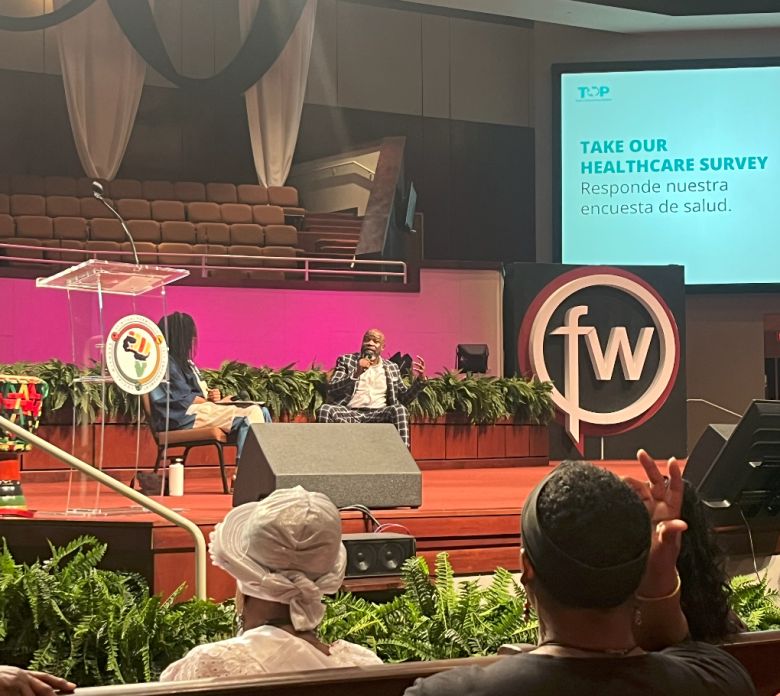 Texas Organizing Project Executive Director Brianna Brown joins Michael Harriot on stage for a conversation about organizing, history and the future of Black political power in Texas. Credit: Ceara Johnson
The conversation also revisited the legacy of progressive Texas leaders such as former U.S. Senator Ralph Yarborough, who supported landmark civil rights legislation when many Southern politicians refused. Their stories illustrate how individuals can influence the broader fight for equality.
Harriot also addressed the ongoing debate about reparations. In his view, justice requires tangible repair, not just symbolic reconciliation.
A Call to Remember and Build
Harriot’s message resonated clearly across the sanctuary at the end of the evening.
History is not just about the past. It is a tool for understanding power, identity and possibility.
Through books like Black AF History, Harriot is helping a new generation see that the struggle for truth is also a struggle for the future. If the past has been rewritten before, it can be reclaimed again.
And in places like Dallas, where organizing and storytelling intersect, that work continues.
Related