
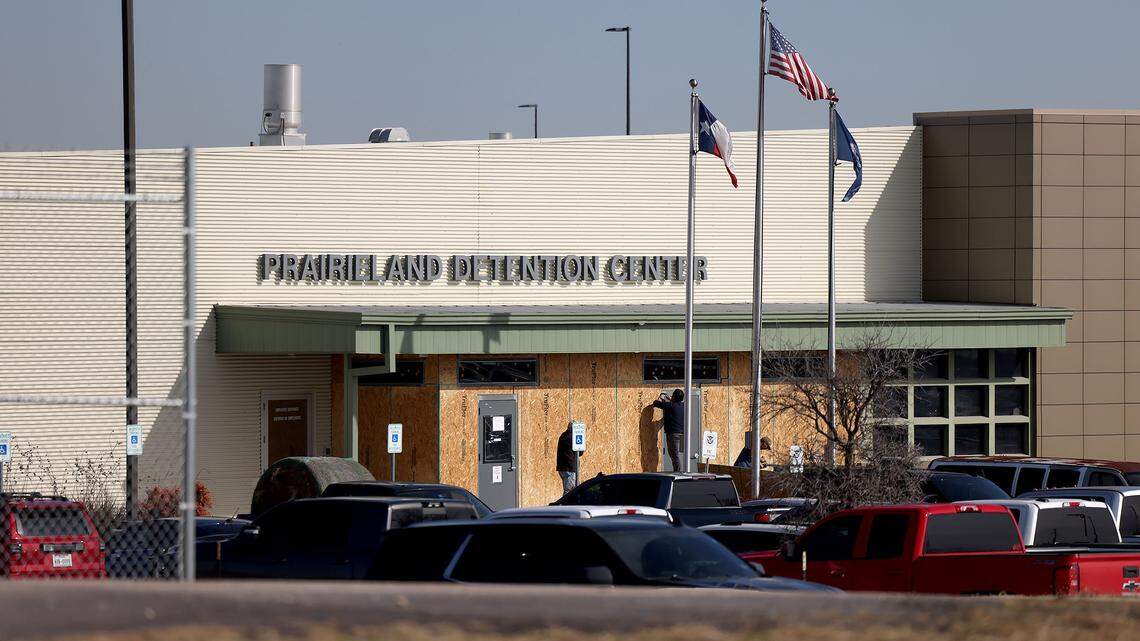
FBI special agents searched the home of Ines and Elizabeth Soto in the days after a police officer was shot in July outside a detention center in Johnson County where the government confines immigrants it intends to deport.
Two months later, the agents, assigned to the bureau’s counterterror squad, returned to the couple’s house in Fort Worth for a second time to pursue items they missed during the first search.
The agents were looking for evidence of mass production of propaganda, FBI Special Agent Morris Boatner testified on Wednesday at a trial in U.S. District Court in Fort Worth of nine people, including the Sotos, who government prosecutors indicted in connection with the shooting. The North Texas U.S. Attorney’s Office alleges the defendants were motivated by anti-government anger, particularly on immigration matters.
In the garage, the agents found a commercial copy machine, paper cutting equipment and a book binder. The FBI seized the printer and other equipment.
The government alleges the Sotos were part of a group of people who created and distributed insurrectionary materials called zines.
Prosecutors have not presented direct evidence that the material was duplicated by the Sotos’ printer, but in questioning of Special Agent Boatner, Assistant U.S. Attorney Shawn Smith said of the Sotos that it “stands to reason … they were the printers.”
Defense attorneys probed the relevance of the printing equipment.
“Respectfully, sir, 22 years ago you took an oath,” Brian Bouffard, a defense attorney who represents Zachary Evetts, another defendant in the case, began a question of the special agent, suggesting any written material produced by the printers would be protected under the First Amendment.
Smith objected, saying that Bouffard’s question was argumentative. U.S. District Judge Mark Pittman stepped in to ask the witness about the legality of the seized items.
There was, Special Agent Boatner testified, nothing illegal about the printing equipment.
Pittman granted a motion Tuesday finding that arguments of self-defense or defense of others are inappropriate in the trial in connection with the shooting of Alvarado police Lt. Thomas Gross.
Pittman’s ruling blocks defense attorneys from making those arguments. Pittman said the defense would not be able to show based on the evidence that Gross’ actions before he was shot were unreasonable.
Prosecutors asserted that the defense theory was legally invalid and should stop because it fueled the potential for the jury to ignore the law in nullification.
Defense attorneys had suggested in cross-examination of government witnesses that defendant Benjamin Song, who is accused of shooting Gross, may have been justified by defense of a third party because he was lawfully defending a running person wearing black clothing.
The defense is flawed, the government argued, because Song is not free from fault in prompting Gross’ use of force and the defense cannot show Gross’ pointing his gun at the fleeing person was objectively unreasonable under the circumstances.
Gross was shot in his upper shoulder, and the projectile left the back of his neck and took a path through tissue and muscle, but avoided vital organs, Gross testified earlier in the trial.
The defense suggested in its response that it should be permitted to explore the justification theories in part because new accounts of the shooting came to light from the witness stand.
The U.S. Attorney’s Office sought the indictments in a novel case against what the government alleges is a group of antifa cell members who intended to kill.
The defendants’ attorneys refer to their clients as noise demonstrators and argue that they wanted, in a protest, to bring hope to immigrants detained by ICE. The indictment represents an attempt to prosecute citizens for their political beliefs, defense attorneys have argued.
Thirteen people wearing black clothes were at Prairieland at the time of the shooting late on July 4, 2025, according to the government account.
Some ignited fireworks and others spoke from a bullhorn or spray-painted anti-ICE phrases on vehicles and an unoccupied guard booth.
Beyond Song, Evetts and the Sotos, the defendants are Autumn Hill (referred to as Cameron Arnold in the indictment), Savanna Batten, Meagan Morris (referred to as Bradford Morris in the indictment), Maricela Rueda and Daniel Rolando Sanchez Estrada.
Song is charged with attempted murder and discharging a firearm during, in relation to and in furtherance of a crime of violence. Evetts, Hill, Morris and Rueda are charged with aiding and abetting.
Song, Batten, Evetts, Hill, Morris, Rueda, and Elizabeth and Ines Soto also were indicted on charges including rioting, providing material support to terrorists and conspiracy to use and carry an explosive.
Rueda and Sanchez Estrada also are charged with conspiracy to conceal documents, and Sanchez Estrada is charged with corruptly concealing a document or record.
The trial was to continue with the government’s case on Thursday.
This story was originally published March 5, 2026 at 9:04 AM.
Related Stories from Fort Worth Star-Telegram

Fort Worth Star-Telegram
Emerson Clarridge covers crime and other breaking news for the Fort Worth Star-Telegram. He works days and reports on law enforcement affairs in Tarrant County. He previously was a reporter at the Omaha World-Herald and the Observer-Dispatch in Utica, New York.