
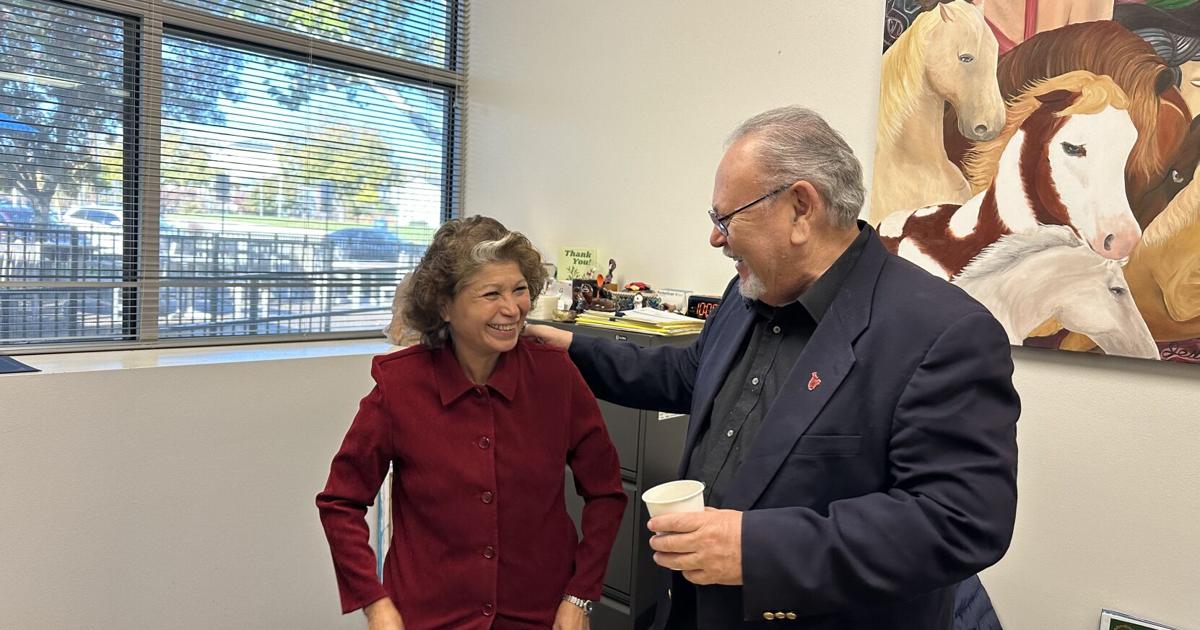

Administrative assistant Diana Botello chats with José Ángel Gutiérrez, founder of UTA’s Center for Mexican American Studies, during his visit for the center’s 30th anniversary celebration in 2024.
Photo courtesy of Xavier Medina Vidal
Between a few young plants and several beds still bare from winter, the garden behind the Center for Mexican American Studies didn’t look like much in February.
Administrative assistant Diana Botello bustled between the beds, arms wide as she pointed to small signs of life on both sides. Cilantro broke through in a vegetable plot to her left, while Texas-native plants emerged for the season to the right. A third bed, for herbs, was planned.
“By summertime, this will be beautiful,” Botello said.
The garden didn’t come together by itself. For years, Botello and her co-worker José Ayala Rodríguez clipped overgrown shrubs, pulled roots and replanted beds. In summer, she watered the plants twice a day, aware that the nearby white wall reflected heat back onto the beds.
In many ways, the care Botello, 64, gave the garden mirrored the 22 years she spent at UTA’s Center for Mexican American Studies before her retirement at the end of February. Both required patience and faith that steady effort would eventually bear fruit.
Like the garden, her interactions with students ran in cycles. Each semester, new arrivals came in like seedlings, unsure where to take root. Each plant buds and grows at its own pace — much like the students who passed through Botello’s desk.
“My whole time here, I really have felt honored that I am Mexican American, and I felt like maybe I’m doing just a little bit to help my kind of Mexican American students,” she said. “I find it just wonderful to see our students succeed. I’ve seen so many — 22 years, so many students — come through here that they’re out there living a wonderful life, the All-American dream life.”
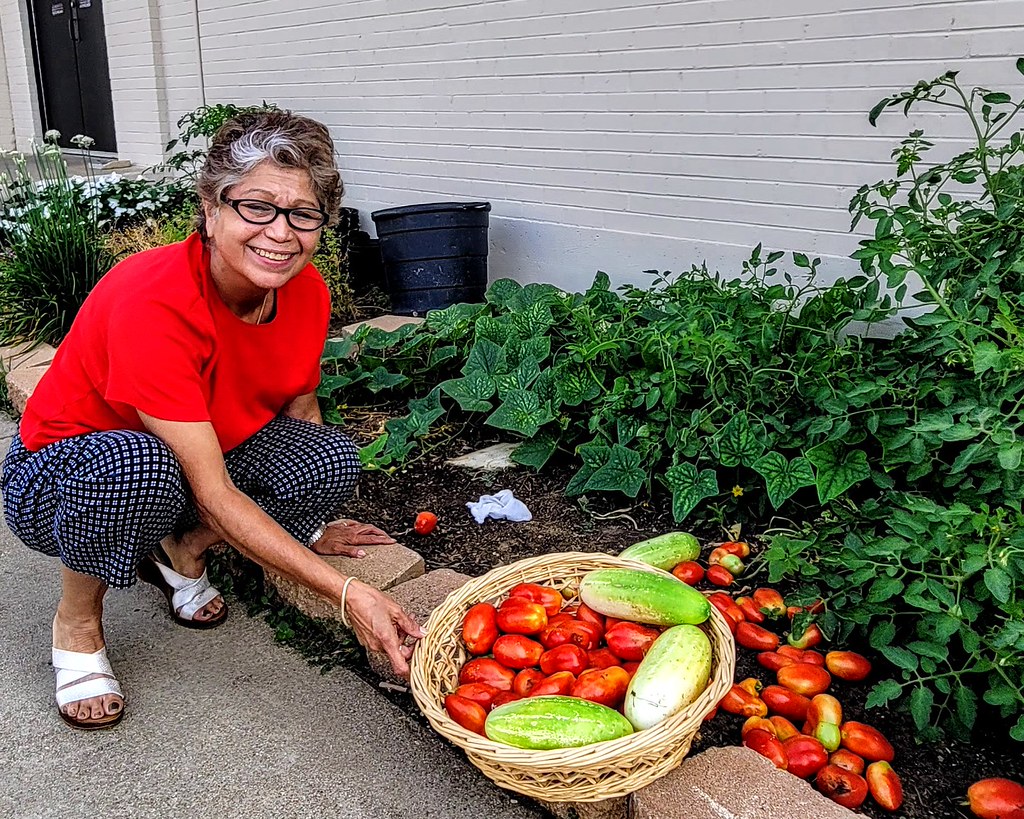
Administrative assistant Diana Botello collects produce in the garden behind the Center for Mexican American Studies in 2025. Photo courtesy of Monica Lopez.
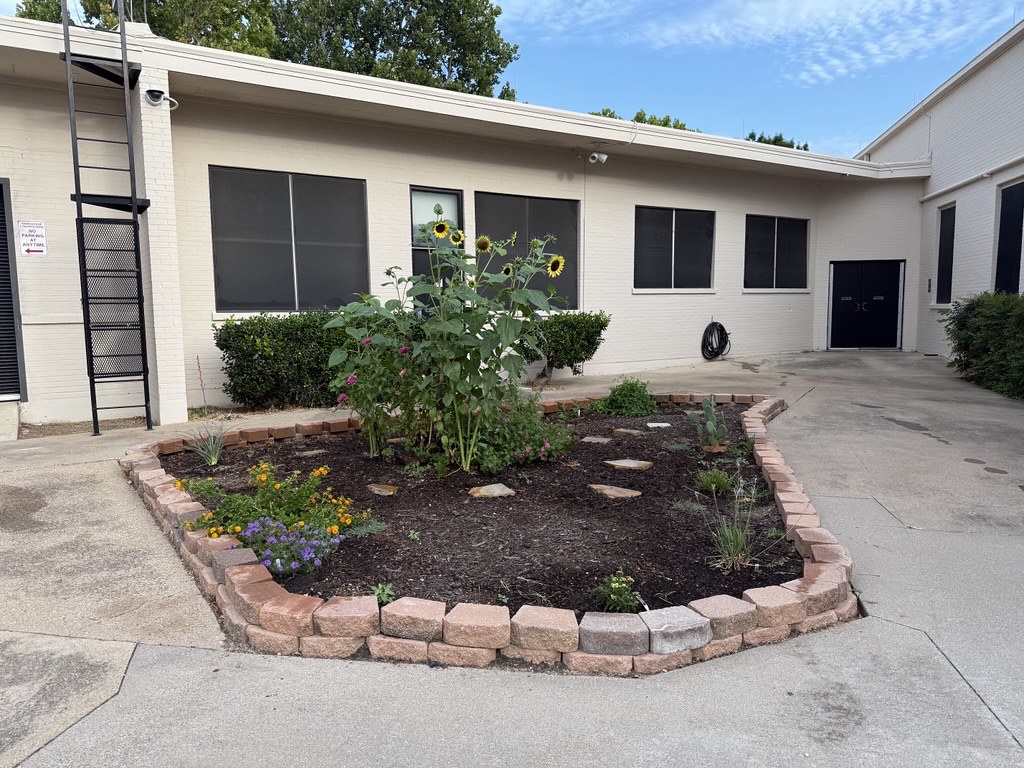
A portion of the native garden behind the Center for Mexican American Studies during summer. Photo courtesy of Xavier Medina Vidal.
The center’s director Xavier Medina Vidal said Botello’s impact extended far beyond her job description. Throughout her tenure, she planted roots across the center — in students’ stories, faculty members’ work and the center’s institutional memory.
“She’s our anchor,” he said.
Botello is the type to “look out for the little guy,” Medina Vidal said. Students often sought guidance on issues affecting immigrant and Hispanic communities, and they trusted Botello to help them navigate those concerns.
“I trust her with my life. I trust her with my kids’ life,” he said.
‘I’ve seen so many — 22 years, so many students — come through here that they’re out there living a wonderful life, the All-American dream life.’
Botello never expected to work in higher education. In the early 2000s, she was doing clerical work in the private industry when the Sept. 11 attacks disrupted everything she thought was stable. She lost her job later that year and was forced to start again from uncertain ground.
In 2003, an opportunity brought her to interview at the center with then-interim director Alejandro Del Carmen.
“I thought I was just going to interview with him one-on-one, but I walked in the conference room and there was, like, five different professors,” she said, laughing. “I sit down in the main chair, and I remember telling myself, ‘Oh, not going to get this job.’”
Despite her doubts, she got it.
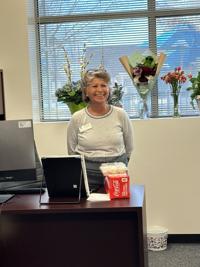
Administrative assistant Diana Botello smiles on her final day working at the Center for Mexican American Studies on Feb. 27. Botello spent 22 years with CMAS.
Photo courtesy of Xavier Medina Vidal
Over the next two decades, Botello stayed with the center through three directors and a relocation from the University Center to its current home at the Swift Center.
“We’re a fun-loving bunch over here and we want our students to succeed and participate with the center,” Botello told The Shorthorn about the move in 2013. “We’re not going to cry and moan about the move, but we are going to make the best of this situation.”
Christian Zlolniski, the center’s former director, said Botello did just that. For the next few years, she took it upon herself to redecorate the space to make it more inviting for students.
Botello’s deep knowledge of the university’s inner workings came from years of building relationships across campus. This helped her navigate bureaucracy and get things done for both students and faculty, Zlolniski said.
Her ability to make people feel welcome shaped how many visitors first experienced the center. Zlolniski recalled a conversation with alumna Pat Brandenburg, whose donations eventually totaled more than $1 million for the Center for Mexican American Studies and the Center for African American Studies.
“She would tell me the difference that made for her, the first time she came to visit campus and the center, to be welcomed by Diana,” he said.
‘This job has awarded me a good life, a great life.’
Yet Botello never brought up major donations or her ability to navigate university systems during the interview. She laughed when asked what she hoped her legacy would be and said she wasn’t expecting one. But then she paused.
“I respected everybody, and that I treated everybody the same,” she said.
Cristina Salinas, associate professor of history and geography and Center for Mexican American Studies faculty member, said Botello’s warmth became part of the center’s culture. Many spaces on campus might feel like business offices for faculty and staff members, but Botello made the center feel like a family supporting one another, Salinas said.
“One of her legacies is that people remember the center partially because of their interaction with her and the way that she made an impact on them,” she said.
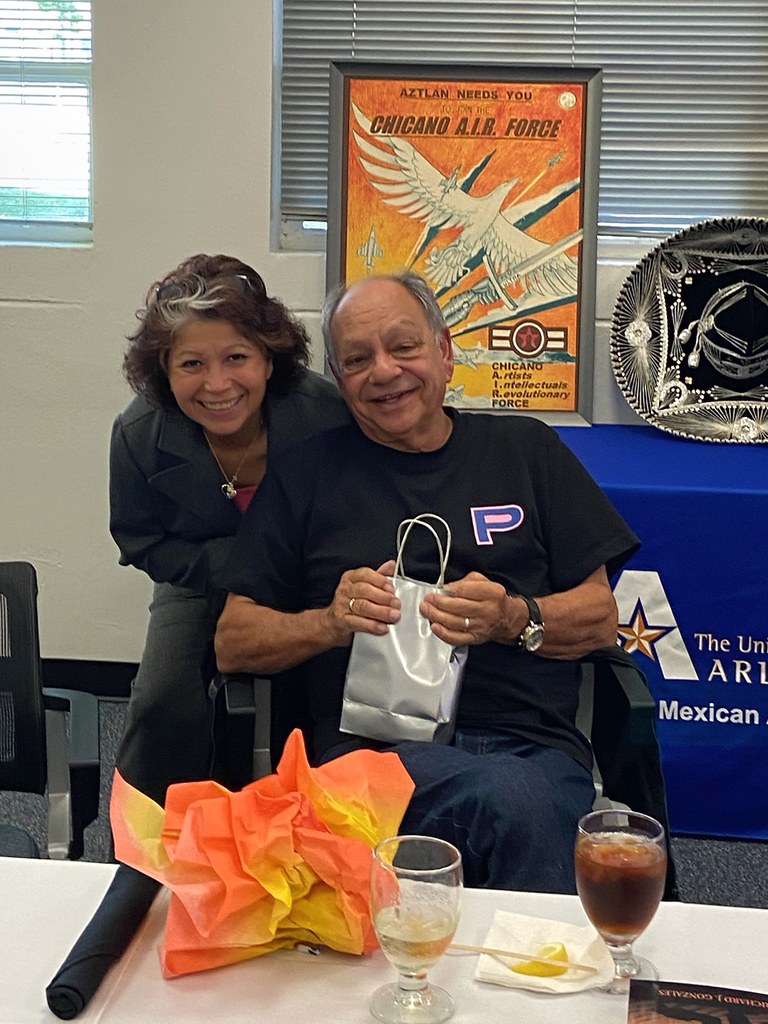
Administrative assistant Diana Botello, left, poses with artist and comedian Richard “Cheech” Marin in 2022. Photo courtesy of Xavier Medina Vidal.
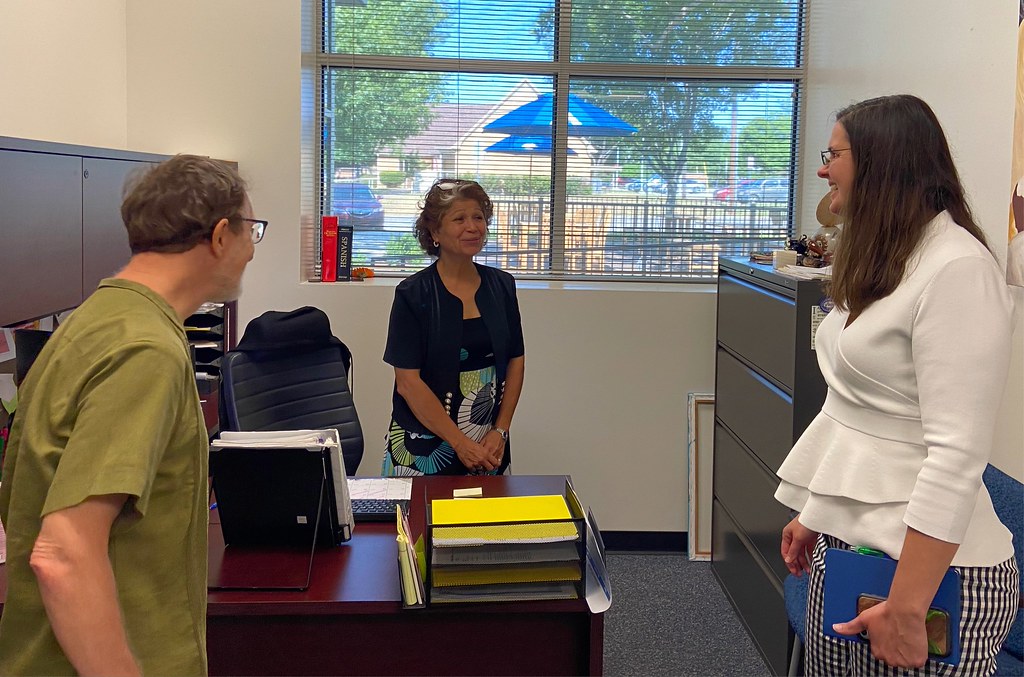
Administrative assistant Diana Botello, center, speaks with President Jennifer Cowley, right, and former director Christian Zlolniski. Cowley was touring the campus during the early months of her tenure. Photo courtesy of Xavier Medina Vidal.
Alumnus Ángel Hinojoza Gándara said Botello’s words lingered in the back of his mind after he graduated: Strive for quality work and treat others with the same respect he hoped to receive.
“What I love most about her is that she’s always willing to help out others,” Hinojoza Gándara said. “Doesn’t matter what mood she’s in, what’s going on in her life, she always helps out with a smile.”
The day before her retirement, Botello was still filling out paperwork. Documents and folders were spread across her table. She enjoyed her position but also felt it was time to step away. More than anything, she felt grateful.
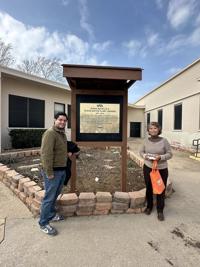
Administrative assistant Diana Botello, right, poses with academic program coordinator José Ayala Rodríguez at the wooden-style sign at the edge of the garden behind the Center for Mexican American Studies.
Photo courtesy of Xavier Medina Vidal
When she came to UTA, she was financially scared and about to lose her house. She’s leaving with stability and is grateful for the chance to meet people she never imagined encountering — scholars, speakers, students whose ideas expanded her world far beyond cubicle work. The students kept her feeling young, she said.
“This job has awarded me a good life, a great life,” she said.
Outside the building, the garden Botello helped cultivate is waking up from winter. Last summer, monarch cocoons appeared among the plants, followed by butterflies. Now, sunlight hits the bed and reflects off a wooden-style sign at the edge, showing its namesake — the center’s way of recognizing her care for the space and the center.
“DIANA BOTELLO & TEXAS NATIVE PLANT GARDEN,” the sign reads.
@DangHLe