
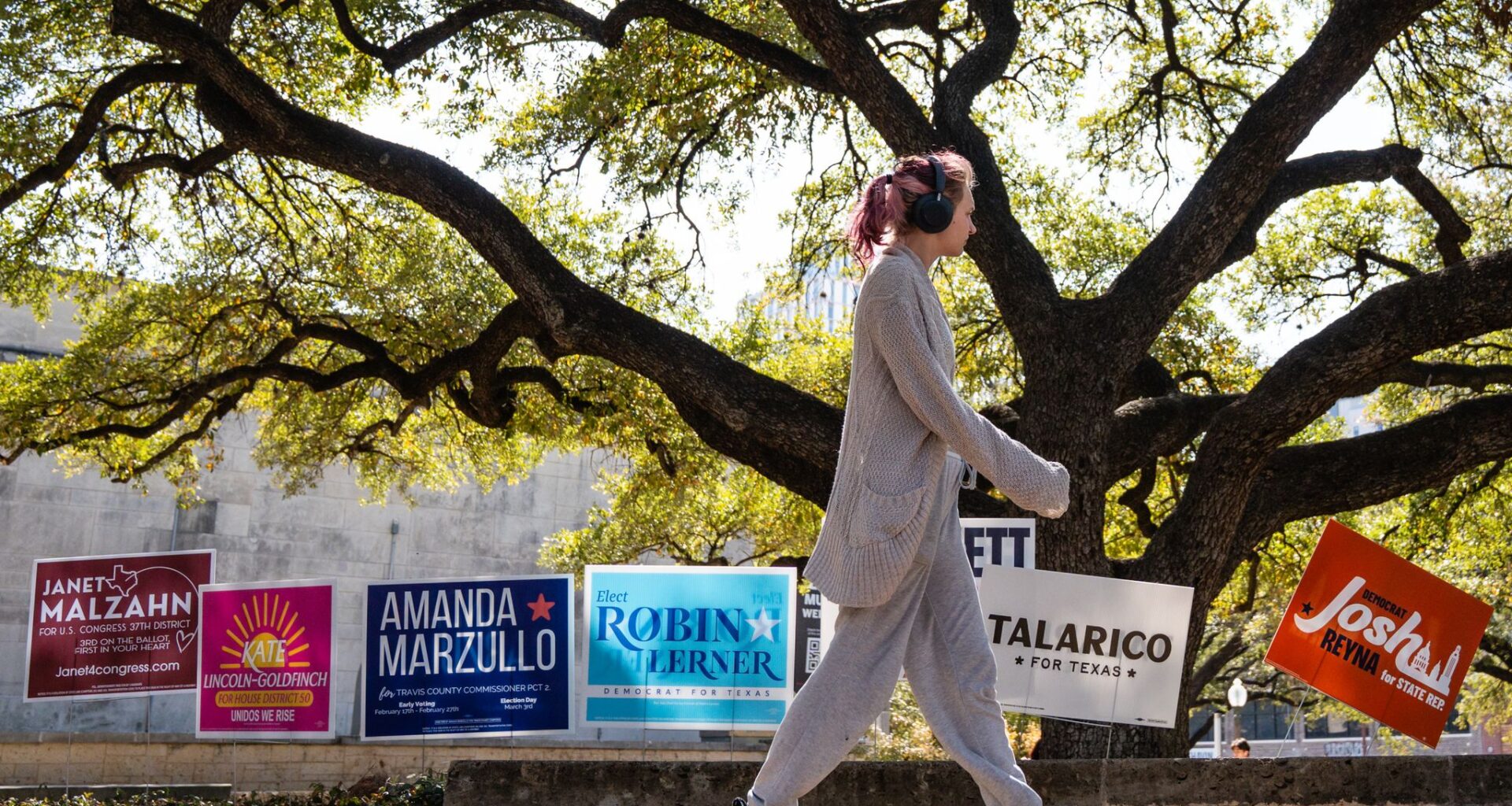
A University of Texas student walks past campaign signs near a campus polling place during the March 3 primary elections. Texas’ primary system forces voters to choose partisan affiliation over candidate merit, Kodi Sawin writes.
Sara Diggins/Austin American-Statesman
I would have picked Hawk Dunlap, voted for Gina Hinojosa and signed Mike Collier’s petition to access the ballot as an independent.

But Texas law wouldn’t let me do all three this primary election season.
Article continues below this ad
These candidates for statewide office chose a public servant’s path. Each understands the depth of the office they sought and the steep road ahead. Yet Texas’ rigid political system prevents voters from supporting candidates individually based on qualifications. Instead, it forces us to choose partisan affiliation over candidate merit.
Here in Texas, we technically have “open” primaries. In practice, the state requires voters to affiliate with either the Republican or Democratic Party during the March primary — or forgo participating in primaries altogether if they want to help an independent or third-party candidate advance to the general election.
Here is how it works: If I wanted to vote for Hawk Dunlap for Railroad Commissioner, I had to vote in the Republican primary. If I wanted to vote for Gina Hinojosa for governor, I had to vote in the Democratic primary. And if I wanted to sign Mike Collier’s ballot-access petition as an independent candidate for lieutenant governor, I would be disqualified from doing so if I had voted in either major party primary or participated in a third-party convention.
Article continues below this ad
ALSO READ: Voter confusion was a choice, not a necessity, in Williamson and Dallas
The constraints don’t end there. Independent candidates trying to qualify for the ballot face sharply compressed timelines to gather required signatures — in the event of a runoff, just 30 days — after major-party candidates have had months to campaign through primaries and runoffs. The system is structured to advantage the two dominant parties and marginalize coalition-building candidates before the general election even begins.
I know this firsthand. I ran for state representative in 2024 as an independent to chip away at a political system built to limit competition. The barriers to reclaiming our voices at the ballot box are many, but Texas primaries are particularly galling. They narrow participation rather than expand it.
In a heavily gerrymandered state like Texas — where most districts are considered safely Republican or Democratic — the primary often determines the eventual officeholder. If a voter chooses not to participate in a party primary in order to support an independent candidate, their voice is effectively sidelined in numerous down-ballot races, including judicial seats and county offices. By November, many of those contests are foregone conclusions.
Article continues below this ad
In other words, the state funnels us into a partisan cattle chute. Candidates are placed on a glide path to elected office before a single vote is cast in the general election — the election where voters who signed an independent’s petition, attended a third-party convention, or simply waited until November are left with little meaningful choice. Statistically, that is a large share of Texans.
SIGN UP FOR THE AUSTIN ANGLE and get Statesman commentaries in your inbox
Local elections have the most direct impact on our daily lives. A wastewater plant does not know whether Republican or Democratic waste flows into its system, and it certainly does not separate water from waste based on party affiliation. A pothole does not distinguish between drivers who voted red or blue when officials decide whether to fund repairs. Governance is practical. Our election system should be, too.
We often hear that primary elections are the elections of consequence. In a state where district lines are weaponized through gerrymandering, that reality has created a widening gap between representative government and the people it is meant to serve.
Article continues below this ad
It is time to reform Texas election laws so voters can select from a single ballot of candidates — regardless of affiliation — on the same day, under the same set of rules. Whether through a top-two primary system or another structure that treats all candidates equally, the goal should be simple: expand competition and empower voters.
Let candidates identify their party affiliation to voters — not force voters to declare their affiliation to the state.
Kodi Sawin specializes in policy at the rural-urban policy nexus, including water and land use issues. She ran in 2024 as an independent for Texas House District 19, which includes west Travis County and part of the Hill Country.
Article continues below this ad