
Guests look at a Tesla Cybertruck at the “Cyber Rodeo” grand opening celebration for the new $1.1 billion Tesla Giga Texas manufacturing facility on Thursday April 7, 2022.
Jay Janner / American-Statesman
A Cybertruck operating with Tesla Inc.’s Autopilot feature allegedly attempted to drive off a Houston overpass, injuring the driver, according to a recently filed lawsuit.

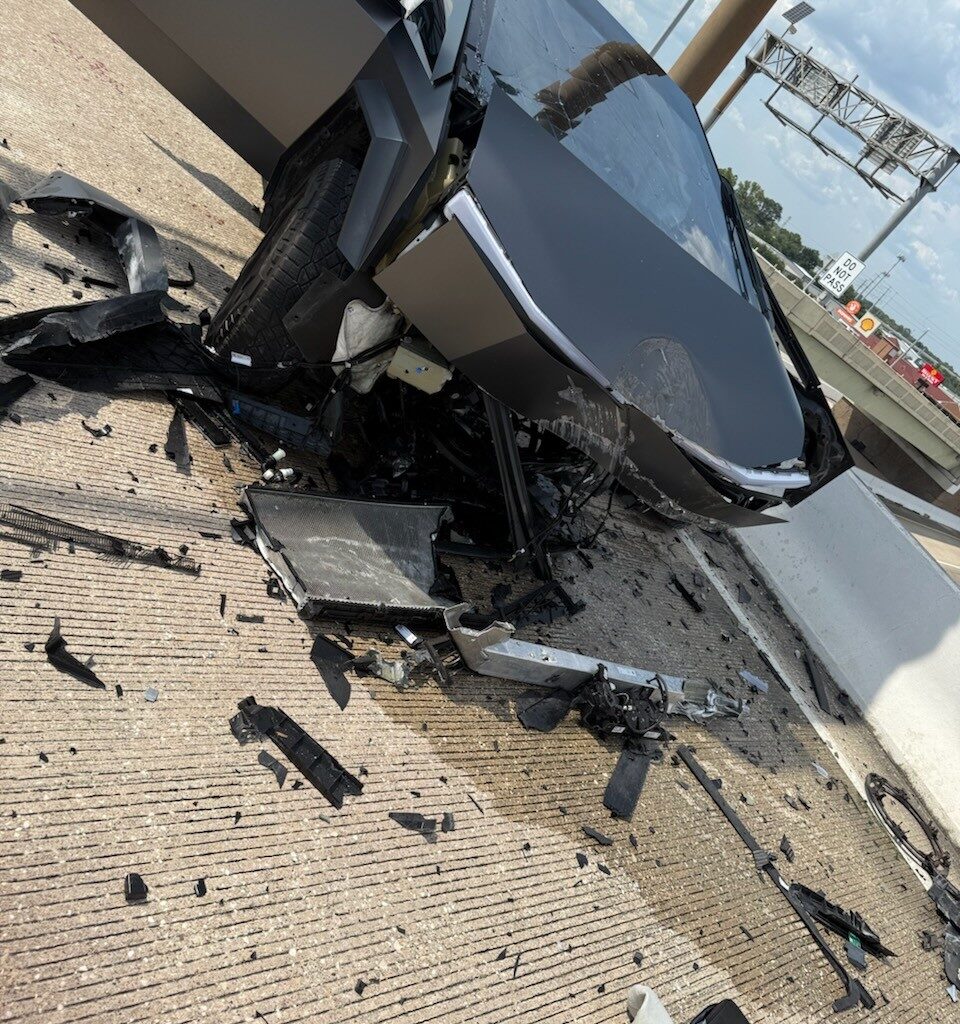
The driver, Houston resident Justine Saint Amour, was in a Cybertruck in August 2025 when the Autopilot-controlled vehicle drove straight into a concrete barrier on a Y-shaped overpass on 69 Eastex Freeway. The vehicle was expected to follow a curve to the right, but when it failed to do so, she disengaged the driver-assistance feature. Still, “it was too late” once she took control of the wheel and the vehicle crashed into the barrier, the lawsuit claims.
Article continues below this ad
The lawsuit, filed in Harris County District Court in late February, came as Tesla was facing accusations from California regulators over misleading advertising for the name “Autopilot.” The Austin-based automaker responded by suing the California Department of Motor Vehicles to reverse the ruling, but still adjusted the name. Navigate on Autopilot is now referred to as “Navigate on Autosteer.”
The incident allegedly caused serious injuries to Saint Amour’s right shoulder, neck and back. She was diagnosed with two herniated discs in her lower back, a herniated disc in her neck, sprained tendons in her wrist, and neuropathy causing numbness, tingling, and weakness in her right hand, attorneys at Hilliard Law said.
She is seeking monetary relief exceeding $1 million over Tesla’s alleged negligence tied to misrepresenting the abilities of Autopilot and failing to incorporate features such as lidar or more effective emergency braking systems, among other acts and omissions.
“Tesla’s decisions made Justine’s accident inevitable. This company wants drivers to believe and trust their life on a lie: that the vehicle can self-drive and that it can do so safely,” Saint Amour’s attorney Bob Hilliard said. “It can’t and it doesn’t. The dashcam footage shows the type of foreseeable scenario where redundancy and override systems matter most.”
Article continues below this ad
Tesla’s driver-assistance systems have landed the company under legal scrutiny before. A class action lawsuit brought in California in 2022 alleged that Tesla “deceptively and misleadingly marketed” its advanced driver assistance systems as autonomous driving technology under the names Autopilot and Full Self-Driving.
Tesla says its Autopilot system is an advanced driver assistance feature that helps enhance safety and convenience behind the wheel. Its Full Self-Driving (Supervised), or FSD, technology is marketed as providing additional advanced driver assistance features for a monthly subscription of $99
A damaged Tesla Cybertruck in seen in Houston following Justine Saint Amour’s crash in August 2025. She is seeking more than $1 million in her lawsuit against the Austin-based the automaker.
Hilliard Law/Courtesy of Hilliard Law
The latest lawsuit filed in Harris County calls out CEO Elon Musk by name, saying his involvement in the design of Tesla vehicles has been “dangerous.”
Article continues below this ad
“While engineers at Tesla recommended the super-human vision of LiDAR be included for self-driving vehicles, and competitors like Waymo and Cruise relied heavily on LiDAR, Musk chose instead to rely only upon cheap video cameras,” the lawsuit says.
Tesla’s reliance on solely cameras for its self-driving projects has been an ongoing controversy, especially as the Tesla prepares to expand its fleet of Robotaxi services and is expected to release the Cybercab, a purpose-built robotaxi, next month.
During Tesla’s 2019 autonomy day, Musk referred to lidar as “lame,” a view not shared by all self-driving enthusiasts. Ford CEO Jim Farley, for example, has called it “mission critical.”
But the method is far more expensive. Some estimates put the cost at about $12,000 per vehicle, which would be a significant sum for Tesla’s Cybercab that it aims to sell for $30,000.
Article continues below this ad
Meanwhile, Tesla’s Austin competitor Waymo boasts lidar’s advantages, saying lidar sensors on its vehicles send millions of laser pulses and measure how long it takes for them to bounce back off objects, giving the vehicle a “a bird’s eye view of what’s around.”
Tesla’s decision to forgo lidar in favor of a camera-only approach is criticized in Saint Amour’s lawsuit.
“The safer design alternatives were technologically and economically feasible at the time the product left the control of Tesla,” the lawsuit reads, adding, “and in a reasonable probability, they would have prevented or significantly reduced the risk of injury in question without substantially impairing the product’s utility.”
Article continues below this ad