
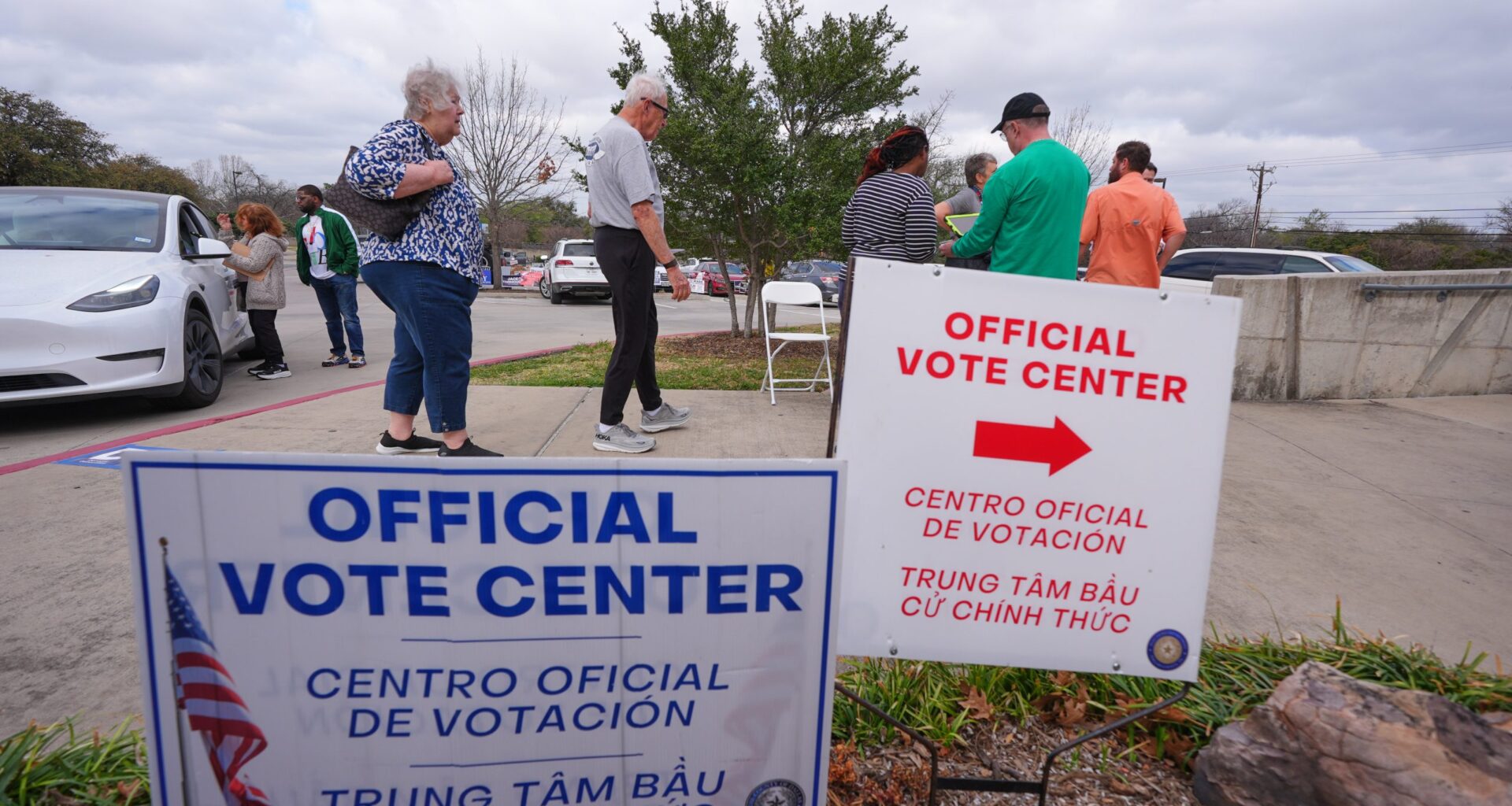
Compared to their urban and suburban counterparts, a greater share of rural voters cast their ballots in the Texas primaries this year.
Texas primary voters turned out in striking numbers this week, with early voting fueling a surge that dominated state headlines. By election night, major outlets reported record-breaking Democratic participation in a closely-watched Senate showdown between US Representative Jasmine Crockett and State Representative James Talarico. On the Republican side, a contest between Senator John Cornyn and Attorney General Ken Paxton energized GOP voters. With neither candidate securing a majority, the contest is now headed to a runoff in May.
The Daily Yonder team crunched the numbers to understand where rural voters fit into the spike in statewide turnout.
Rural counties led the state in voter turnout during the 2026 primaries. About 26% of registered rural voters showed up to the polls on Tuesday, the highest turnout rate among all county types, surpassing major metropolitan counties (24%), suburbs of major metros (25%), small metros (23%), suburbs of medium metros (24%), and medium-sized metros (20%).
The overall turnout exceeded 4.4 million voters, the highest primary turnout in raw numbers in decades, leap-frogging even the 2024 and 2020 presidential primaries. The majority of votes were cast in the Democratic primary, the first time this has occurred since the 2020 presidential primary. In total, more than 24% of registered voters cast a vote in this year’s primary election, compared to 17% in 2018 and 18% in 2022. Together, these figures indicate a notable surge in voter engagement compared with recent primary cycles.
Across partisan primaries, overall turnout in Texas increased 47% compared to the last midterm elections in 2022. Major metropolitan counties posted the largest jump at approximately 66%, followed by suburbs of major metros at 54% and medium-sized metros at 46%. Growth was more subdued in small metro and rural counties, with a 24% and 12% increase, respectively.
It’s important to note that the 2022 Texas election was a gubernatorial race, not a Senate contest, so comparisons with that cycle are not directly one-to-one; however, 2026 turnout still shows a notable surge when compared with previous presidential, senate, and gubernatorial primary years.
Some of the increase in voter turnout can be explained by population growth in Texas between 2022 and 2026. State policy changes have tightened the oversight and monitoring of voter rolls.
The Texas primaries were marked by voter confusion in multiple counties as new voting procedures were introduced. In Dallas County, voters returned to precinct-based polling for the first time since the county adopted countywide vote centers in 2019. Many voters went to the wrong locations, resulting in long lines. Officials in Dallas and Williamson counties initially extended polling hours at some sites, but the Texas Supreme Court later blocked that extension and directed that any ballots cast by voters not in line by 7 pm be set aside until a final ruling.
Rural counties followed the statewide trend of higher participation than in recent election cycles, and their turnout percentage now stands as the highest among all county types, even as urban and suburban areas drove the largest gains in turnout. As the primary season continues across the country, turnout patterns in rural communities will remain an important signal to watch ahead of the general election in November.
Related
Republish This Story

Republish our articles for free, online or in print, under a Creative Commons license.