
Austin’s planned consolidation of city technology staff is facing pushback from some employees concerned about the shift’s cost and possible risks, such as reduced service response times and lost expertise.
The big picture
Several initiatives to reduce expenses and improve government efficiency are now advancing. Those have included departmental strategic assessments, a “reset” of social service spending and a broad new recurring audit program authorized by City Council in February.
Another is the reorganization of technology services citywide, an effort announced by City Manager T.C. Broadnax to align Austin with comparable cities. The project includes centralizing information technology, or IT, employees across all city departments under Austin Technology Services, or ATS.
Broadnax previously reported that Austin’s technology spending and staff headcount are well above peer cities. Those findings came from a review by consultant Gartner Inc., currently working with the city under a five-year $17 million contract.
Chief Financial Officer Ed Van Eenoo told council members technology has become one of the fastest-growing pieces of Austin’s budget.
“It kind of makes sense, right? It’s the technology age, so it’s not too surprising that our technology spend has been growing,” he said. “But given the harsh realities of the financial constraints we find ourselves under, the historic growth rate really isn’t sustainable.”
 City leaders say Austin’s IT practices are out of line with similar governments. (Courtesy city of Austin)Planning for the reorganization, including reviews and recommendations from third-party consultants, has been in progress since last May. As that work continues, members of the city and county employees’ union AFSCME Local 1624 are now asking Austin to halt the “One ATS,” or OATS, initiative and find other ways to roll out structural improvements.
The city didn’t respond to questions about the consolidation initiative, its costs and potential savings, and comments from AFSCME members as of press time March 5. This story will be updated.
Put in perspective
AFSCME leaders delivered an open letter to city management March 4 raising alarm about the ATS consolidation. They claimed several Austin department heads previously outlined significant risks to city operations and services, infrastructure and safety if specialized technology workers are removed from their current teams.
David Cruz, an AFSCME leader and Austin Housing planner, said external consultants produced “misleading” claims about city IT staff to justify the reorganization and questioned any eventual cost savings. Similar IT consolidations in other cities have been unsuccessful and lost valuable data, AFSCME Business Manager Carol Guthrie said.
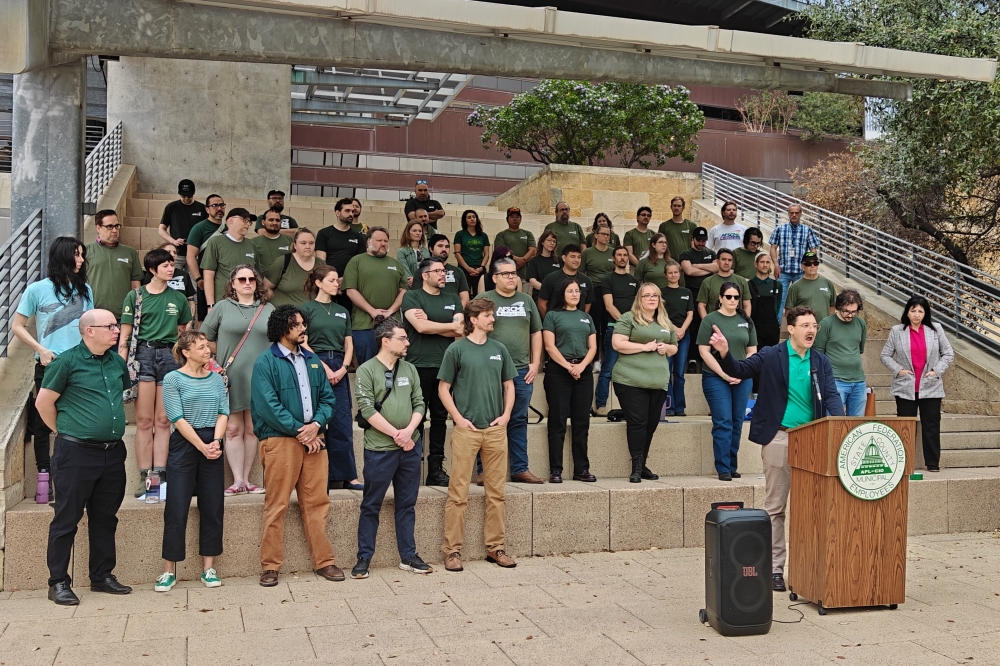
 AFSCME Local 1624 presented concerns with Austin’s information technology consolidation to city leaders March 4. (Ben Thompson/Community Impact)Other employees highlighted how removing staff experts from their departments could affect the public.
Amenity Applewhite, an Austin Transportation & Public Works data architect, said close IT coordination is key for the city’s Vision Zero traffic death and injury reduction program, and worried its reported impacts on crashes in town could be reduced. Ashlee Kraus, a program manager with Austin Public Health, said a restructuring in that department could leave residents’ sensitive medical data unprotected.
Braniff Davis, a senior geospatial analyst at Austin Fire, said removing technical workers from their departments could slow civic responses to fires, floods and other emergencies.
“With absolutely no nuance, the city decided that because we have ‘IT’ in our titles and because we use software to do one aspect of our jobs, that is all we are,” Davis said at a March 4 rally. “Because of the appearance of cost savings, the city has decided that having subject-matter experts does not matter. By pushing One ATS, the city has decided that public safety does not matter.”
 Public employees rallied against Austin’s proposed information technology consolidation March 4. (Ben Thompson/Community Impact)An update about the ATS reorganization from city leadership was also presented to council members March 4. Austin Chief Information Officer Kerrica Laake reported the multiyear process, including employee transitions planned to start this spring, is advancing given “duplicate functions, redundant systems, inconsistent standards” and departments’ unequal IT growth.
She also acknowledged it’s drawing a mixed reception from city staff so far, and that the city is taking feedback into consideration. ATS is holding workshops about the upcoming changes and responding to employee questions through a website, she said.
“We have people who are excited about working in a larger organization where they have more defined career opportunities and career paths in technology leaders, and as a pure technologist,” Laake said. “On the other hand, we have people who are concerned about the change. They are very aligned to the mission of their departments, and it is something new.”
What else?
The push from some to adjust course on One ATS comes weeks after officials passed a new policy requiring city management to consult with AFSCME on major personnel decisions. That action, promoted by council member Mike Siegel, established a new consultation committee for city and union representatives to discuss labor issues on a regular basis.
Van Eenoo said the new consultation process will be used to hear AFSCME’s concerns about the ongoing One ATS process across multiple upcoming meetings.