
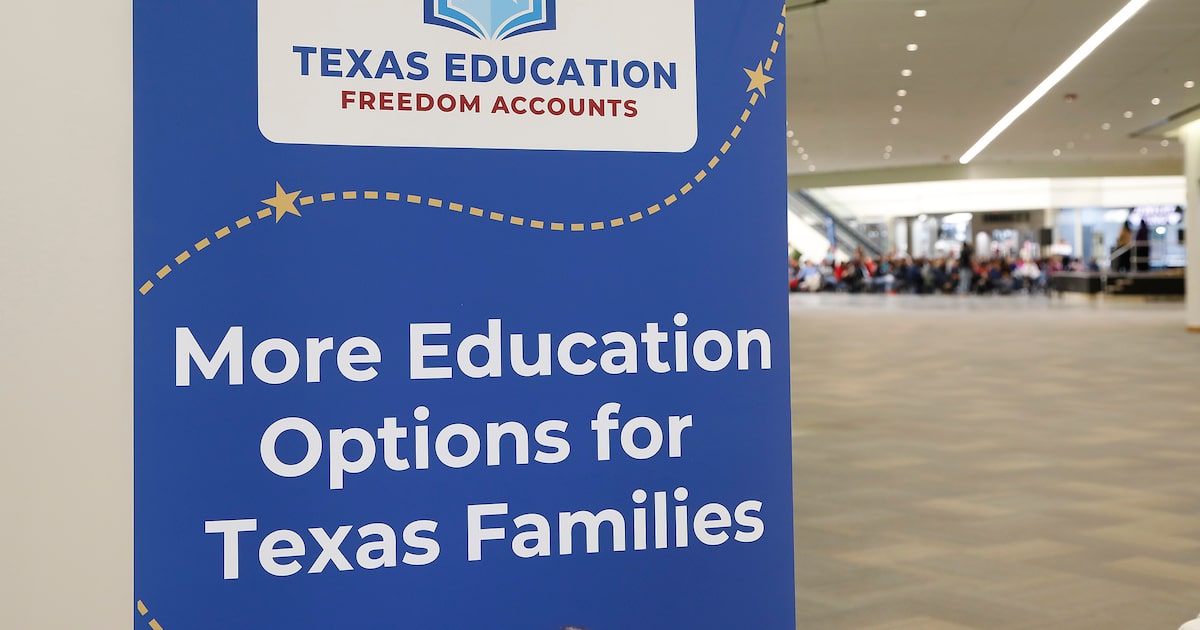
As part of Texas’ $1 billion school voucher-style program, children with disabilities can receive up to $30,000 to go toward private schooling this fall.
Lawmakers have promised Texas Education Freedom Accounts will prioritize low-income students and students with special needs. About 847,000 Texas public school students are in special education programs, according to 2024-25 state data.
Special education became a focal point during lawmakers’ discussions about establishing TEFA. Questions about how this program would serve students with special needs have emerged as a key source of tension in the school choice debate.
Supporters argue that TEFA better allows families to afford schools that meet their child’s needs. Critics worry that the state aid will funnel money away from cash-strapped public school districts, which are legally obligated to provide a free education and services to students with disabilities.
The Education Lab
Related

Here’s what families should know about TEFA.
Are private schools required to admit children with disabilities?
Of the roughly 1,500 accredited private schools in Texas, about 50 serve students with special needs exclusively, according to the Texas Private Schools Association. Most are concentrated in metropolitan areas, like Dallas-Fort Worth and San Antonio. About 75% of Texas private schools serve students with special needs in some capacity.
Private schools can deny admission to students for their own reasons. On the other hand, public schools are required to serve every child.
In a 2022 survey, conducted by the Texas Private Schools Association, 35% of private schools said they would enroll additional students with special needs; another 54% said maybe.
How do protections in a private school compare with a public one?
School choice critics worry that special needs students would lose legal protections if they switch to private schools.
In public schools, students are protected under federal laws, like the Individuals with Disabilities Education Act and Americans with Disabilities Act. Public schools are required to work with families to provide an individualized education program, or IEP.
Private schools do not have to develop an IEP. However, ADA requires private schools to ensure that students with disabilities are not excluded or treated differently.
Texas’ public school system has had a contentious history with serving students with special needs. In 2018, federal officials found that Texas schools denied special education services for students. The U.S. Department of Education launched its investigation after the Houston Chronicle reported that the Texas Education Agency sought to cap special education enrollment at 8.5%.
Related
 How do students with a disability apply for TEFA?
To qualify, the student must have an IEP on file with the Texas Education Agency. While students can receive up to $30,000, the awarded amount is based on the cost for the child’s local school district to provide the IEP.
Applications for the upcoming school year opened Feb. 4 and will close March 17. Parents should know starting in April whether they have been approved for an account.
Related
 Will students with disabilities be prioritized in the program?
In less than three weeks, more than 123,000 students applied to the program, which is expected to serve about 100,000 students in its first year. Since the number of applicants exceeds the available program funding, the Texas comptroller’s office, which runs TEFA, will prioritize certain applicants.
TEFA will give first preference to special needs children whose household income is at or below 500% of the federal poverty level — or $165,000 for a family of four.
The DMN Education Lab deepens the coverage and conversation about urgent education issues critical to the future of North Texas.
The DMN Education Lab is a community-funded journalism initiative, with support from Bobby and Lottye Lyle, Communities Foundation of Texas, The Dallas Foundation, Dallas Regional Chamber, Deedie Rose, Garrett and Cecilia Boone, Judy and Jim Gibbs, The Meadows Foundation, The Murrell Foundation, Ron and Phyllis Steinhart, Solutions Journalism Network, Southern Methodist University, Sydney Smith Hicks, and the University of Texas at Dallas. The Dallas Morning News retains full editorial control of the Education Lab’s journalism.