
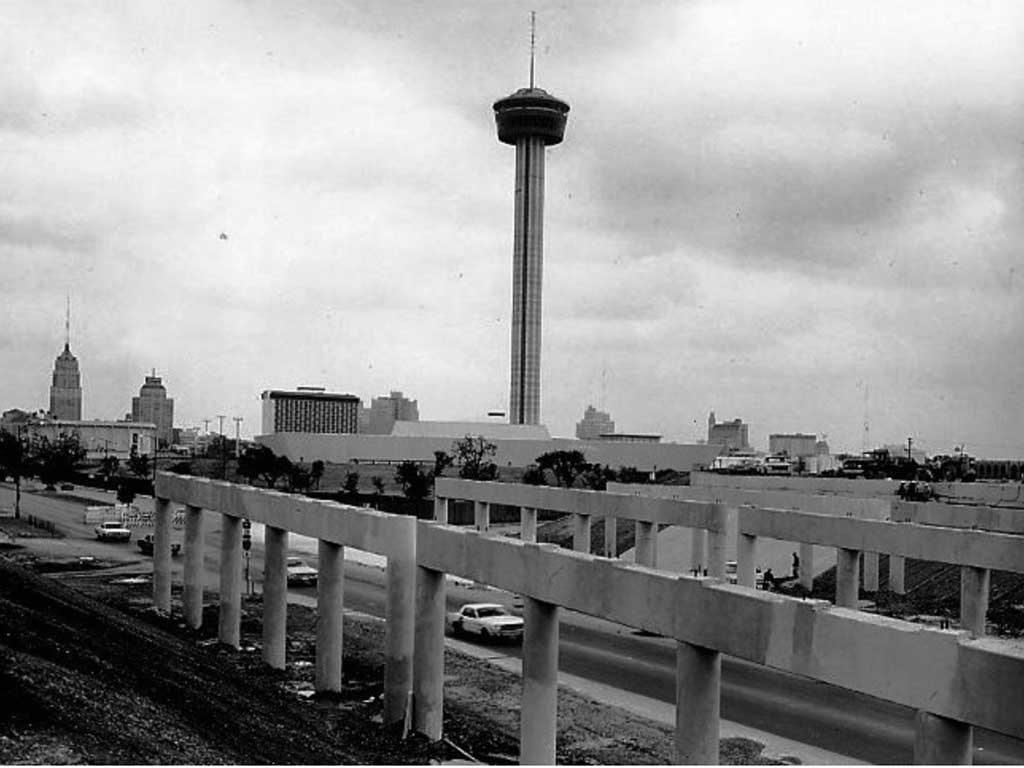
The San Antonio City Council on Thursday gave the go-ahead for a consulting firm to come up with plans for how to connect the East Side and downtown, two neighborhoods spliced long ago by Interstate 37.
The goal is to improve pedestrian and bicycle infrastructure and make the area safer and more walkable for people traveling between Hemisfair, the convention center and a planned sports and entertainment district in the urban core and the Alamodome, hotels and other venues on the east side of the highway.
A public input process toward defining problems and solutions is expected to kick off in April.
The council signed off on handing the $3.7 million contract for the study to Dallas-based global infrastructure planning and engineering firm AECOM Technical Services.
AECOM counts among its projects the 1,776-tall One World Trade Center in New York City, the Mercedes-Benz Stadium in Atlanta and Warner Bros. World in Abu Dhabi.
The connector study project is expected to start this month and continue through the end of the year.
Funding for the study includes almost $3 million from a U.S. Department of Transportation Neighborhood Access and Equity Planning Grant, and $740,000 for the 20% local match that will come from the city’s Hotel Occupancy Tax Redemption and Capital Fund.
The study will focus on the nearly 2-mile stretch of I-37 from Houston Street to Carolina Street, an area that encompasses the future sports and entertainment district, Project Marvel and the Alamodome.
A city memo calls the potential connector an attempt at creating a “seamless urban experience.”
But it might not be the grassy and inviting land bridge like the one proposed in full-scale renderings during the rollout of Project Marvel, a well-baked plan kept under wraps until late 2024.
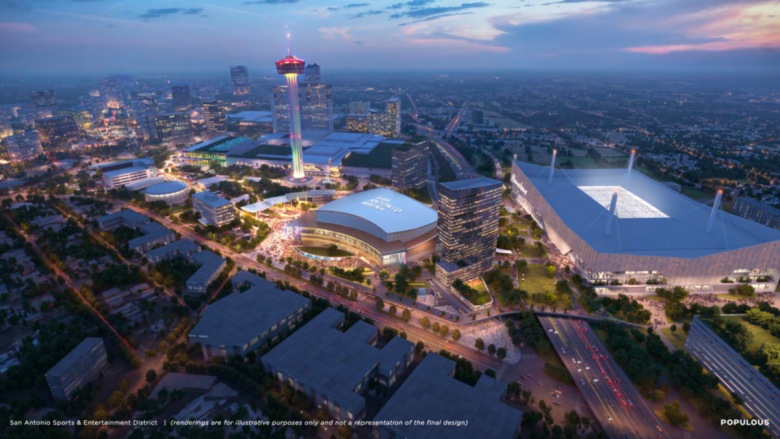 A rendering of the proposed downtown sports and entertainment district known as Project Marvel is shown. Credit: Courtesy / Populous
When Bexar County voters backed Project Marvel plans in November, they did so based on a sweeping proposal that included renderings of not just a new Spurs arena but also a potential land bridge reconnecting the East Side to downtown.
The city even had the start of funding for such a project, one similar to the $23 million Robert L.B. Tobin Land Bridge built over Wurzbach Parkway to connect the two sides of Phil Hardberger Park in 2020.
A $2.9 million federal grant designed to help reconnect communities that have been divided by highways, authorized for San Antonio in March 2024, would allow the city to start making those plans. The grant money came as San Antonio leaders had also collected federal money for other projects, and had been encouraged by the previous administration to apply for more.
But by early 2025, the city was less certain that funding would materialize, Chief of Financial and Administrative Services Ben Gorzell told the council at a January meeting.
In October, city officials were already backing away from plans for the land bridge along with other parts of the $3-4 billion Project Marvel.
Speaking on a CityFest panel, City Manager Erik Walsh said the land bridge had been ruled out due to lack of federal support, though it could come back into the picture sometime in the future.
At the same time, Mayor Gina Ortiz Jones also said the city had begun to pause federally funded projects that might no longer be feasible under the Trump Administration.
In January, Gorzell told city leaders that the grant funding had in fact been secured but had to be spent by the end of the year.
Officials then moved forward with a bidding process for the planning work that it could result in alternatives to a land bridge, with things like neighborhood-scale projects — sidewalks, crosswalks, mid-block crossings, bike paths. The study could also recommend a land bridge, underpass or pedestrian bridge, he said.
Construction on I-37 downtown was completed in the late 1960s effectively creating a barrier between neighborhoods where people and streetcars once flowed more freely.
Redlining of Eastside neighborhoods had already occurred in the 1930s, so despite the Alamodome’s presence and other attempts to revive the district, it has struggled to recover economically.
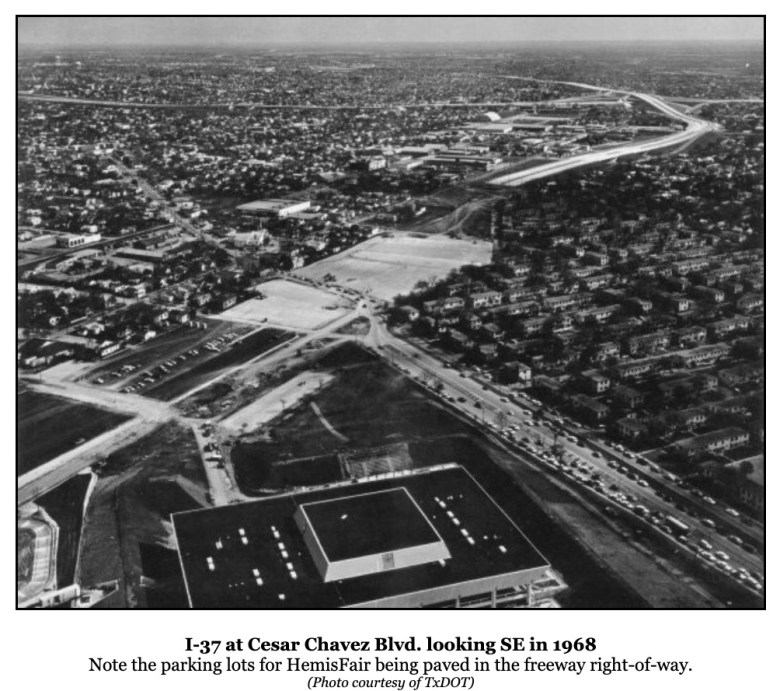 I‑37 at E. César E. Chávez Blvd looking South East photographed in 1968. Credit: Courtesy / Texas Highway Man
City documents also state that because the connector study project uses federal dollars, the city was required to follow the rules of the state’s Disadvantaged Business Enterprise Program (DBE), which is intended to give small business owners an equal shot at government contracts, in selecting a contractor.
But, although DBE goals were initially set for the project, they no longer applied due to a 2025 ruling by the federal government prohibiting the use of DBE goals that use race- and gender-based presumptions, calling them unconstitutional.