
Israel is expected to do what no other country on earth has done or would do: admit into its sovereign territory millions of people who reject the very basis of the country into which they seek passage.
This so-called “Palestinian Right of Return,” which has been central to Palestinian identity and refugee mythology since 1948, was passed as UN Resolution 194, Section 11. It “resolves that the refugees wishing to return to their homes and live at peace with their neighbors should be permitted to do so at the earliest practicable date, and that compensation should be paid for the property of those choosing not to return and for loss of or damage to property …”
Nearly 80 years ago, the UN Partition Plan called for the partition of Palestine into Arab and Jewish states. The Palestinians rejected the partition plan. In addition, armies from five Arab nations – Egypt, Jordan, Lebanon, Syria and Iraq – chose to fight the State of Israel. The Arabs lost the war.
Some 750,000 Palestinians fled or were forced out of Israel as a result of the war. To allow them to return would have been like committing suicide for the young Jewish state. The United Nations Relief and Works Agency for Palestine Refugees (UNRWA) was created in 1949 to provide humanitarian relief to Palestinian-Arab refugees. It was intended to be a short-term organization, to help get the refugees get back on their feet and get them off welfare.
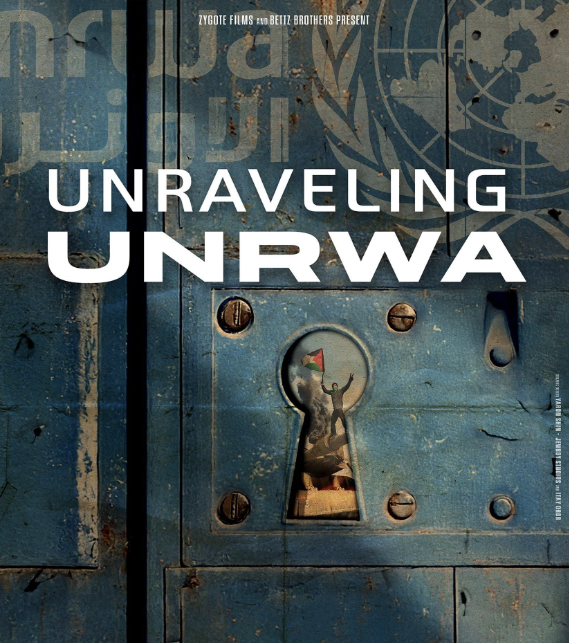
A new documentary film, “Unraveling UNRWA,” charges that UNRWA employees participated in the Hamas-led Oct. 7, 2023, massacre in Israel. Critics assert UNRWA fuels the war against the Jewish state and, through its education programs, fuels the vision that one day there will be no Jewish state.
“Unraveling UNRWA” will screen on Tuesday, March 24, at 7:30 p.m., in the Kaplan Theatre at the Evelyn Rubenstein JCC. The film is part of this year’s Houston Jewish Film Festival.
Up until 1924, when it paused funding, the U.S. was the largest donor to UNRWA, giving the agency some $300 million a year. It’s the sole U.N. agency set up for one set of refugees – the Palestinians.
In 1949, two solutions to the Palestinian refugee problem were proposed: resettlement or return. Jordan and Egypt offered land for resettlement. But many Palestinians argued that any solution other than return was treason. The Arab nations that set up Palestinian refugee camps also did not support any sort of resettlement programs in their territories.
In the film, Zlatko Zigic, former director of the U.N. migration agency from 1997 to 2017, says “the problem of UNRWA is the concept of endless struggle of Palestinians to return,” adding that maintaining a right of return to Israel has “become a tool to perpetuate the conflict.”
The film brings to light that during the early 1950s, the U.N. created another agency, UNKRA, to provide relief and rehabilitation to South Korea during and after the Korean War. UNKRA built schools, factories and hospitals, improved agricultural systems and served some 3.1 Korean refugees.
By focusing on long-term development rather than immediate humanitarian aid, UNKRA set the foundation for South Korea’s later industrialization.
UNRWA, in contrast, was successful in providing education to the next generation of Palestinians. A significant part of that education was the indoctrination of the idea that Israel was a colonial power that unfairly deprived Palestinians of their homes.
After the 1967 war, Israel became administrators of those Palestinians who were living in Gaza and the West Bank. Education, welfare and health services continued to be run by UNRWA. And the number of refugees continued to grow, from 750,000 to some 6 million.
Who decides what qualifies a person as a refugee? UNRWA considers all descendants of Palestinians to be “refugees” for an unlimited number of generations. UNRWA defines “Palestinian refugees” to include all offspring of male Palestinian refugees from 1948, including legally adopted children, regardless of whether they have been granted citizenship elsewhere.
On its own website, UNRWA states that “the principles of humanity, impartiality, neutrality and independence are at the heart of all UNRWA operations.”
“Unraveling UNRWA” raises serious doubts as to whether the agency truly follows the principles of impartiality, neutrality and independence in their day-to-day operations.
Tickets to “Unraveling UNRWA” and other Houston Jewish Film Festival films are available at erjcchouston.org/filmfest..