
Allen ISD officials plan to report back to the state an estimated cost for complying with a new law that requires school buses to be equipped with three-point seatbelts.
The overview
Senate Bill 546 was passed by the Texas Legislature in 2025 and requires that all school buses operated by the school district must be equipped with seatbelts for every passenger. The deadline for full compliance with the law is Sept. 1, 2029, but the state is requesting estimated costs from districts by the end of the current school year.
It would cost $20.79 million to replace all buses that currently don’t have three-point seatbelts, said Clint Cypert, executive director of support services. It would cost nearly $3.46 million to retrofit buses that don’t have three-point seatbelts.
Cypert reviewed Allen ISD’s current bus fleet size and condition during a March 2 board of trustees workshop. District officials are planning to report estimated costs in order to be eligible for any state grant funding.
“We want to make sure that we can access those state funds if that’s at all possible,” said Kyle Penn, assistant superintendent of business and technology.
A closer look
A grant opportunity will be made available to school districts that report estimated costs, according to the Texas Education Agency’s website. Exact funding is yet to be determined.
“We don’t have the specifics,” Penn said. “I think they are going to need the information from each of the districts to then tell us what the funding would look like.”
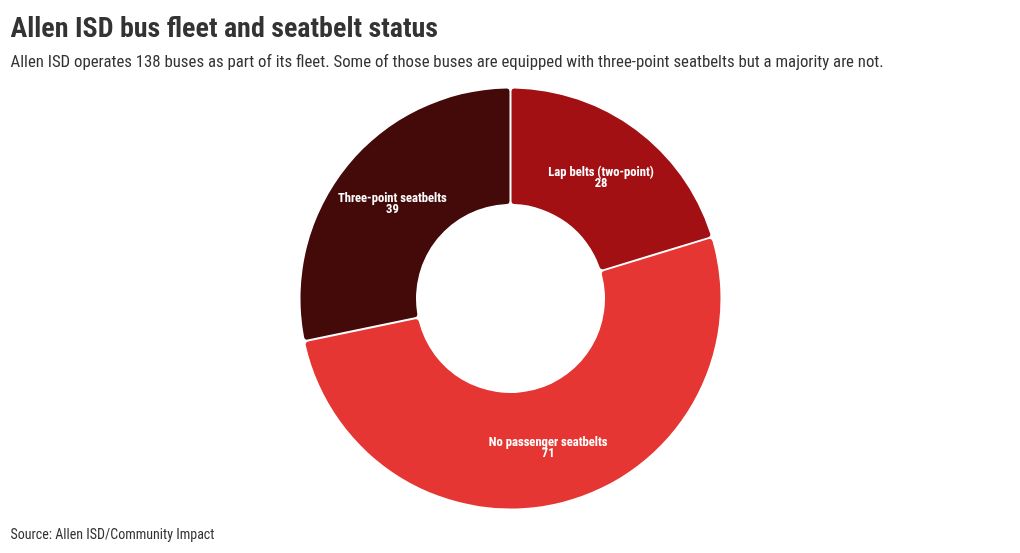
Allen ISD currently maintains a fleet of 138 buses, 39 of which are fully equipped with three-point seatbelts, according to Cypert’s presentation. The remaining buses either have two-point seatbelts or none.
 The cost
District officials are planning to purchase 18 replacement buses with three-point seatbelts over the next two years. That purchase, if approved by the board of trustees, would be funded by the voter-approved bond proposition passed in 2024.
The remaining buses without three-point seatbelts would be due for replacement between 2028 and 2038, Cypert said. Those replacements are not funded by the bond. Officials look at multiple factors, including bus age, mileage and maintenance needs, and reliability, according to Cypert’s presentation.
Besides the bus replacements already scheduled as part of the 2024 bond proposition, funds have not been allocated for this project, Penn said.
“The general fund, as we know, does not have the capacity to take on a cost like that,” he said. “We’re trying to use that to recruit and retain our staff and put the money in the classrooms.”
Instead, officials want to see what information on grant opportunities will be shared from the state, Penn said. At that point, they can look at phasing in new buses with access to grant funding.