
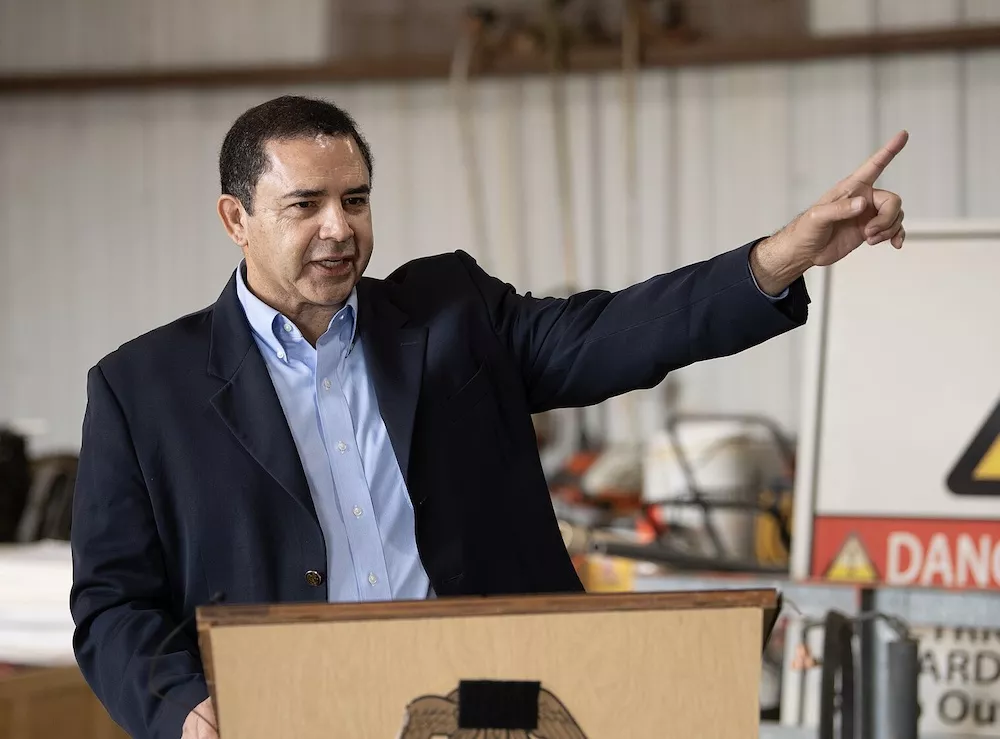
 U.S. Rep. Henry Cuellar speaks at an event held at a South Texas business. Credit: U.S. Department of Agriculture
South Texas Congressman Henry Cuellar was one of just four Democrats who helped defeat a U.S. House resolution which would have removed U.S. troops from Iran.
Cuellar joined Democratic U.S. Reps. Greg Landsman, Jared Golden and Juan Vargas and all but two House Republicans in a Thursday afternoon vote defeating a resolution to limit President Donald Trump’s ability to take unchecked military action against Iran without congressional approval.
All four Dems who voted against the resolution have accepted money from the American Israel Public Affairs Committee (AIPAC), a bipartisan lobbying group that advances the interests of the Israeli government, according to FEC reports.
Cuellar, whose District 28 includes parts of San Antonio, has accepted $3.2 million in donations over the course of his career from the pro-Israel lobby and its megadonors, according to grassroots transparency group AIPAC Tracker. That’s the second highest amount of AIPAC-tied donations of the four Dems who voted against the resolution. Only Golden has accepted more at $3.4 million.
Thursday’s Iran resolution failed on a 212-219 vote. Given Republicans’ narrow majority in the House, the measure would have passed had the four Democrats voted with the rest of their party.
The two Republicans who broke ranks were U.S. Reps. Thomas Massie of Kentucky and Warren Davidson of Ohio. Massie was a co-sponsor of the resolution along with U.S. Rep. Ro Khanna, a progressive Democrat from California.
The U.S. joined Israel in attacking Iran, according to Secretary of State Marco Rubio, because of the “imminent threat” posed by Israel’s planned missile strikes in the region. He said U.S. intelligence believed Israel’s action was sure to lead Iran to make a retaliatory strike on U.S. bases in the region.
“We knew that there was going to be an Israeli action, we knew that that would precipitate an attack against American forces, and we knew that if we didn’t preemptively go after them before they launched those attacks, we would suffer higher casualties and perhaps even higher those killed, and then we would all be here answering questions about why we knew that and didn’t act,” Rubio said in remarks still posted on the State Department’s website.
However, Trump has since contradicted that narrative in the press, and Rubio later backpedalled on the revelation that there was no credible threat posed by an unprovoked Iran.
Only one in four Americans approve of the U.S.-Israel strikes on Iran, according to a Reuters/Ipsos poll. Experts point out this early, overwhelming opposition — that even crosses political lines — is nearly unprecedented compared to previous conflicts, for which there is usually an initial “rally ’round the flag” effect, CNN reports.
U.S. Central Command projects the conflict will last more than 100 days, “likely through September,” Politico reports. Meanwhile, the broadening Middle East conflict is costing U.S. taxpayers more than $1 billion daily, according to Pentagon preliminary estimates tabulated by Iran Cost Tracker.
Sign Up for SA Current newsletters.
Follow us: Apple News | Google News | NewsBreak | Reddit | Instagram | Facebook | Twitter | Or sign up for our RSS Feed
Related Stories

Sticking an ICE detention site on the city’s economically depressed East Side would further hurt the area’s chances of bringing in new jobs, Mayor Gina Ortiz Jones said in a letter.

After years of bipartisan carveouts from Congress, plans for the border wall now cut through wildlife refuges and cultural sites in the Rio Grande Valley.
The Laredo congressman joined Republicans and six other Democrats in voting to give billions more to the agency, even as public furor builds over its aggressive enforcement actions.