
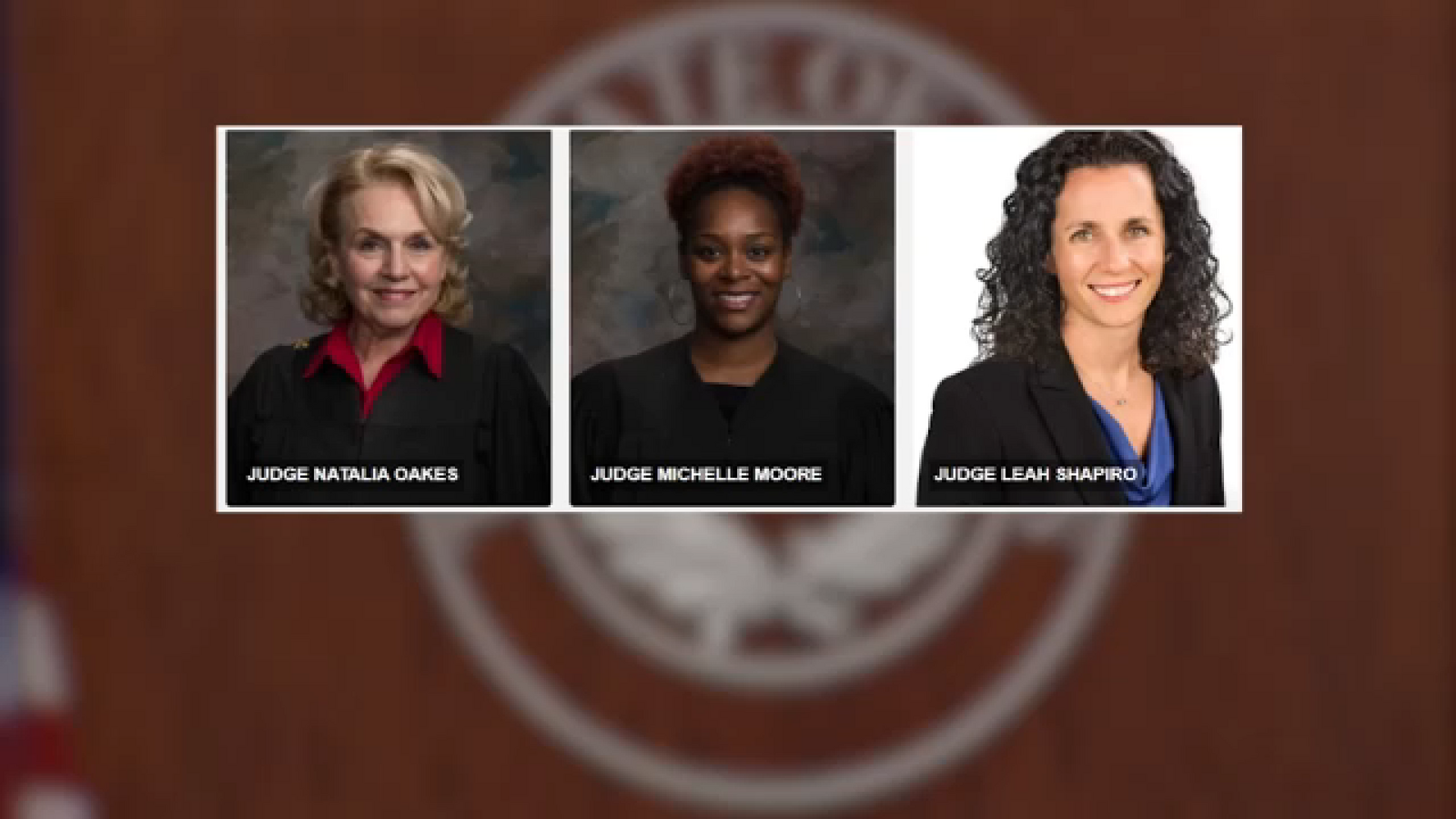
HARRIS COUNTY, Texas (KTRK) — When it comes to deciding whether violent juvenile offenders should finish their sentences in adult prison, Harris County judges do not always reach the same conclusions.
In January, Eyewitness News reported on a controversial decision by District Judge Leah Shapiro, who allowed a teen found delinquent in a fatal shooting to go free on probation instead of transferring him to an adult prison in the Texas Department of Criminal Justice (TDCJ).
Five months later, that teen was back behind bars, accused of new violent crimes.
Court records show that Edmound Guillory, 19, had already been sentenced to 17 years in the juvenile system for the 2022 shooting death of Anthony Merchant.
Before Guillory turned 19, the age when, by law, judges must decide whether to terminate a juvenile’s sentence, release the juvenile on probation, or transfer the juvenile to the adult system, the Harris County District Attorney’s Office (HCDAO) said they asked the court to send him to adult prison.
Instead, Judge Shapiro of the 315th District Court released Guillory on probation and ordered him to wear an ankle monitor.
Court records show Guillory cut off the monitor in January.
Three days later, Sugar Land police say Guillory and three other teens beat a jailer unconscious and escaped after being arrested for an armed robbery at a CVS.
Veteran prosecutor John Jordan said prosecutors had warned the court.
“In real time, we thought this young man was a threat to the community,” Jordan, the HCDAO’s Executive Bureau Chief, said in January. “There are other victims now that didn’t have to be that way.”
Because juvenile records are sealed under Texas law, much of Guillory’s juvenile history only became public when he was charged as an adult.
So how do the county’s three juvenile court judges compare when it comes to transferring serious offenders to the adult system?
ABC13 requested data from the Harris County Juvenile Probation Department showing how often each of the county’s three juvenile court judges transfers violent offenders to the adult system.
The numbers show significant differences.
Over a three-year period, Judge Shapiro transferred 64% of violent cases, including murder, robbery, and sexual assault, to adult court. Judge Natalia Cokinos Oakes transferred 78% of violent cases. Judge Michelle Moore transferred 96% of violent cases.
Retired juvenile court judge Mike Schneider said differences between judges are not unusual.
“Different judges are different people,” Schneider said. “Judges are human. They have different biases, different interests, different philosophies, so you are going to see reasonable people can make extremely different decisions.”
Schneider added that juvenile courts often focus on rehabilitation rather than punishment, but said that judges must weigh the interests of the juvenile offender against the safety of the community.
“Ultimately, it is the decision of an individual to reoffend,” Schneider said. “But one of the responsibilities judges have is to look at the relevant information and try to figure out a way that balances what’s in the best interest of that child versus the best interest of the community.”
The Texas Code of Judicial Conduct prevents judges from commenting on specific cases, and Judges Shapiro and Moore, both up for re-election in November, declined ABC13’s request to discuss their widely different records.
ABC13 also requested detailed data on what types of crimes are, and are not, being transferred to adult court.
The Harris County Juvenile Probation Department provided data but said it may not be fully accurate.
Sources inside the juvenile justice system told ABC13 the lack of reliable records is concerning. The department did not respond to questions about why more precise records are not maintained.
For more on this story, follow Jessica Willey on Facebook, X and Instagram.
Copyright © 2026 KTRK-TV. All Rights Reserved.