
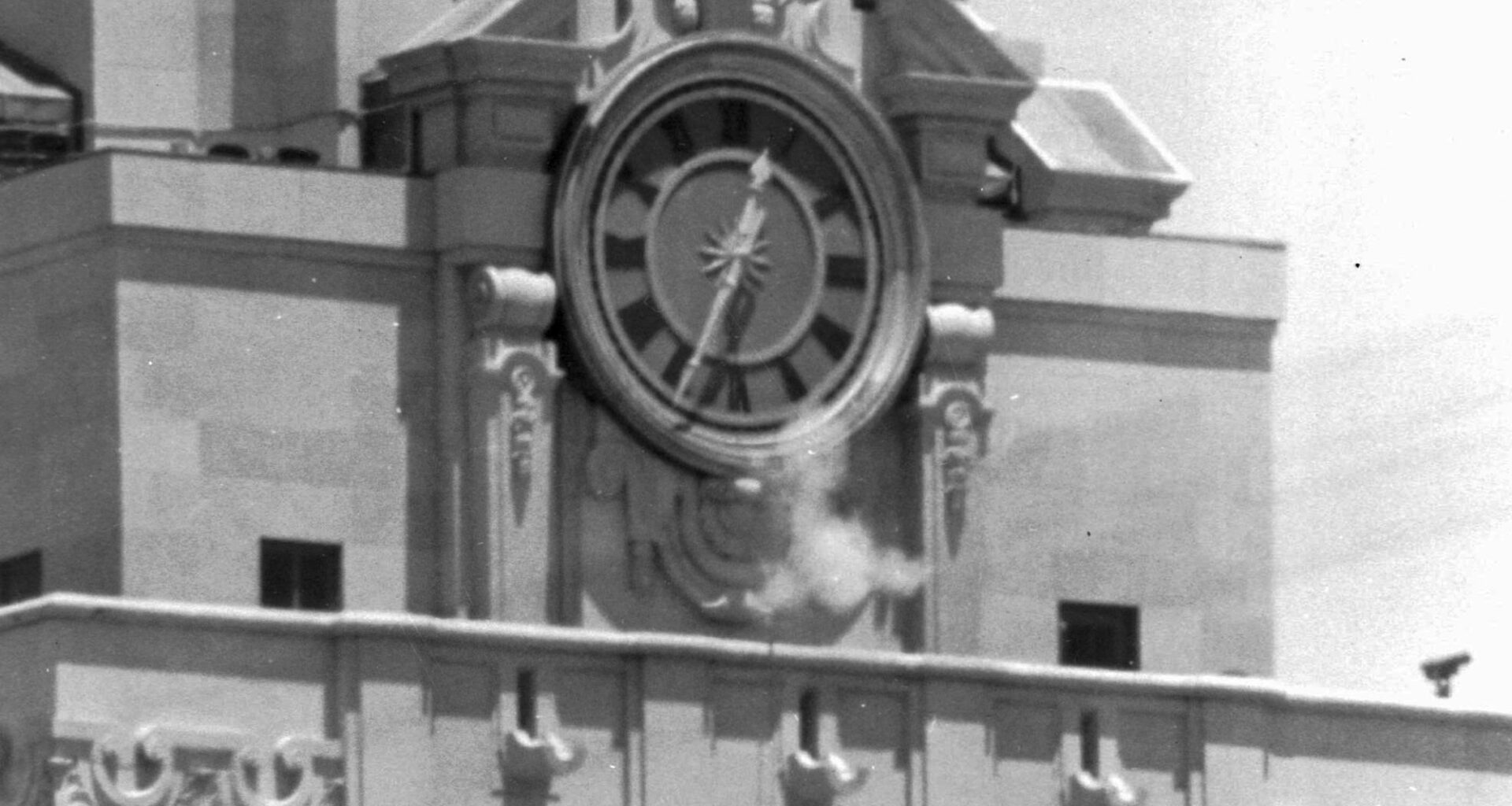
Smoke rises from a sniper’s gun as he fires from the tower of the University of Texas administration building at crowds below in this Aug. 1, 1966 photo. The violent incident, which lasted more than 90 minutes, was among the first mass shootings on a school campus in American history.
AP
In the early hours of March 1, a lone gunman shot 18 people at or near a West Sixth Street bar.

Three of his victims have died: Jorge Pederson, Ryder Harrington and Savitha Shan.
Article continues below this ad
On the scene, officers shot and killed the shooter, leaving four people dead among a total of 19 casualties.
This jarring crime has been rightly called “one of Austin’s deadliest mass shootings in recent history.”
While the first waves of shock and sadness rolled through the city, journalists, historians and public figures reached into the past to help make sense of this week’s violence.
Particular comparisons have been made to the Aug. 1, 1966 shootings at the University of Texas Tower. From his sniper’s perch, U.S. Marine veteran Charles Whitman killed 15 people — including an unborn child — and injured 31 others.
Article continues below this ad
Before the tower shooting, he killed his wife and mother at their homes, making his total murder count that day 17.
This unfolded at a time when police and medical personnel were not prepared for rapid responses to such large-scale outbreaks of violence.
Officers shot Whitman, leaving 18 people dead.
Yet it was hardly the city’s only brush with mass violence. Several past crimes have left permanent scars on the city’s collective memory.
Article continues below this ad
University of Texas Austin campus during and after the Charles Whitman UT Tower shooting on August 1, 1966. Witnesses to events unfolding Aug. 1, 1966. Photo by Robert Anschutz Austin History Center PICA 37431
Austin American-Statesman
Deadly day: 1966 UT Tower shooting
The UT Tower tragedy is often described as the first mass civilian shooting of the American modern era. Certainly, it was one of the first of its kind committed on a school campus.
Numerous books, movies and TV shows have documented the crime, yet experts still disagree on what drove the shooter to kill his mother and his wife, drag a cache of weapons all the way up to the tower’s observation deck, and then use his military training to shoot at those passing by for more than an hour and a half.
Article continues below this ad
The best book on the subject is the thoroughly researched and even-handed “A Sniper in the Tower: The Charles Whitman Murders” by Gary M. Lavergne (University of North Texas Press).
The most powerful of the movies and TV shows is the 2016 documentary, “Tower,” produced and directed by Keith Maitland.
Mostly animated, it is based on a 2006 Texas Monthly article, “96 Minutes,” by Pamela Colloff. It can be streamed on YouTube, Apple TV, Amazon Prime and through other providers.
Based on interviews with survivors and archival searches, the Statesman in 2016 published a 50th anniversary story about the shootings under the headline “Otherwise engaged: Austin in 1966 before and after the Tower shooting.”
Article continues below this ad
The unexpected conclusion: Although witnesses, police officers, medical personnel and others bore — and still bear — the trauma of that hot, unthinkable day, most of the city, and even the UT campus, returned to a semblance of normalcy quickly.
“In the quiet morning hours of Tuesday, there were those who had come to see more and others who, painfully and unwillingly, had already seen too much,” wrote Derro Evans for the Aug. 2, 1966, Austin Statesman (afternoon edition). “The combination of the curious and the stunned walked quietly about the UT campus in the aftermath of Monday’s day of death. There were signs of an outward calm and normalcy that a visitor sought for reassurance: a gardener watering shrubs, the sounds of a few typewriters clicking away, students reading in the Texas Union, and the familiar sound of ‘pay-puh’ cried by newsboy Gordon Knight.”
Classes had been canceled, but shops on the Drag were open, some still under repair.
“But there were indications that this day was radically different,” Evans continued. “The most ominous sign was all the silence. The youthful sounds of laughter and enthusiastic conversation were missing. The visitors stood in the August sunshine; some would say to each other, ‘That’s where he was — up there,’ or ‘Here’s where three people were shot.’ Most of the time, the people waited silently, shading their eyes as they looked above.”
Article continues below this ad
The billboard advertising a reward of $125,000 for leads in the Yogurt Shop murders. The billboard was at South Congress Avenue and Ben Whilte Boulevard.
American-Statesman file
Other famous Austin murders, shootings
Media outlets and government agencies do not agree on the definitions for mass shootings, active killers or mass killings. They are on more solid ground when they define serial killings and gun violence.
Austin history is pocked with all these calamities.
Article continues below this ad
1991: The yogurt shop murders, a mass shooting, rape and arson that left Eliza Thomas, 17; Jennifer Harbison, 17; Sarah Harbison, 15; and Amy Ayers, 13, dead, burned a scar on Austin’s psyche. Four young men were accused of the killings, but more than 30 years later, DNA and ballistic evidence laid the blame squarely on the late Robert Eugene Brashers. In February, a judge declared innocent the previously accused Robert Springsteen — who had been sent to death row — Michael Scott, Forrest Welborn and Maurice Pierce. The most heartbreaking book on the subject is “Who Killed These Girls?” by Beverly Lowry (Alfred A. Knopf).
1991: George Pierre Hennard ran his pickup truck through the window of a Luby’s cafeteria in Killeen, then opened fire. He killed 23 people and wounded 27 others. One of the things Hennard was reported to have shouted: “This is what Bell County did to me. This is payback day!” Two other mass shootings took place in Bell County north of Austin during the past 35 years (Fort Hood in 2009 and 2014).
1925: In an unsolved murder, three members of the Engler family were riddled with bullets at their farm near Del Valle late on Aug. 8 or early on Aug. 9, 1925. The location, Moore’s Crossing, is just south of what is now Austin-Bergstrom International Airport. Crack investigators and journalists gathered from around the country, and many suspects were questioned, but nobody was definitively identified as the shooter.
1884-1885: Austin’s most famous crime spree before the Tower shooting was the work of a serial killer, not a mass murderer. Just as deadly, but not all the victims were killed in a short space of time. The bloody series known as the “Servant Girl Murders” prompted wild newspaper coverage around the world. The unknown killer used an axe on eight victims and came to be known as the “Servant Girl Annihilator.” It’s best to avoid that term because the last two victims were not Black servants. The better term might be the “Midnight Assassin,” which happens to be the title of the best book on the subject, written by Skip Hollandsworth (Henry Holt and Co.).
Late 20th century: Another serial killer, Kenneth McDuff, confessed to dozens of kidnappings and killings, but was firmly identified in nine of the gruesome cases, some of them in the Central Texas area. He was given three death sentences for the first three murders, but was re-sentenced to life and paroled in 1989. After that, he continued to rape and murder women, and took the Texas Rangers on a tour of purported crime sites. He received another death sentence and was executed in 1998.
1878: During the mid- to late-19th-century, Austin fit the image of a routinely violent frontier town. Fights broke out regularly on the city’s streets. For instance, Joseph Nalle, a member of a prominent local family, murdered another alderman in cold blood on Congress Avenue in 1878 with a big knife. He not only got away with it, he was later elected mayor.
1839: From the first days of the city’s founding, Native American — especially Comanche — raids led to the deaths of Austinites, including that of an enslaved man in 1839. Said to be the first person buried on the hill that became Oakwood Cemetery, the city’s oldest, he was killed while traveling between Bastrop and Austin. Skirmishes with Native Americans — sometimes wrongly labeled “massacres” — and kidnappings followed during the next decades. They were prominently reported by this newspaper and its predecessors, which contributed to the expulsion of almost all Native Americans from Texas.
While certain periods of 19th-century Austin could be considered part of the Wild West, the past decades here have seen the casualty count from gun violence in Austin and statewide grow to previously unimaginable levels. The 2026 tragedy on West Sixth Street ranks eighth in the state — and first in Austin — for the number of victims from recent gun violence.