
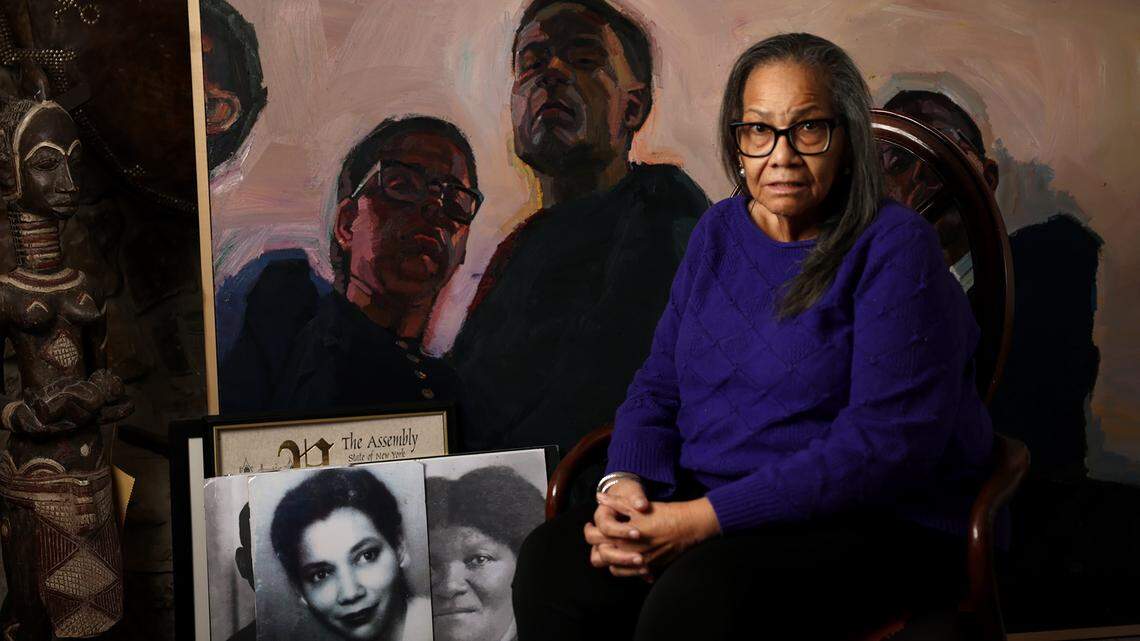
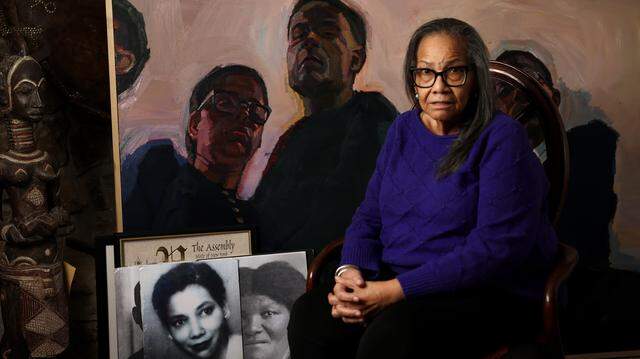
Judge Maryellen Hicks is photographed in front of a painting by Sedrick Huckaby and with photographs of her ancestors. The Black Women Lawyers Association of Tarrant County is renaming its organization in her honor.
Amanda McCoy
amccoy@star-telegram.com
On a Thursday evening at the Tarrant County Bar Association in downtown Fort Worth, dozens gathered to recognize Maryellen Hicks.
Hicks, 76, has spent over 50 years as a lawyer and judge in Texas. Over 40 years ago, she and other Black women lawyers founded the Black Women Lawyers Association. The group will now rename itself the Maryellen Hicks Black Women Lawyers Association in her honor.
“Tonight is meant to live in practice, because this renaming is not simply about what we call ourselves. It is about what we commit ourselves to do,” Crystal Gayden, president of the association, said. “We strive to ensure that this legacy never rests only in memory, but instead lives in action.”
Friends from Hicks’ childhood in Odessa, peers from her years as a judge in Tarrant County, and community admirers praised her, often holding back tears. In 1974, Hicks was the first Black woman lawyer ever to be licensed in Tarrant County, one of many “firsts” in her legal career. She was hesitant about the recognition, but agreed to accept it after being convinced and supported by her family.
She hopes her work in the legal field and in the community lives on in those she met and in the continued impact of the Black Women Lawyers Association now named for her.
“I just hope our organization inspires more people to be involved, and not just in the legal world, but in the community, that’s what we need,” Hicks said.
“As good as I could be”
Hicks was born in 1949 in Odessa to Albert and Kathleen Whitlock, the third-oldest of six children. Her first name is a combination of her great-grandmother’s and grandmother’s names, Mary Durham and Ellen Grey. The family lived in Odessa until the early 1960s, when they moved to the Germantown area in north Philadelphia, Pennsylvania.
In Philadelphia, she cherished the integrated schools, the presence of Black professionals, and the city’s culture. After her parents’ divorce, her mother took her and her siblings back to Odessa, where her grandfather, Bruce Durham, still lived.
Odessa was segregated. Black people sat in theater balconies, and Black children like Hicks and her siblings attended Blackshear and Ector high schools instead of the majority-white high schools of Odessa and Permian. It was, as Hicks said, a “painful experience.”
Texas was difficult, but her mother had a plan for her children’s future: higher education. Hicks’ mom was a teacher. Her grandfather was a barber but also owned real estate. Her uncle was W.J. Durham, a Dallas civil rights attorney. He worked with Thurgood Marshall on cases such as Sweatt v. Painter, which desegregated the University of Texas Law School. He inspired Hicks to become a lawyer.
She attended Texas Woman’s University in Denton and majored in history. She later graduated from Texas Tech, becoming its first Black female law school graduate.
She had multiple job opportunities, but chose to work at a Black law firm, Bonner & Mitchell, in Fort Worth. Norman Bonner and Hicks later founded Bonner & Hicks on Evans Avenue, in the heart of the Black community in south Fort Worth.
In 1978, Mayor Hugh Parmer appointed Hicks to the Municipal Court bench. Her goal was never to be a judge, and she didn’t think she was ready. But her family’s support pushed her to accept it. She became the first African American and the first female Municipal Court Judge and Chief Municipal Court Judge for the city of Fort Worth.
In 1984, Gov. Mark White appointed her as the first and only African American woman to serve as a State District Judge on the 231st State District Court bench, handling family law. She served 10 years as a family court judge. She was appointed at the same time as the late Judge L. Clifford Davis, a Civil Rights icon, who joined the Criminal District Court No. 2 bench.
In 1992, Gov. Ann Richards appointed Hicks to the Texas Second Court of Appeals. This made her the first African American and the first woman to serve as a justice in that role. After leaving the Court of Appeals in 1994, Hicks served as a visiting judge in Harris County for over 19 years. She returned to Fort Worth and is a visiting judge in the district, with her own private practice.
Looking back on her career, Hicks said she wasn’t driven by the “firsts” she experienced as an African American or a woman.
“I never thought about being the first. Every time something like this has happened to me, what I thought about is being as good as I could be,” Hicks said.
Uplifting the community
In the 1980s, Hicks and other Black women attorneys in Tarrant County felt overlooked, treated unfairly by judges, and unacknowledged for their work. They formed the Black Women Lawyers Association of Tarrant County to address issues facing Black female attorneys, boost their visibility, and support the community.
One way the group supported the community was through a divorce clinic. Lawyers from the association volunteered to help clients who couldn’t afford legal services in a system known for treating African Americans unfairly. Hicks made people feel comfortable and pushed to ensure the group’s services connected with the community, said A.Y. Collins, former president of the Black Women Lawyers Association.
“By uplifting her, you’re also uplifting the community and educating them on what they could accomplish in life,” Collins said.
The Tarrant County Family Law Bar Association has since taken over the services of the divorce clinic.
Karmen Johnson was a young lawyer in the 1980s when she first met Hicks. Johnson said seeing someone in her career who looked like her, had charisma, and was compassionate was powerful. Hicks would help lawyers in her court, mentor young people like Johnson, and introduce them to the Black Women Lawyers Association.
For Johnson, the best way to embrace Hicks’ legacy is to follow her lead in engaging with the community and helping others in need.
“She is an icon and not just in Tarrant County, but across the state,” Johnson said. “People know Judge Hicks, people respect Judge Hicks, and we want the organization to continue to live and thrive.”
With power comes responsibility
During an interview in the home of Hicks’ sister, Councilwoman Deborah Peoples, in east Fort Worth, Hicks sat in front of a painting by Sedrick Huckaby, co-founder of Kinfolk House, that depicts four Black people looking into a coffin. Hicks said the painting captivated her when she first saw it. Photos of her mother and grandfather were nearby.
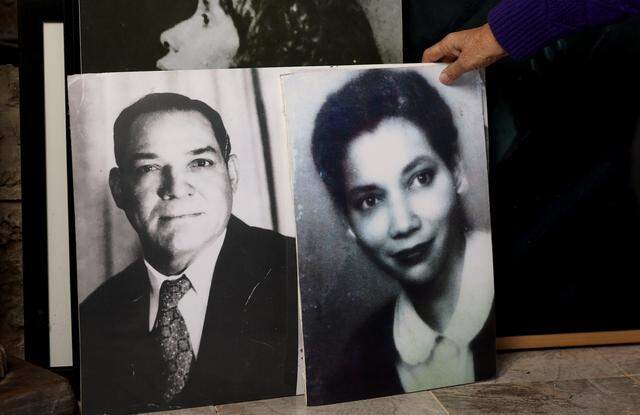 Judge Maryellen Hicks shows photographs of her ancestors. Throughout her career, Hicks achieved numerous milestones, including serving as the first African American woman to hold the position of state district judge in Fort Worth. Amanda McCoy amccoy@star-telegram.com
Hicks was surrounded by African and African American art, which she said she collects out of love for her culture and people. She lives with Peoples, who inspired her to collect artwork. Though accomplished, Hicks’ main motivation has always been to give back, especially to the community that supported her, she said.
“Judges have a lot of power, not just in criminal court, but in all the courts,” Hicks said. “And with power comes responsibility, and I want to see a kinder, more caring and diverse legal community … a just system.”
Related Stories from Fort Worth Star-Telegram
Fort Worth Star-Telegram
Kamal Morgan covers racial equity issues for the Fort Worth Star-Telegram. He came to Texas from the Pensacola News Journal in Florida. Send tips to his email or Twitter.