
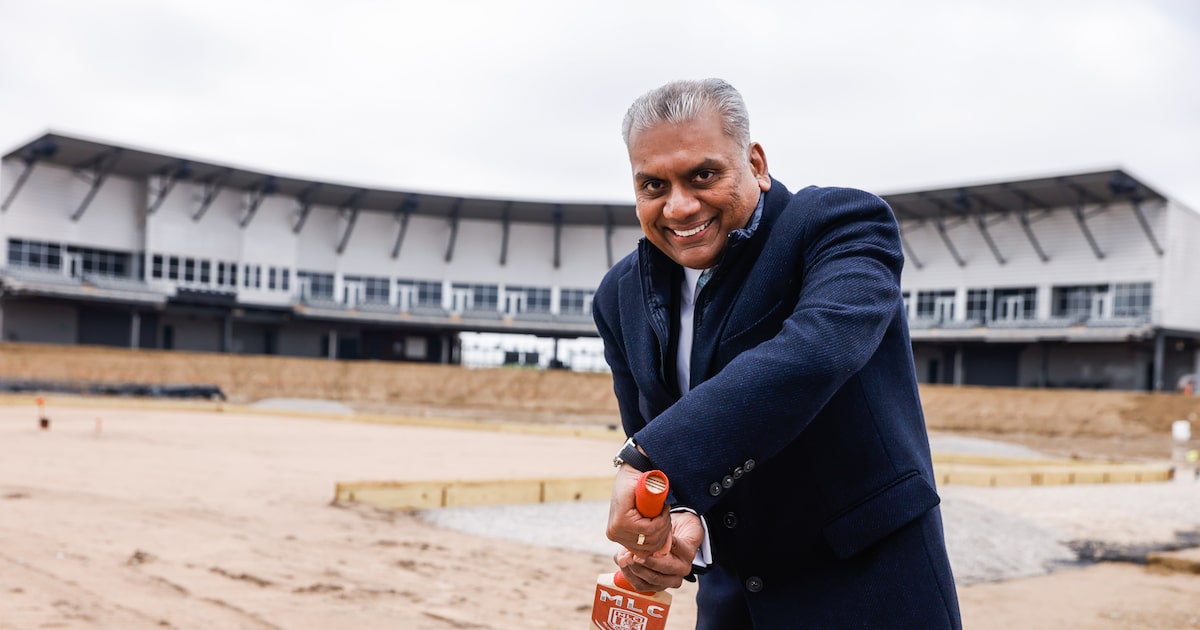
As the founder and CEO of Access Healthcare and the co-founder (with his longtime business partner Ross Perot Jr.) of Perot Jain, a Dallas-based venture capital firm, Anurag Jain ranks among North Texas’ most prominent businessmen.
As a co-owner of Major League Cricket — an upstart American league that began in 2023 — and one of its teams, the Grand Prairie-based Texas Super Kings, Jain also ranks among North Texas’ most influential sports figures. For years, he’s been part of a broader push, along with other several notable South Asian immigrant business leaders, to grow cricket’s U.S. presence and transform Texas into the sport’s American epicenter.
This year, Perot Jain also served as a sponsor of the U.S. men’s team in the T20 World Cup, which began last month in India and Sri Lanka and was scheduled to hold its final, between New Zealand and India early Sunday Central time.
Related

The Chennai, India, native spoke with The Dallas Morning News about the U.S. team’s performance, the sport’s future in North America and why the Super Kings have already been a business success. This interview has been edited for length and clarity.
Business Briefing
I saw the U.S. went 2-2 in the World Cup, and did not get out of the group stage. How do you feel about that result?
The result doesn’t tell you what really happened, so I’ll start with that. So let’s go back in history: In 2024 — and by the way, we’ve been working on this team for six or seven years, grooming talent inside the U.S., bringing some foreign talent, putting it all together, then they’ve played in Major League Cricket where they play with the top players in the world. And the talent upgradation in terms of the quality of their playing today versus two years [ago] versus four years [ago] is off the charts.
And then the 2024 World Cup: The U.S. team, actually in Dallas in our stadium here, beats Pakistan and qualifies for the next round and makes it to this World Cup because of that. That was in America, in their backyard. This is in India. And if you look at the world [rankings], India’s [number one] by many miles. The U.S. is probably somewhere between 15 and 18. But it shows you how the [International Cricket Council] is thinking about the U.S. market, that the first opening game was U.S. versus India. The biggest market in the world and the biggest — what they think is the biggest emerging market in the world — coming together to play cricket on the World Cup stage.
And then the U.S. was one catch away from winning against India. I mean, the Indians were quiet, and usually the Indians are very noisy watchers of the game. What does it really tell you? It’s that we were playing way beyond [what] anybody expected us to, and we left with a significant amount of respect.
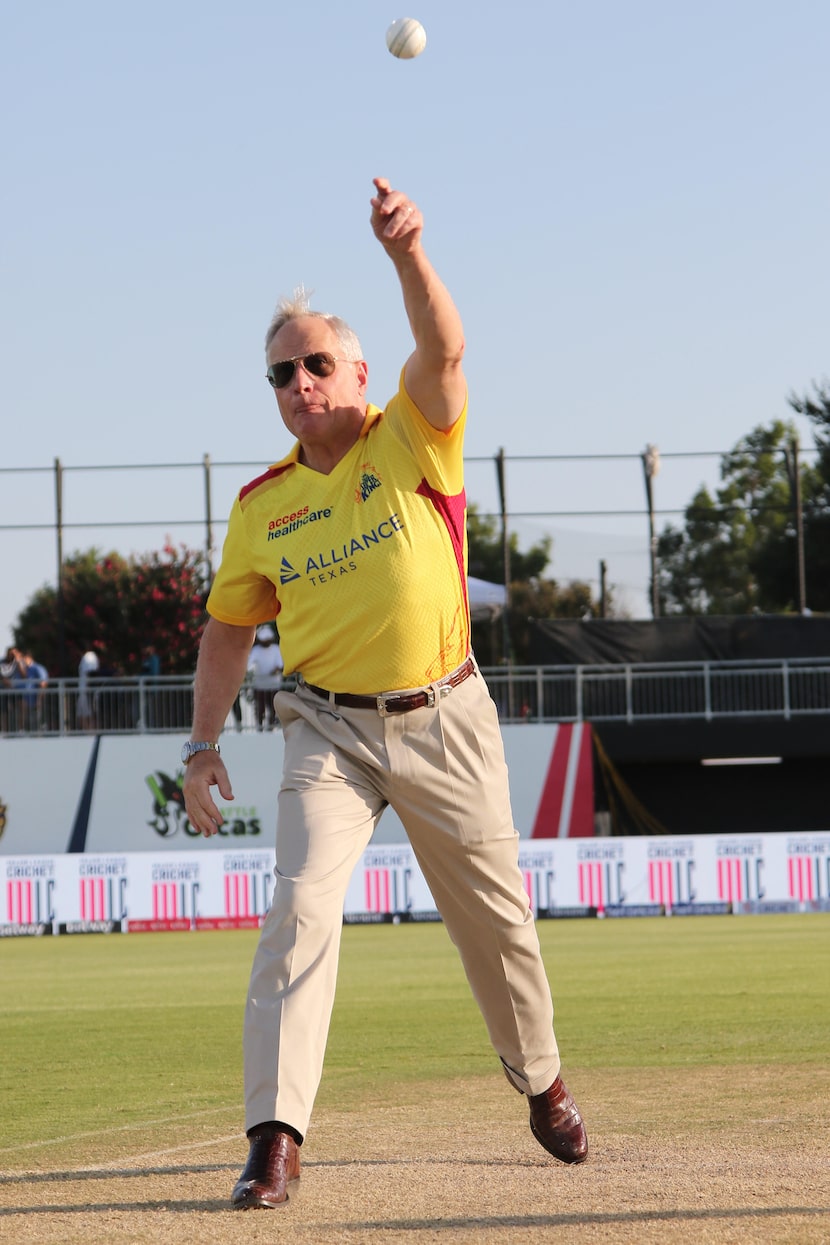
Dallas business mogul Ross Perot Jr., demonstrating his form in a game of Major League Cricket.
Perot Jain
So this is a team [where] the trajectory is toward improvement, [and] you expect the performance of the U.S. team to keep getting better.
Yeah. Go back to, what was the first MLC season? 2023? So these guys were on the field and my coach comes out on the field and says, ‘My American players can’t even run on the field and catch the ball yet.’ And that’s OK, they were early in the trajectory. And if you go to today where they’re playing against the top team in the world and almost winning, the talent change has been off the charts. Faster than we expected.
Related

Why did you want to sponsor the U.S. national team?
When we sponsor the team, most of that money is going to the team and to the upgradation of the team. So what we’re doing by sponsoring the team is basically helping the ecosystem continue to thrive. What does the ecosystem need? It needs more cricket. It needs more experience. It needs better support staff. It needs more infrastructure.
So that’s the number one reason we did it. Of course, you know, you want our players to feel special, for them to have our brand on. I think just by having our brand on, they felt like there was an American sponsor of a team that, you know, wasn’t that [highly] ranked, but we were behind them, and we were patting them on the back and saying, ‘You guys go.’
Obviously, you’ve been a big backer of professional cricket in the U.S., growing cricket in the U.S. What does the near-term future for the sport look like in the U.S.?
In two and a half years we have [the] Olympics in L.A. And that’s a very important moment because cricket will be played in the L.A. Olympics for the first time, right? And that’s what you’ve got to think about. So we will be playing with the top teams in the Olympics, with billions of people around the world watching the game, not just the regular cricket fans. And that’s a huge change for the sport, and for us as the American team to be the host, and to be part of that, is huge.
You’re a co-owner of the MLC (Major League Cricket). What’s it like trying to build up a new professional sports league? That’s not something many people try to do.
It’s a lot of work. You better put on your seatbelt. But you gotta have the passion, right? So, go back to the 1830s. What was the number one sport in this country? Cricket was the number one sport. In fact, the first international event that the English played, I think, was in Philadelphia against the U.S.
So cricket was burgeoning up — this is a longer game, and all that other stuff that people can complain about. People had more attention spans than they have today, but cricket was really moving forward. And then when the British left, we kind of sent them back off with their games. So we kind of left it. But the new version [T20, which features shorter matches] of this sport is interesting, is exciting, is the second-most-watched sport in the world, and we think this is a great market for it.
So we are patient. In the early run, we had, I would say, the Commonwealth fans — the South Asians, the British, the Australians, the South Africans, the West Indians. But we’re beginning to slowly break into the larger market in the U.S. and we think it’s a competitive sport that will grow.
What’s the most challenging part of this venture, building up the MLC?
It’s building infrastructure all over the country. Think about building stadiums with the right infrastructure at the right places. Just the ecosystem. You’re bringing an ecosystem of nonprofit boards and rules and what do you follow? What follows the U.S.? Are you going to be U.S. first versus, ‘think about the international market?’ I’ll give you a small example. We could have made the choice that we would play games in the morning and go after the Indian marketplace. We said ‘No, we’re going to focus on the U.S. marketplace.’ And that’s, in the short run, maybe less lucrative, but long term, that’s our marketplace. So it’s those kinds of decisions that you make every single day.
You have your own successful career and business and a whole background there. How does that sort of apply to starting a sports league and trying just to make the business side of it work? How do you find that challenge?
It’s just like another business. It’s as complicated as another large business might be. It has global stakeholders, it has local stakeholders, it has players, it has team owners. So it’s probably even more complex than any other business that we have run. It’s a startup, but a very complex startup — it requires you to invest a lot of money and be very patient, but understand that you can’t just throw money into the well, you gotta make sure that it’s appropriately used.
As an investor, do you have a certain expectation of a return? Obviously, you’re a passionate cricket fan anyway, but do you think of it that way?
No, absolutely. We’re business people, and I believe that the American model of business capitalism works. So you always want to do things with a passion but have the eye on the ball. You may never sell the team, but you always want the value to increase. … Today, I can probably get two to four times my money out by selling these assets, which I don’t want to sell, but it shows you the value of creating in that way, at least for the short to medium [term].
So I guess just from a numbers sense, or a financial sense, you feel it’s already been a success?
Absolutely.
Any numbers you want to share?
I don’t want to share them because of fiduciary obligations. Whatever value we paid, we paid, but the new teams that will come up in the next two to three years are coming up at probably three to five times that value.
Well, how does that feel, just as a business guy?
Hey, we’re business guys, apart from passion, and we look at all of those metrics. Any blue number versus a red number feels good — I got to justify to my wife the checks that I’m writing every year for the game.
Anurag, you were a pretty good youth player, right?
I believe so. So I believe that I was a very good player in my time, but I was inconsistent. I needed more support and mentorship, but my father said I shouldn’t be playing cricket, I should be going to study engineering. Which is what I did.
It seems like it turned out ok. But I was wondering, do you ever get on the pitch? Do you still play?
Very little, very little. I did, and then my arm and my back hurt for a week. [Laughs.] I don’t know if you want to say that.
Have you ever been out with Ross [Perot Jr.]? Does he play?
So Ross doesn’t play, but he bowled the first ever ball that was bowled [in] MLC history. And we have a video and a picture of that, and we actually have the original ball in his office.
How was his form?
He was pretty good, actually. I was surprised, I would say.