
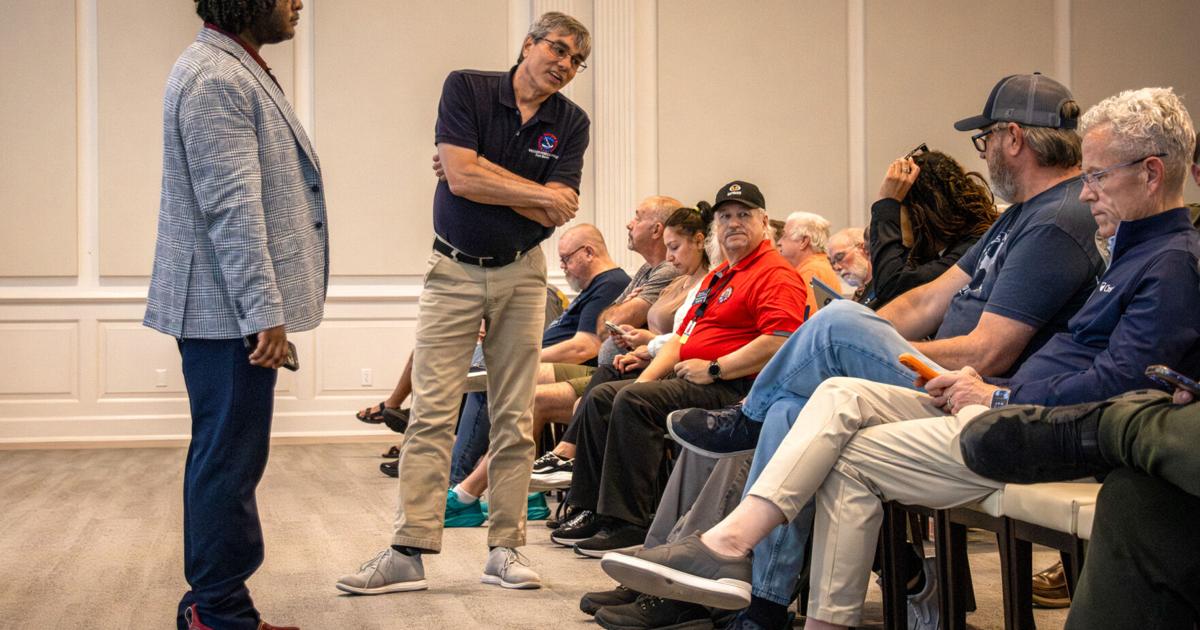
Storm spotters, amateur radio operators, storm chasers, first responders and other individuals attended the National Weather Service Fort Worth and SKYWARN training hosted at Texas Woman’s University.
Henry Tucker, a volunteer firefighter in Justin, Texas, and medical captain of Denton County’s Community Emergency Response Team, said he became a storm spotter not only for his own safety, but for the safety of others. He added the difference in education, like the NWS course, can create a massive difference in a severe weather situation.
“People freak out when there are storms, but taking this course can save your life,” Tucker said.
SKYWARN is an NWS program that trains volunteers to be storm spotters and provide critical information, often used for early warning systems. Tom Bradshaw, meteorologist-in-charge from the NWS Fort Worth and University of Oklahoma alumnus, said counties such as Fannin and Grayson rely on the radar in Fort Worth, despite being approximately 90 miles away.
“It gets down to the fact that the radar beam is functioning on a curved Earth,” Bradshaw said. “We’re losing a lot of the detail that we see at the lower parts of the storms, and we need to fill that gap of information.”
The NWS utilizes Doppler radar technology to detect precipitation and motion, allowing meteorologists to gather accurate information by peering into the thunderstorm. Yet many storms fall below the radar, leading to critical information about storms being missed.
Shawn Reyes, a 38-year-old Denton resident and ham radio operator whose callsign is KX7WTF, said he is able to provide NWS with information they cannot see on radar.
“The radar can only see so much,” Reyes said. “A lot of times, [the NWS] need at least three verifications of reasons to issue a tornado warning.”
The verifications given from the SKYWARN storm spotters help the NWS determine whether to issue severe weather warnings, which Reyes said improves public safety.
Reyes said he has been fascinated with severe weather since he was a child growing up in Tornado Alley, to the present day as a storm spotter.
“In 1999 in Moore, Oklahoma, the biggest tornado event happened to that date, and in Oklahoma, you either run from tornadoes or you chase them,” Reyes said. “I went crazy and decided to chase them. Now, because I enjoy making sure people are safe, [storm spotting] is another way I can do that.”
Alba Torres, 46, and Norberto Aponte, 53, who are originally from Puerto Rico, came to the course for the first time with one goal in mind: safety.
The couple lives in a recreational vehicle behind Torres’ brother’s house, and since moving up from Houston, have had to rush to take shelter in his bunker during severe weather.
“The earlier we can get to safety, the better,” Aponte said. “If you have the knowledge, it works in your favor.”
After moving from a foreign country with completely different weather, Aponte said his experience with the Puerto Rican hurricane season varies drastically from tornado season in Texas.
“The weather here is completely different than anything we’ve ever seen, like before moving here, we had never seen hail,” Aponte said. “There is more time to prepare when it is hurricane season, you know when the storms are coming in advance. With tornado season, tornadoes can come out of nowhere.”
Reyes added to Tucker’s point with an anecdote from when he was 11 years old. He said he witnessed the Great Plains Tornado Outbreak, which spawned over 70 tornadoes across the region, killing 40 people and injuring 675 people.
“[Tornadoes] are nature’s magical wonder to me, but I’ve also seen the destruction they can cause,” Reyes said. “If I can help somebody, if I can save one life by getting the message out […], I know I at least did my part. There’s so many people who died that day because they weren’t aware.”