


The FIFA World Cup comes to H-Town June 14.
It was 2018, and the opening match of the FIFA World Cup pitted defending champs Germany against the Mexican men’s national team, known as El Tri. As luck would have it, I was in Mexico City serving as a tour guide. In the 35th minute, after Germany lost the ball, Mexican superstars Andrés Guardado and Javier “Chicharito” Hernández moved the ball up the field on a swift counterattack. A perfect pass in the box found winger Hirving “Chucky” Lozano, who managed to olé his defender and send a gorgeous shot past German goalkeeper Manuel Neuer. And that’s when I felt the ground shake.
Exactly seven seconds after Lozano’s goal, two seismic sensors detected an earthquake caused by the celebratory jumping of millions of soccer fans all around Mexico City.
That same energy, love, and celebration for “the Beautiful Game”—a nickname coined by soccer icon Pelé—is coming to our city this summer, when Houston is slated to host seven matches of the 2026 FIFA World Cup. Space City is one of 16 North American host cities for what will be the largest World Cup in history, with 48 teams competing for the title. Only one will be crowned the champion of the soccer world, but before we get into the specifics, let’s begin with the absolute basics.
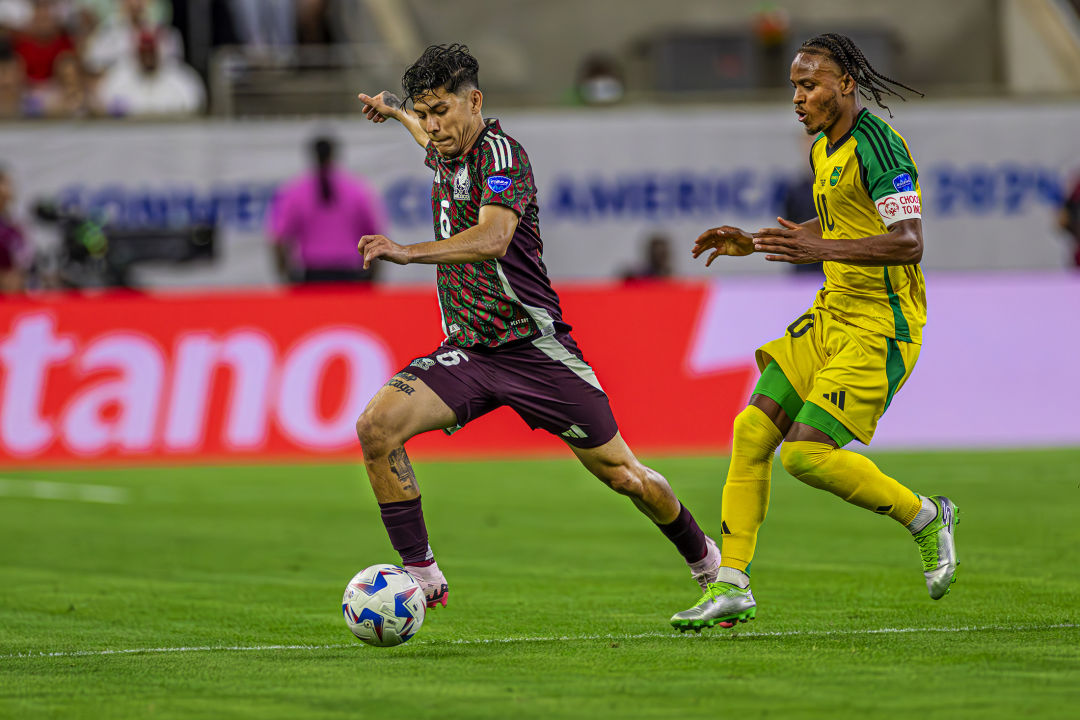
Referred to as the “Beautiful Game” by soccer legend Pelé, fútbol is loved globally.
The History
What we now know as “soccer” originated in England in the 1800s, and came to be called “Association Football” to differentiate it from rugby. University students began calling rugby “rugger” and association football “assoccer,” which was later shortened to “soccer.” These days, the game is referred to as soccer in the United States and much of Canada, while most of the world calls the game football. Spanish-speaking countries call it fútbol, and in Portuguese it’s futebol.
The Fundamentals
The objective of the game is quite simple: Move the ball down the field and into the opponent’s goal. Only one player on each team—the goalie, or keeper—can use their hands. Everyone else relies on their feet, heads, legs, and chests to control and maneuver the ball.
Each game is called a “match,” which is played on the rectangular field known as the “pitch,” usually measuring 68 meters by 105 meters (74 by 115 yards), though there is some variance between stadiums. Matches last 90 minutes, split into two 45-minute halves. Each team fields 11 players: one goalkeeper, plus defenders, midfielders, and forwards.

Each game, called a match, is played in two 45-minute halves.
UNDERSTANDING THE GAME
Skill and timing are required to break through the defense. The offense must time its attack to slip past the defense after the ball is in motion. Otherwise, they can be called for an offside penalty. Think of it like the line of scrimmage in American football: You can’t cross that line until after the ball is snapped.
When the ball goes out of play over the end line or a shot on goal is stopped by the goalie, it can be placed back into play by either a goal kick or, if it went over the end line and a member of the team on defense was the last to touch it, a corner kick. If it goes over the sidelines, someone on the team that didn’t kick it out throws the ball back in to restart play.
A referee oversees the match, ensuring the players’ safety and the integrity of the game. Assistant referees patrol the sidelines. Referees decide how much “stoppage time” is added to each half due to injuries, substitutions, celebrations, and other pauses in play. (The game clock itself doesn’t stop and start like it does in football, basketball, or hockey.) They also carry penalty cards, which include yellow (warning and caution) and red (ejection of the player). In case you haven’t noticed, players do not want to get yellow or red cards, but sometimes, s— happens!
Games end in a tie if the score is even after 90 minutes plus stoppage time—unless the game is a knockout match, which must have a winner. In that case, teams play two 15-minute halves of extra time. If still tied, the match is decided by penalty kicks.
KEY figureS
The World Cup is governed by FIFA (Fédération Internationale de Football Association), which includes 211 member associations. It’s basically the United Nations of soccer. The tournament takes place every four years to crown the world champion, with men’s and women’s tournaments staggered by one year. (Brazil hosts the next women’s tourney, in 2027.) This year’s edition expands from 32 men’s teams to 48, making it the largest World Cup in history, and it’s jointly hosted by the US, Canada, and Mexico.
The tournament opens with a kickoff game in Mexico City on June 11 at the historic Estadio Azteca, between the Mexico and South Africa national teams.
In Houston, matches begin June 14, with the seven matches running through July 4. The final will be played on July 19 at New York New Jersey Stadium (actually MetLife Stadium, but FIFA rules around sponsorships dictate that it go by a nickname for its World Cup games).

A total of seven World Cup matches will be played in Houston.
WHO’S COMING TO H-TOWN?
Houston will host seven matches at NRG Stadium, which is temporarily renamed Houston Stadium. (Shell Energy Stadium, where pro teams the Dynamo and Dash play, doesn’t have enough seats for FIFA host standards.) Five games will take place in the group stage, followed by two knockout matches: one in the round of 32, the other in the round of 16.
Three top-10 teams will play here, including Germany (#9), the Netherlands (#7), and Portugal (#6). Other competing teams include Saudi Arabia, plus newcomers Cape Verde, Curaçao, and Uzbekistan, all playing in the World Cup for the first time.
Led by global superstar Cristiano Ronaldo, Portugal’s team is by far the most popular ticket in Houston. At 41 years old, Ronaldo is playing his final World Cup, giving Houston fans a chance to see one of the greatest goal scorers in history before he retires.
THE SCHEDULE
Sunday, June 14: Germany vs. Curaçao
Wednesday, June 17: Portugal vs. Congo DR/Jamaica/New Caledonia (to be determined by an inter-confederation playoff at the end of March)
Saturday, June 20: Netherlands vs. Albania/Poland/Sweden/Ukraine (to be determined by a European playoff at the end of March)
Tuesday, June 23: Portugal vs. Uzbekistan
Friday, June 26: Cape Verde vs. Saudi Arabia
Monday, June 29: Match 76 (Round of 32)
Saturday, July 4: Match 90 (Round of 16)
WHY IS THIS SUCH A BIG DEAL?
“Houston is expecting around 500,000 visitors for our World Cup festivities, which will create an economic impact of roughly $1.5 billion,” says Chris Canetti, president of the FIFA World Cup Houston host committee. “This will be the biggest sporting event in the history of the world, and Houston is fortunate to be one of the cities chosen as a host.”
Canetti notes that the World Cup is even bigger than the Super Bowl, which is largely watched by American audiences. “This year’s Super Bowl was seen by 125 million viewers. Each game of the World Cup will be viewed by at least 200 million viewers, and that’s not even including the final match, which is predicted to be viewed by 1.5 billion people worldwide,” he says. Just as FIFA’s 2022 slogan claims, “football unites the world.”
With global attention focused on Houston, Canetti says each match will create lasting “memories and a positive impact.”
Beyond the games themselves, the influx of international fans is expected to energize the city. The Netherlands’ official fan club, Het Oranje Legioen (Dutch for “the Orange Legion”), is planning a massive fan walk to the stadium. East Downtown will also host the FIFA Fan Festival, featuring live match screenings and free public events across 34 of the 39 days of the tournament, along with cultural programming and food and beverage for purchase.