
This article is part of a series of pieces celebrating Glasstire’s 25th anniversary. To see other stories from this series, go here. To see pieces from the month of March, around the theme Texas Topographies: Examining Place & Practice, go here.
Finishing up graduate school at the University of Southern California in 2010, I witnessed the final planning stages for one of the most innovative art historical projects ever attempted. Funded by the Getty, this project was called “Pacific Standard Time” or PST and it set out to comprehensively address the history of Southern California art. In its first year, 2011-12, PST involved 60 different regional institutions, produced roughly 70 exhibitions, as well as publications such as Pacific Standard Time: Art in Los Angeles, 1945 to 1980, which I use in my teaching frequently. One major success of this project is that it charted the birth and evolution of what is now recognized as one of the most vibrant art scenes in the country and the world. And that “now” is key. Before PST, most art historians had not recognized the significance, diversity, and influence of SoCal art on the narratives we teach and research. I was one of those people. Now, I cannot imagine teaching the history of modern and contemporary art — which I do all the time at West Texas A&M University (WTAMU) — without including the PST artists and art movements.
Immediately after grad school, I moved from Southern California to Texas, and not to one of the major cities. I moved to the Panhandle, where I have lived and worked ever since. In that time, I shifted my research focus from Europe to Texas, and from the broad history of art history to the focused history of regional art. Recently, however, I was asked to participate in a project that addressed the history and parameters of “Texas art.” Strangely, as someone who had spent years thinking about art historiography, the topic of my dissertation, I had never considered working on the historiography of Texas art. Why? For one, I have been primarily researching a single region of Texas art — the Panhandle — a region often overlooked or ignored by Texans downstate and one that is a unique Venn diagram of various regional identities, including Texas, the South, the Southwest, the Midwest, Middle America, and the West. For me, seeing my research topics as “Texas art” has always seemed too limiting. And so, I have never bothered to ask, “What is Texas art?”
But then I was invited to participate in a panel on this very topic for the Alliance of Texas History Conference at Texas Christian University this May. I especially thank Dr. Rex Koontz of the University of Houston for this invitation. In preparing for my presentation, I began to believe Texas should take on a “Texas Standard Time” or TST project modeled after SoCal’s PST.
Texas art, like the art of Southern California, has been undervalued in the wider world of art history. Don’t get me wrong, it is deeply appreciated by Texans — Texas collectors, curators, and art historians based in the state. But beyond the borders of Texas, the topic of “Texas art” is rarely researched, rarely the subject of major exhibitions. In her keynote presentation at the 2018 CASETA conference — reviewed in Glasstire by Gene Fowler — Eleanor Harvey lamented that the Smithsonian American Art Museum (SAAM) is seriously lacking in Texas examples. She chided Texas collectors for keeping too much Texas art to themselves, and for not letting the rest of the country learn how great Texas artists are. A TST project could show the rest of the country that the Texas branch of the art history tree is worthy of their attention.
Treating Texas as its own “time zone” is an interesting concept. Texas falls primarily under the Central time zone, one that includes everything from the humid Gulf Coast to the High Plains of the Panhandle to the vast oil fields of West Texas to the mountains along the Rio Grande near Marfa and Big Bend National Park. But then there’s El Paso and Far West Texas, which run on Mountain Time, asserting their independence from the rest of the state, as well as the area’s deep connection to New Mexico and Mexico. Moreover, Texas is made up of huge metroplexes and small cities, tiny towns and ghost towns. A TST project could help us recognize anew the incredible diversity of Texas — geographically, culturally, linguistically, and artistically — a diversity that has nurtured artists in ways yet to be fully understood by Texans and others.
Too often, “Texas art” has been the story of regionalist scene painters, like Tom Lea or Jerry Bywaters, and of cowboy artists like Frank Reaugh. To be sure, the two Texas artworks that hung in the White House during the presidency of George W. Bush were a scene painting by Lea, Rio Grande (1954), and a cattle painting by Reaugh, The Approaching Herd (1902). For a new model of thinking about Texas aesthetics, we might turn to the recent architectural history of Texas Home, Heat, Money, God: Texas and Modern Architecture. This book, with text by Kathryn E. O’Rourke and stunning photography by Ben Koush, explores the modern built environments of Texas without the expected biases toward the urban centers of Dallas, Fort Worth, Austin, San Antonio, and Houston. Rather, it spends page-space on the buildings of El Paso, Laredo, Amarillo, Waco, and Denton, in addition to the biggest cities. The book sensitively explores structures across the vast arena of Texas spaces with a refreshingly balanced commitment to the diversity and complexity of Texas built forms. And it also reminds readers that the architecture of Texas should not just be interesting to Texans, but also to a wider audience of architectural enthusiasts. A TST project could do the same for Texas visual art, shedding light on how much that term “Texas art” can encompass.
In addition to Lea and Bywaters and Reaugh, Texas art includes the shiny, glitzy bucking bronco of Luis Jiménez that welcomes visitors into SAAM, while it also includes the series of Standard Oil Station photographs, paintings, and prints that Ed Ruscha worked on for six decades, and which so prominently featured in the PST publication as “LA art.” But the series was birthed in Amarillo, Texas, when Ruscha traveled Route 66 between his home state of Oklahoma and his artistic home of LA, a genesis I explore in my recent book Art at the Crossroads: The Surprising Aesthetics of the Texas Panhandle. The “Texas art” of Jiménez and Ruscha expand upon the rich traditions of scene painting and cowboy art in Texas without negating either one.
 Carmen Lomas Garza, “Quinceañera (The Fifteenth Birthday),” 2001, oil and alkyd on linen on wood, 48 x 36 inches. Collection of the artist
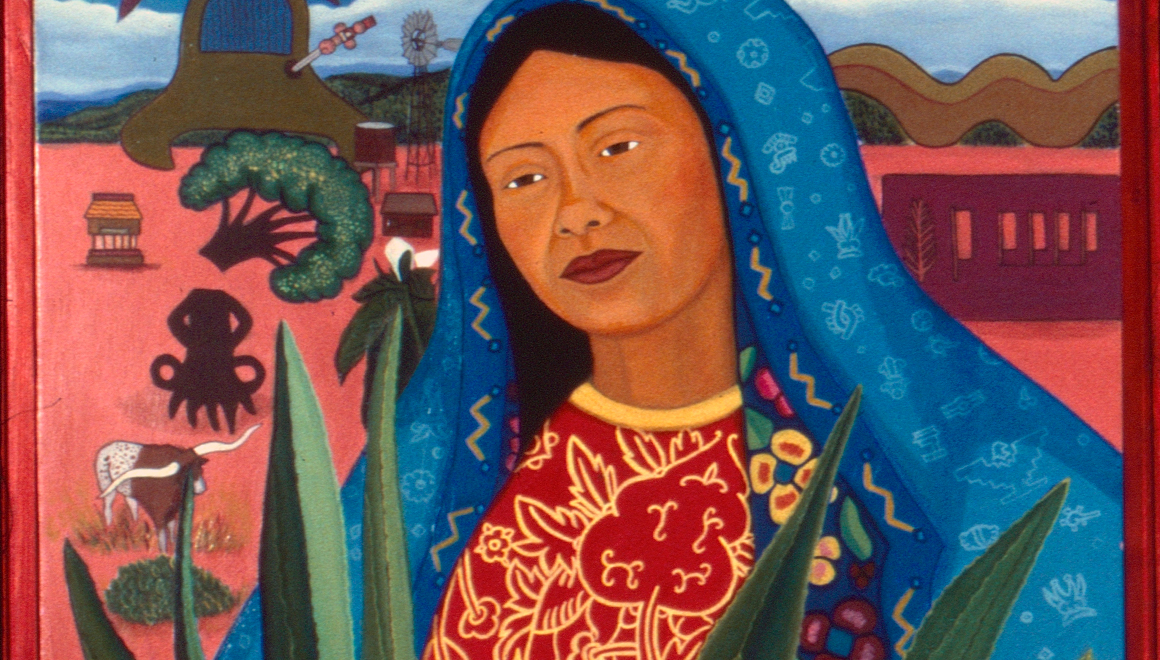
“Texas art” should also include the work of Carmen Lomas Garza, whose paintings feature colorful scenes of fiestas and quinceañeras, which are of course part of the Texas scene painting tradition. As Jerry Bywaters defined it, regional art — including Texas art — must respond to the life and environment of the artist. And Lomas Garza’s life in South Texas looked and felt, sounded and tasted, very much like what her images depict. At the same time, Texas art should include the painting of Santa Barraza, La Lupe Tejana, in which a Virgin of Guadalupe emerges from a maguey cactus while symbols and the landscape of the King Ranch in South Texas appear in the painting’s background. The ranch brand of the W, for example, repeats on the border of the Virgin’s blue cloak as well as in the hills behind her.
 Santa Barraza, “La Lupe Tejana,” 1995, oil on canvas, 30 x 51 inches. Private Collection
A TST project would treat Texas art inclusively instead of exclusively. And I have personally witnessed such exclusivity at work. Several of the artists I work on have been judged as “not Texan enough” to be included in volumes on Texas artists, such as the recent publication Making the Unknown Known: Women in Early Texas Art, 1860s-1960s. In a future article for Glasstire, I will address this issue of exclusivity in more depth, arguing that Texas art needs to include artists nurtured by the vast spaces and places of the state, instead of just artists “born and bred” in Texas. For now, I mention this issue to call for a Texas art that is as big as the state. If everything is “bigger” in Texas, let’s tell a bigger art history of Texas.
A TST project would draw out the deep and intricate connections between Texas and its southern neighbor, Mexico. The PST project in 2017 took on the theme of LA/LA, or Los Angeles/Latin America, which included more than 70 institutions dedicated to tracking the vibrant cross-cultural artistic dialogue between Southern California and Latin America. Texas could and should do the same. One of the most innovative exhibitions featuring “Texas art” outside of Texas is the recent show Soy de Tejas held at the Cheech Marin Center for Chicano Art & Culture in Riverside, California. Texas institutions need to take up this challenge and start collaborating on a vast art history of Texas/Tejas.
Finally, a TST project would show that not only is Texas teeming with Latinx and Chicanx artists worthy of study, but that canonical Texas artists, such as Jerry Bywaters, have also been deeply nurtured by Mexican and Latin American art. Another article I am working on will argue that Texas needs to produce coordinated exhibitions and research modeled on the Vida Americana show at the Whitney Museum of American Art (2020-2021). This exhibition brilliantly argued that modern American art cannot be understood without acknowledging its deep roots in Mexican art. But interestingly, nowhere in the show or in the related exhibition catalog are Texas art and artists considered.
While the project featured discussions of locations across America — from San Francisco to Detroit to New York — Texas is nowhere to be found. And yet, a “Vida Tejana” project would undoubtedly show that Texas art similarly cannot be understood without acknowledging its roots in Mexican and Latin America art, from Pre-Columbian to contemporary. Such a project would illustrate that Texas art is not insularly “homegrown” but deeply international. It would introduce new artists into the canon of Texas art, while also introducing new ways that Texas art is positioned as central rather than peripheral to American art and global art. Its geographic centrality in the Americas can be seen as a launching point for its centrality in a hemispheric art history.
In other words, Texas should not be a fenced-in and walled-up place, despite the many fences and walls that define the state. It should be a fulcrum for the art history of the Americas. Texas art history is worthy of our inquiry, especially if we approach it with an openness for different artists, alternative narratives, and an appreciation of the wide range of regional contexts. Texas can be more than an insular place that finds itself interesting but that remains misunderstood and underappreciated by non-Texans. Its international roots and influences can be celebrated rather than ignored, embraced rather than avoided. It’s time. Texas Standard Time.