
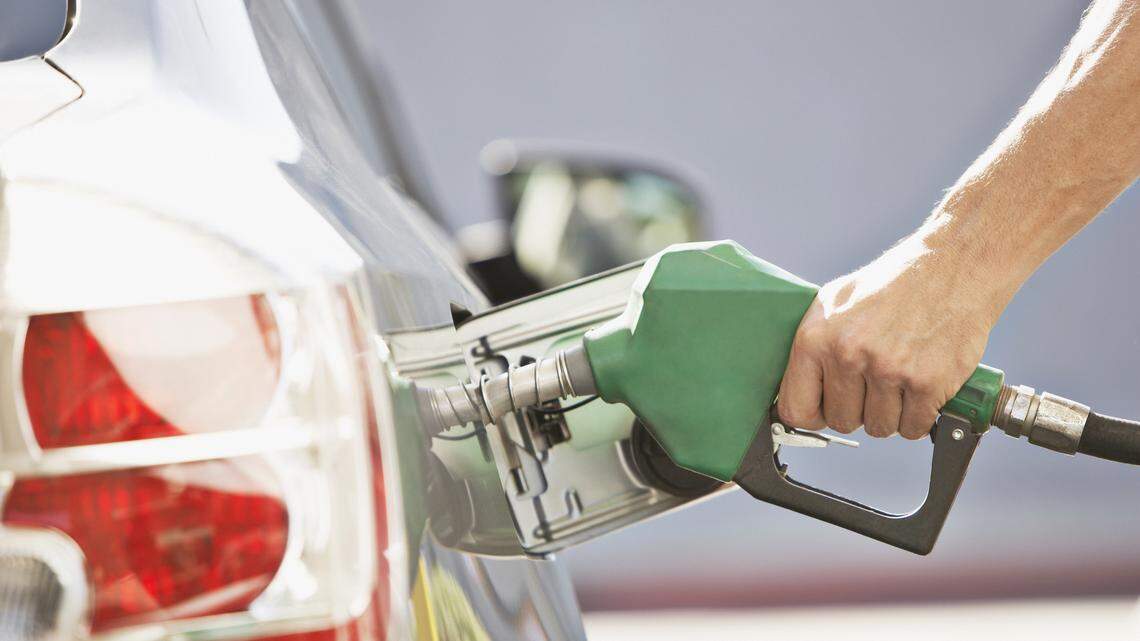
An archive photo of a car at a gas pump.
Tom Merton
Getty Images
Gas prices moved into the $3 range across North Texas over the weekend, a jump many drivers noticed as soon as they pulled up to the pump.
A matching $3.19 price at different stations made people even more curious, since prices normally vary from block to block.
The sudden climb left Texans wondering what changed and whether something bigger was behind it, including whether the United States’ conflict with Iran was playing a role.
President Donald Trump addressed the concerns in a Truth Social post on Sunday, saying “Short term oil prices, which will drop rapidly when the destruction of the Iran nuclear threat is over, is a very small price to pay for U.S.A. and world safety and peace.”
In addition to global tensions, experts say several other factors are pushing gas prices higher.
Here’s what to know.
🔥 In case you missed it…
Where do gas prices in Texas stand right now?
AAA Texas spokesperson Daniel Armbruster said Monday, March 9 that prices in Fort Worth climbed sharply compared to last week.
“The average today in Fort Worth is $3.18 a gallon, and a week ago it was $2.63 a gallon, so that’s a pretty stark increase,” he said. “The average a year ago was $2.79 on this day, so we’re not only higher than we were a week ago or a month ago, but we’re higher than we were a year ago.”
Armbruster said spikes of this size have been rare in recent years.
“The last time we saw a jump week over week like this was when Russia invaded Ukraine,” he said.
GasBuddy’s March 9 update showed a similar trend. According to the emailed report, Fort Worth prices rose 60.9 cents in the past week, 59.2 cents over the past month and 42.3 cents compared to this time last year.
Drivers saw wide differences from station to station. GasBuddy listed the cheapest station in the city at 2.42 per gallon and the most expensive at 3.51, a spread of more than a dollar.
Nearby cities saw similar jumps, including Dallas at $3.19, Waco at $3.16 and College Station at $3.17 per gallon.
Why are gas prices rising so quickly?
Armbruster said the conflict involving Iran is directly influencing the global oil market.
“Iran is a key player in the global market when it comes to crude oil and its oil infrastructure, so any disruption to that will have consequences,” he said. “The U.S. doesn’t import oil from Iran, but China and India do, so it has a major impact on the global market. When there’s a shortfall in one part of the world, it affects other parts as well, including here in the United States.”
Because crude oil is the main ingredient in gasoline, changes in the global market show up at U.S. pumps quickly.
He said any jump in global oil prices can show up at local pumps in days.
Were prices already increasing before the conflict?
Yes. Armbruster said several seasonal and market factors were already putting upward pressure on prices before events overseas accelerated the jump.
“We’re at a time of year when refineries begin producing summer blend gasoline that contains pricier additives to help reduce evaporation during warmer months, so we were already seeing gas prices increase,” he said. “It’s also a little bit more expensive, so some of that cost increase is passed on to the consumer.”
Demand was also rising with spring travel on the horizon.
“The weather is getting warmer, so more people take road trips and spring break is coming up,” he said.
Why did so many North Texas stations show the same $3.19 price?
Armbruster said it’s not unusual to see a lot of stations land on the same number when prices are moving fast.
“Certainly the individual retailers set the price where they see fit based on their business model,” Armbruster said.
He said stations also keep an eye on each other.
“The station across the street may say, ‘Hey, you know the guy over here is selling for this price. I’m going to match them,’” he said.
When prices shift overnight or change quickly during the day, stations tend to react at the same time, which can make the numbers look identical across town.
Armbruster said drivers can’t control how stations set their prices, but they can do a few things to make a tank last longer.
“Keeping your vehicle well maintained and planning your trips can really help improve your fuel efficiency and save money at the pump,” he said.
How long could higher gas prices last?
Armbruster said there’s no clear timeline for when drivers will see relief.
“A lot of this is going to depend on geopolitical tensions, the cost of crude oil and how the market reacts to that in the coming weeks,” he said.
GasBuddy petroleum analyst Patrick De Haan said drivers could see prices climb even more in the short term.
“With additional attacks across the Middle East over the weekend pushing oil above 100 dollars per barrel for the first time in years, fuel markets are now rapidly recalibrating to the risk of prolonged disruption to global supply flows,” he said. “As a result, gasoline prices in many states could climb another 20 to 50 cents per gallon this week, with price cycling markets potentially seeing increases as early as today.”
Related Stories from Fort Worth Star-Telegram

Fort Worth Star-Telegram
Tiffani is a service journalism reporter for the Fort Worth Star-Telegram. She is part of a team of local journalists who answer reader questions about life in North Texas. Tiffani mainly writes about Texas laws and health news.