
“FastrFlow”, a quickly growing $3 million+ AI copilot company founded by two TCU seniors, is transforming the use of AI in universities and classrooms worldwide.
FastrFlow was founded by Madhavam Shadi and Kavish Soningra, both senior computer science majors.
“FastrFlow is an application that can hear what you hear, see what you see, and builds a perfect memory layer of what each student sees and hears to give them perfect memory at every moment, so they can always recollect different things of their academic life that can help them perform better,” Shadi said.
The two friends developed the idea for FastrFlow after personally struggling and seeing their peers struggle to manage having numerous tabs open on their laptops and in their lives. They wanted to create a program to simplify their studies and allow students to adequately balance school, work and socializing.
“It’s essentially the perfect AI copilot specific for college students,” Soningra said.
As a result, the friends created a program that could do it all — from creating flashcards and practice quizzes similar to Quizlet, to generating instant answers and advice like ChatGPT and Google Gemini.
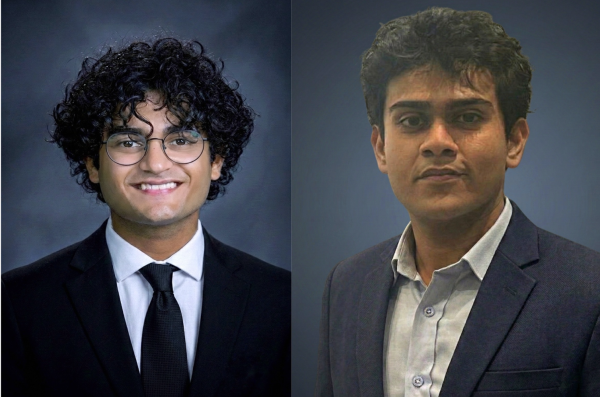 TCU Student founders of FastrFlow, Kavish Soningra (left), and Madhavam Shadi (right). (Photo courtesy of Soningra and Shandi)
“Instead of it being a website, it’s an overlay that lives on your screen,” Shadi said. “It can help you do whatever you’re doing by seeing your screen rather than you going to a website.”
Currently being used on over 20 college campuses, FastrFlow is tailored to university students’ needs.
The copilot’s development from start to finish took four and a half months.
“We created an initial MVP, and we gave it out to users, and we sat with them to see how they used the application,” Shadi said. “What buttons did they press? What features did they want? We noted everything down, and we made it as simple as possible, so there’s not a very high learning curve to the application, and it’s very simple to use.”
In the next 5-10 years, Shadi and Soningra hope to see FastrFlow on every student’s laptop.
With over 2,000 users already, Sonigra said, “Our long-term goal in the next year is to expand it to over a million users in the U.S. itself.”
“Take the risk,” Shadi and Soningra said in unison, encouraging other students and entrepreneurs to turn their ideas into reality.
Many TCU professors are open to and excited about the expansion of AI tools in their classroom settings.
“I do think that [AI tools] can aid students in the process of overall effective learning, simply because they can provide fast and certain specific details that will eventually help students understand what initially is required or what they might need to do,” said Ahmed Ajaberi, an English professor at TCU.
 FastrFlow promotional message on their website. (FastrFlow.com)
Kirsten Queen, a professor in the TCU College of Fine Arts, views AI as a thinking partner, emphasizing its usefulness in thinking alongside you, not for you.
Queen is open to the incorporation of AI tools such as FastrFlow into her teaching methods, recalling a specific time AI allowed for the incorporation of inclusivity in her classroom.
“A student who has some learning differences is able to use an AI program that captures the lecture and helps interpret that into notes so that the student can study better,” Queen said.