
As Highland Park approaches the May 2 special election, when residents will decide whether to continue DART membership, it is important to explain how we arrived at this point and why the Town Council placed this decision before the voters.
For more than 40 years, the Town of Highland Park has been a member of Dallas Area Rapid Transit (DART). That decision, made in 1983, reflected the realities of its time. The Dallas–Fort Worth region was smaller, municipal finance was more flexible, and DART was envisioned as the transit system to serve the greater region.
Before DART was created, state law limited cities to a 1% local sales tax that could not be used for economic development. In 1983, the Legislature allowed an additional 1% sales tax to fund DART. Fifteen cities, including Highland Park, opted in to establish DART as an area transit system for its members—hence the name Dallas Area Rapid Transit. The expectation was that the system would evolve and deliver long-term value proportional to the cost.
What’s changed
Between 1989 and 1991, the Legislature fundamentally reshaped municipal finance by allowing cities outside transit authorities to levy the same additional one-cent sales tax but for local priorities. Non-DART cities gained full access to a 2% sales tax with flexibility to invest locally. DART member cities, having already committed one cent to transit, were locked out. The funding imbalance was fixed; non-DART cities had an economic advantage over DART member cities that they would never give up. As a result, no new cities have joined DART in more than four decades, and two original members withdrew, leaving 13 member cities today.
Opinion
The challenge to grow is compounded by DART’s governance and regional imbalance. DART continues to rely on just 13 member cities, even as the region it purports to serve has expanded far beyond those boundaries. North Texas is projected to become the largest metropolitan region in the country by late-century, yet no other city has the economic appetite to join DART.
Independent analysis shows significant disparities between what some cities contribute and what they receive. In fiscal year 2023, Dallas received service value from DART that equated to 169% of the sales tax it contributed, a $283 million surplus subsidized by other member cities. which to Highland Park, who received service value that equated to only 30% of the sales tax it contributed, and the disparities between “donor” cities like Highland Park and “recipient” cities like Dallas are crystal clear. Approximately 70% of Highland Park’s contribution to DART is being used to subsidize other cities.
This financial imbalance is mirrored by DART’s governance imbalance. Historically, Highland Park shared a single board seat with three other cities, giving it little to no voice on the board. DART recently proposed a new governance model that provides the town its own seat. However, the vote for that seat is weighted, meaning the town still holds only a fractional vote, rather than a 1:1 vote.
Implementation of the new governance structure and any new funding modifications will require action by the Legislature beginning in the 2027 session.
Service today
In 2025, Highland Park’s sales tax contribution of $8 million was just 1% of DART’s $900 million sales tax revenue, or .44% of DART’s full budget. The 2026 projection has Highland Park contributing approximately $9 million in sales tax to DART.
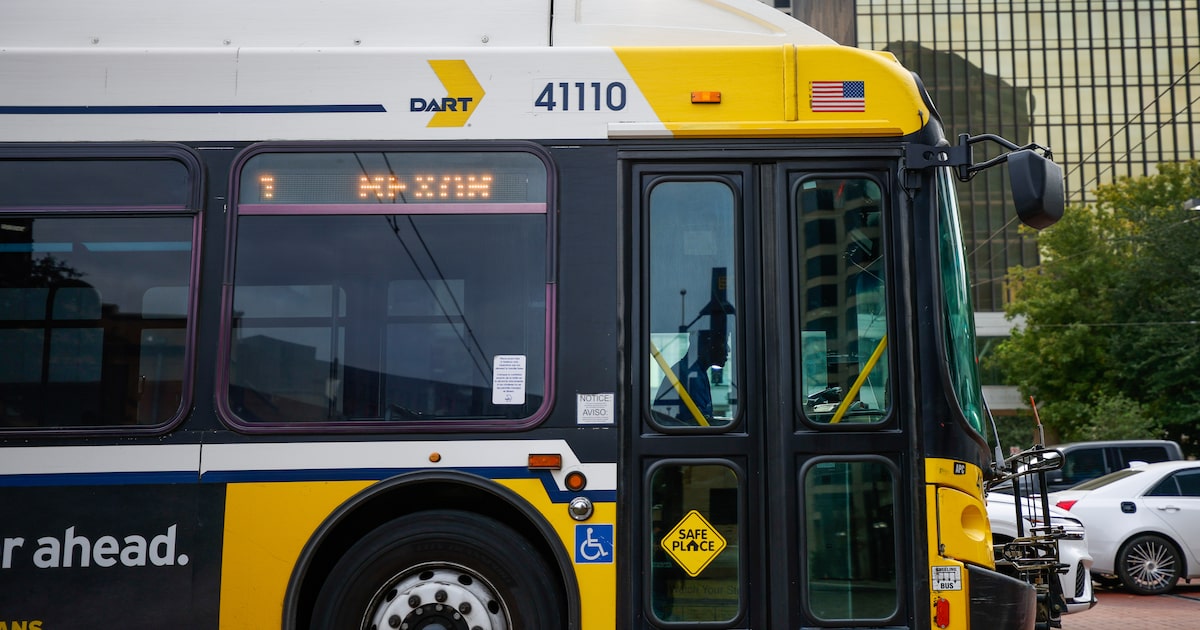
Over the past four decades, DART has eliminated most services within town limits. Highland Park has no rail service. Since 2014, three of four bus routes have been removed, leaving a single fixed route along Preston Road that largely duplicates nearby rail service along Central Expressway. According to DART, the remaining route averages roughly 12,000 annual boardings, or about 33 riders per day.
A revenue crunch
Sales tax revenue is becoming a critical need for cities like Highland Park. In 2019, the state began tightening municipal budgets, whereby Senate Bill 2 capped effective property tax revenue growth at 3.5% without voter approval; the previous cap was 8%. For fully developed communities like Highland Park, this cap functions as a de facto salary and service limit, particularly for public safety and an aging infrastructure, leaving sales tax as the only meaningful flexible revenue source. Dedicating half of that capacity to DART significantly constrains the town’s ability to meet essential local needs for its residents.
Mass transit and coordinated transportation options are essential to the long-term success of our entire region. However, when existing funding and service delivery models no longer reflect actual usage patterns or community priorities, the town has an obligation to evaluate alternatives. Highland Park is prepared to explore third-party transit providers and other flexible options to meet the modern transportation needs of our residents while maintaining regional connectivity.
Federal transit dollars made possible by DART’s mass transit system are shared region-wide across more than 100 cities and 12 counties, yet the current funding and governance model limits DART’s ability to reinvest in a truly regional system, leaving its 13 member cities shouldering a disproportionate share of the cost to operate and maintain the system. The Legislature should be tasked with creating a fully restructured regional transit authority for the greater region, supported by an equitable, region-wide funding model.
At the Legislature’s explicit direction, the Town Council determined that the responsible course of action was to place the decision to remain in or exit DART with the voters.
The May 2 election ensures the issue is decided openly, locally and democratically by the residents who, through their elected Town Council, are accountable for every dollar allocated in the Town’s budget.
Rest assured, if the voters choose to exit DART, they can take solace in knowing that Highland Park has played a meaningful role in building a regional transit system by ultimately contributing approximately $150 million over the last 40-plus years.
Will C. Beecherl is mayor of the Town of Highland Park.
We welcome your thoughts in a letter to the editor. See the guidelines and submit your letter here.
If you have problems with the form, you can submit via email at letters@dallasnews.com