
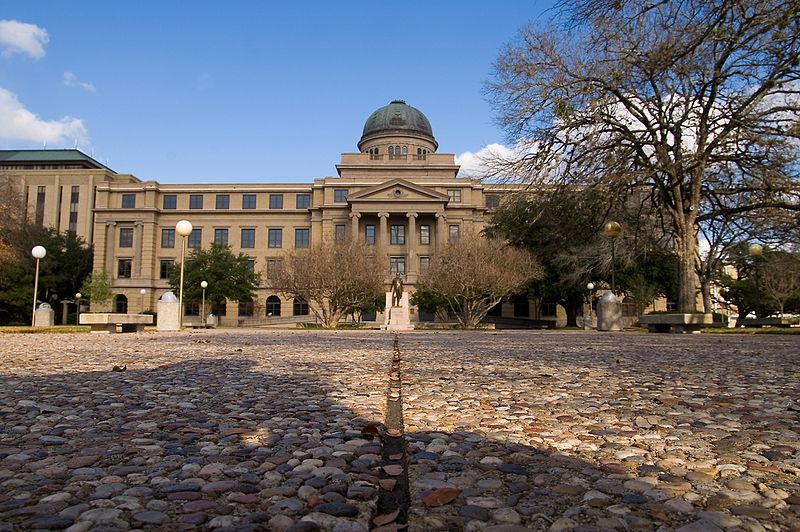
 Pictured is the Academic Building at Texas A&M University.
The chairman of the U.S. House of Representatives’ Select Committee on China sent a letter to the National Science Foundation (NSF) on Tuesday, requesting the federal agency pause its funding to Texas A&M University for alleged security failures regarding its research with China.
In the letter written by Rep. John Moolenaar, the Michigan Republican outlined several accusations against Texas A&M and the University of Washington. Moolenaar listed five publications by Texas A&M faculty and Chinese researchers, claiming the joint research efforts were being exploited by the Chinese government.
“These research partnerships span critical fields such as quantum chemistry, AI explainability, hyperspectral imaging and tensegrity robotics, technologies with dual-use implications that are routinely targeted and exploited by the Chinese military and outlined in the PRC government’s industrial policies,” Moolenaar wrote in the letter.
Sign up for the Hello, Houston! daily newsletter to get local reports like this delivered directly to your inbox.
Skip to PDF content
Moolenaar is specifically asking the NSF to pause its $17 million in funding to Texas A&M. The university northwest of Houston was awarded the funds in 2024 as part of the NFS’s five-year, $67 million investment to support research security through an initiative called Safeguarding the Entire Community of the U.S. Research Ecosystem (SECURE). The University of Washington was also included in the initiative and received $50 million.
In a statement to Houston Public Media on Tuesday, an NSF spokesperson said the agency “will respond directly to the committee’s letter,” and did not provide any further comment.
Moolenaar said NSF should pause its SECURE funding and conduct a comprehensive review of Texas A&M and other universities participating in the initiative.
Texas A&M did not immediately respond to a request for comment regarding the letter.
Moolenaar gave NSF a deadline of March 31 to respond to the letter.
“Institutions entrusted with U.S. taxpayer dollars to safeguard the nation’s research enterprise should not simultaneously enable foreign adversaries to access and exploit sensitive research and taxpayer-funded scientific advances,” Moolenaar wrote in the letter. “When universities fail to enforce their own meaningful research security standards, they risk diverting U.S. innovation, talent, research, and federally funded discoveries.”
In September 2022, former NASA researcher and Texas A&M University professor Zhengdong Cheng pleaded guilty to two counts of violating NASA regulations and falsifying official documents, according to The Associated Press.
After Cheng’s initial arrest in August 2020, prosecutors accused him of not disclosing his work in China, despite receiving over $700,000 in grant money for space research at Texas A&M. Cheng had allegedly served as the director of a soft matter institute at a Chinese university.